
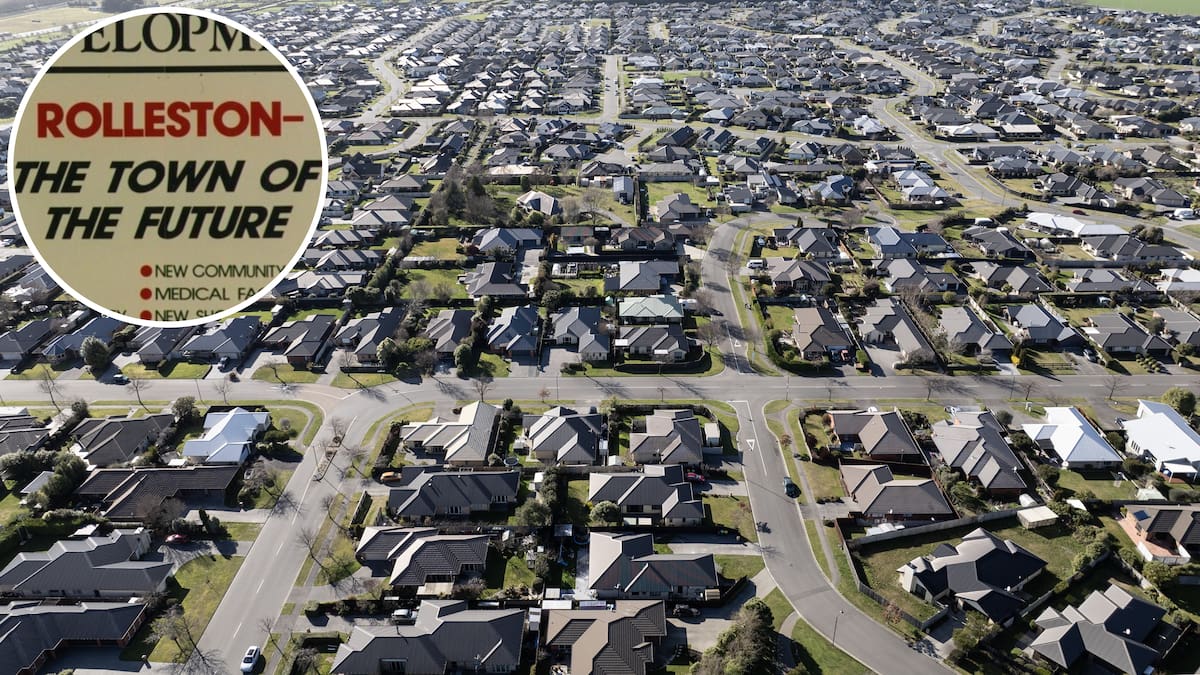
An aerial image of Rolleston from the early 1990’s. Photo / LINZ
The most recent population data from 2025 is almost 12 months old and puts the town at more than 34,000 residents. Given the continued growth and most recent growth rates, Rolleston could have an estimated population of around 36,000 by now.
It is well ahead of Paraparaumu, Timaru, Blenheim, Taupo, Pukekohe and Queenstown. It also has Gisborne in its sights as it zeroes in on the top 20 most populous places in New Zealand.
“The downside is it makes it particularly difficult to deliver infrastructure. When we’re talking about drinking water, wastewater, and we’re not just taking that in one direction in a township, you are taking it 4-5-6 different directions. That costs money,” says current Selwyn District Mayor Lydia Gliddon.
Rolleston had seen incredible growth by the 2020s.
The number of people calling Rolleston home more than doubled in the past decade. In 2016 it was 14,700, which was almost three times as many people as the previous decade (5220 in 2006). By 2036, it could be between 50,000 and 60,000 and potentially be reclassified as a city.
“Yeah, we’re going to get there. We need to start planning for that,” says Gliddon.
Planning for a number even bigger than that actually started well before Gliddon was even born.
Rolleston – The Town of the Future
History
Rolleston was established 160 years ago as a railway terminus and named after Canterbury figurehead William Rolleston.
It was the junction where the Midland rail line to the West Coast branched away from the Main Line south. In the 1860s, the land was used to farm sheep before it was sold off and subdivided – but its first real steps towards the thriving population that it boasts today came more than a century after it was founded.
In fact, Rolleston was reimagined with a population twice the size of what it is now.
Former Prime Minister Norman Kirk dubbed it the “town of the future” in the early 1970s when he secretly planned to develop the area to ease Christchurch’s urban sprawl.
Former Prime Minister Norman Kirk. Photo / Archive
As documented by Selwyn Libraries, “Big Norm” had grown up in the Christchurch suburb of Linwood, which he remembered as “a grim, joyless ‘filing cabinet’ dormitory suburb from where workers travelled to the city”. Kirk’s vision for Rolleston was as “a thriving community, where families and industry could prosper”.
When Kirk’s Labour government came to power in 1972, he and his deputy – Minister of Works Hugh Watt, began planning for the new town of Rolleston. The secret was unveiled on November 29, 1973, as a “bombshell letter” to 170 shocked Rolleston landowners informed them of the Government’s intent to buy their land under the Public Works Act.
“A total of 4000 hectares would be taken for the proposed city of 80,000 people. Farming within the new boundaries would end, leaving only existing houses,” reads a passage from Selwyn Libraries’ historical account.
In the 1970s, Rolleston was being planned as the “Town of the Future”. Photo / LINZ
“There had been no advice, consultation or warning; even local government and the Christchurch Regional Planning Authority were taken by surprise.”
A total of 110 objections were lodged, but Kirk’s government “pressed on”.
However, less than two years after taking office, Kirk died on August 31, 1974. The following year Robert Muldoon’s National government swept to power, and the plan for Rolleston was abandoned.
“By this time 70 properties, over 1265 hectares, had been bought. This land was then leased, often to people who did not live in the area,” reads the Selwyn Libraries account.
It seemed the “town of the future” would be consigned to history. It wasn’t forgotten, though – the unfulfilled moniker became something of a source of mockery.
But it has “certainly made it now”, says Coe.
The earthquake and the commute
Rolleston emerged largely unscathed after the 2011 Christchurch earthquake and became a viable solution for displaced homeowners who were cashed up and ready to move on.
“The earthquake changed everything there,” says Coe.
The influx broke the development dam.
“We figured that after the earthquake we would get probably, maybe 1000 houses a year built in Rolleston for a few years, but I was always thinking that after maybe five years that would taper off. But it hasn’t. It’s just kept going and growing and growing,” said Coe.
Rolleston’s population has grown by almost 30,000 since the 2011 earthquake and the opening of the Southern Motorway in late 2012 made commuting more palatable.
Selwyn District Mayor Lydia Gliddon and her deputy, Brendan “Big Red” Shefford. Photo / Supplied
Gliddon believes there could also be a future for commuter rail.
“I took the Crusader Express support train from Rolleston to the city. I think there’s a real partnership there to spend some time with Mainland Rail and look at what does light rail look like into the city, because, you know, you could start to build a business case from that. Twenty minutes, it’s pretty quick,” says Gliddon.
Business
It’s not only Kirk’s residential vision that is being realised – industry and business are booming too.
Business growth has led to a large-scale redevelopment of the town centre and the 188ha Izone Industrial Park on the north side of SH1. It’s home to more than 120 companies from manufacturing to warehousing and logistics.
Rolleston’s main street has been fully redeveloped, like the rist of the town centre. Photo / Alyse Wright
“I can remember when McDonald’s came to Rolleston and we thought, ‘Hey, hello, Rolleston’s come of age, we’ve got a McDonald’s’,” said Coe.
Virtually every major food franchise is now close by and there are three large supermarkets, with a fourth being built. The latest to open its doors is Pak’nSave. Sarah and Phil Blackburn are vastly experienced supermarket proprietors and leaped at the chance to open in New Zealand’s fastest-growing area.
“It was certainly a no-brainer for us to apply for a Pak’nSave in Rolleston,” says Sarah Blackburn.
It’s not just a Pak’nSave, at 8100sq m it is the largest in the South Island.
“We’re the biggest floor space because why wouldn’t you, with the projected growth and the fact that it was reasonably easy to build a supermarket that big? Why wouldn’t you just go for it?” asks Blackburn.
A Mitre 10 is also understood to be in the works on a vacant neighbouring site.
A second Woolworths is already under construction in Arbor Green – yet another Rolleston subdivision that includes the latest primary school – Te Rau Horopito.
Rolleston College has a roll of 2000 students. Photo / File
Schools
Ten primary schools feed into one high school across two campuses with a current roll of 2000 students. The original junior campus caters from Year 9 to Year 11 and the new senior campus is for Year 12 and 13.
Rolleston College is co-educational and was founded in January 2017 when Rolleston’s population was half of what it is today. The school began with only Year 9 students, with that cohort becoming each year group’s inaugural class until there was a full school of Year 9-13 in 2021. Even before then, the school was making plans to expand. The growth had been anticipated, but it arrived much quicker than expected.
“Planning for the senior campus started a very long time ago. Around six years ago [we] first started thinking and started planning and there was obviously the extension to the [original] campus here as well,” says principal Rachel Skelton.
Being the sole secondary school in Rolleston, up to 80% of the town’s primary school students enrol in the college while others venture further afield – most often to single sex schools in Christchurch.
“At the moment we’ve got 471 Year 9 students. That will probably be into the 500s as things sort of progress, that’s what is predicted,” says Skelton.
Rachel Skelton says there won’t be a third campus. The next step will need to be a second high school. Photo / Rolleston College
Between the two campuses (junior – 1800, senior – 800) the school’s capacity sits at around 2600 students. Skelton says there won’t be a third campus.
“I really think following the second campus that there needs to be another high school built. I think the ministry will need to look at where they predict the next big piece of growth. Is it between us and Lincoln? Is it between Rolleston and Templeton? Or is it more out towards West Melton – Darfield?”
Future growth and fast-track
The idea of continued growth goes almost without question. It will happen. How it happens is up for varying degrees of discussion.
The flat agricultural land of Rolleston is nowhere near capacity – though just how far it can spread towards neighbouring towns is being watched closely. To the southeast of Rolleston lies Lincoln – another rapidly expanding town in the Selwyn District.
“Look, we want to try and keep that separate. We recognise that those townships have their own identity, and we recognise it’s really important for the people that live in that space as well. So, in the middle part of this year, what we’re going to do is come out with some area plans.
“So, it’s almost a bit of spatial planning to talk with our community and say, ‘Hey, where do you want to see growth? How does that look? And is there any intensification that you see appropriate in your townships?’” says Gliddon.
New builds going up in Rolleston’s Ackland Park development. Photo / Alyse Wright
Gliddon says the intensification of Rolleston will be exacerbated by fast-track legislation, potentially speeding up the approval process.
“It becomes difficult, and the fact that we have limited say in that. We get to give feedback to a panel. But, you know, whether that’s taken on board or not is at the discretion of that panel.
“It’s even more particularly difficult for our community because they don’t get to have a say in where growth happens in our district. I think that’s probably the most contentious point of a fast-track. It’s at the speed that a fast track happens, so that we then have an obligation to match the infrastructure to that.
“And then add rates capping on top of that.”
Rolleston’s redeveloped main street. Photo / Alyse Wright
Still, Gliddon is aware that the alternative offers bigger headaches.
“Don’t get me wrong, I would rather be in a growth space than a decline. It allows affordable housing for people, because there’s so much demand. And it allows growth for business.
“It’s GDP, it’s our economy, and it can be quite circular as well. We know that agriculture is our main GDP earner, but actually, what businesses can we have that support that as well, for exports? So, it’s a nice place to be in, in that respect,” says Gliddon.
More than 450 new homes could be built on another huge block of land on the southwest corner of Rolleston from late 2027.
The 28ha owned by the Carter Group is next to the successful Arbor Green. It is the latest example of how quickly the area can convert from agriculture to residential.
West Rolleston subdivision at the intersection of Dunns Crossing and Selwyn Roads. Photo / Bayleys Real Estate
It’s a speed that Gliddon and her council continue to grapple with.
“What does this place look like for us in, in 20-30 years, and how can we sort of get ahead of that?” she asks.
“I think we’ve been guilty of not planning well enough for what this looks like in the future, and you can kind of only do things once, but we also want to maintain that feel of Selwyn.
“I don’t think, and this is just my personal view, we want to become a city vibe, but we’ve got a plan for that amount of people.”
Mike Thorpe is a senior journalist for the Herald, based in Christchurch. He has been a broadcast journalist across television and radio for 20 years and joined the Herald in August 2024.