
First published on 
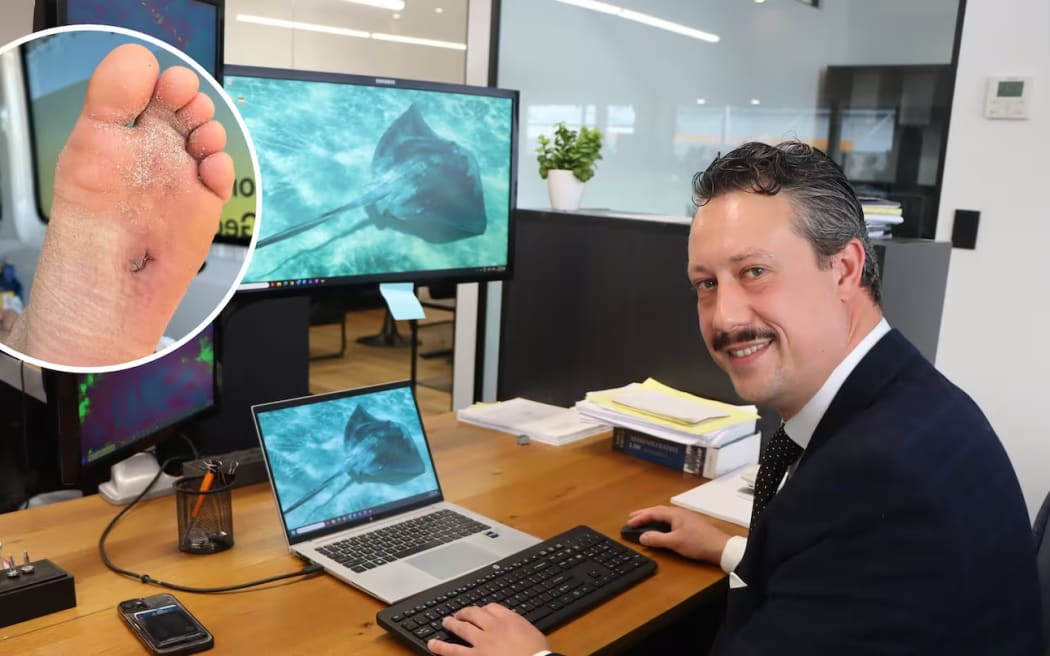
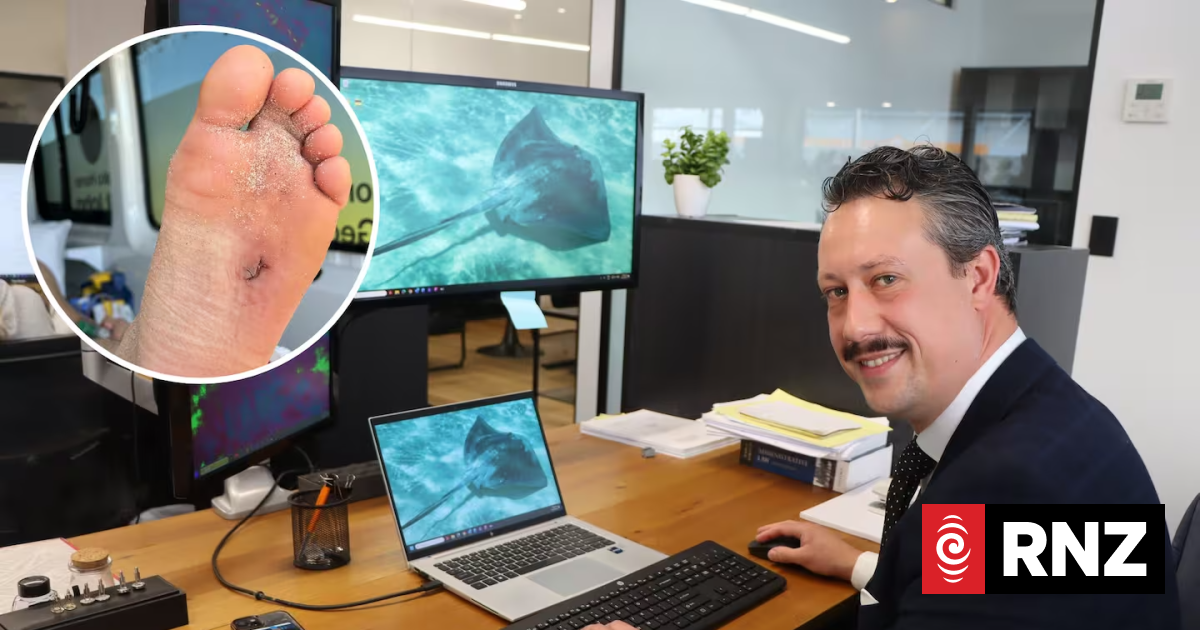
Prosecutor Tobias Taane was in the shallows at Papamoa beach, when a stingray barb punctured his foot.
Photo: Supplied / Open Justice
Warning: This story contains graphic images of a stingray injury
Prosecutor Tobias Taane is used to fending off the odd legal barb, but wading in the Pāpāmoa beach shallows over Waitangi weekend, stinging submissions from “the dark side” were the least of his worries.
Taane was keeping an eye on his partner’s four-year-old son, when he felt a “chomp” on his foot.
“I thought I had been bitten by something,” he told NZME.
His first thought was some kind of fish or a bronze whaler shark.
“Freaking out”, he immediately tried to grab the boy, who was just out of reach, then he looked down.
“There was just blood all through the water,” he said.
He began to hobble out, as his partner called out to ask why he was leaving the water.
“Then she saw all the blood and started freaking out.”
After clearing away the blood with some water, Taane said they saw “a great big hole” in his foot and his partner realised what must have caused the damage – a stingray.
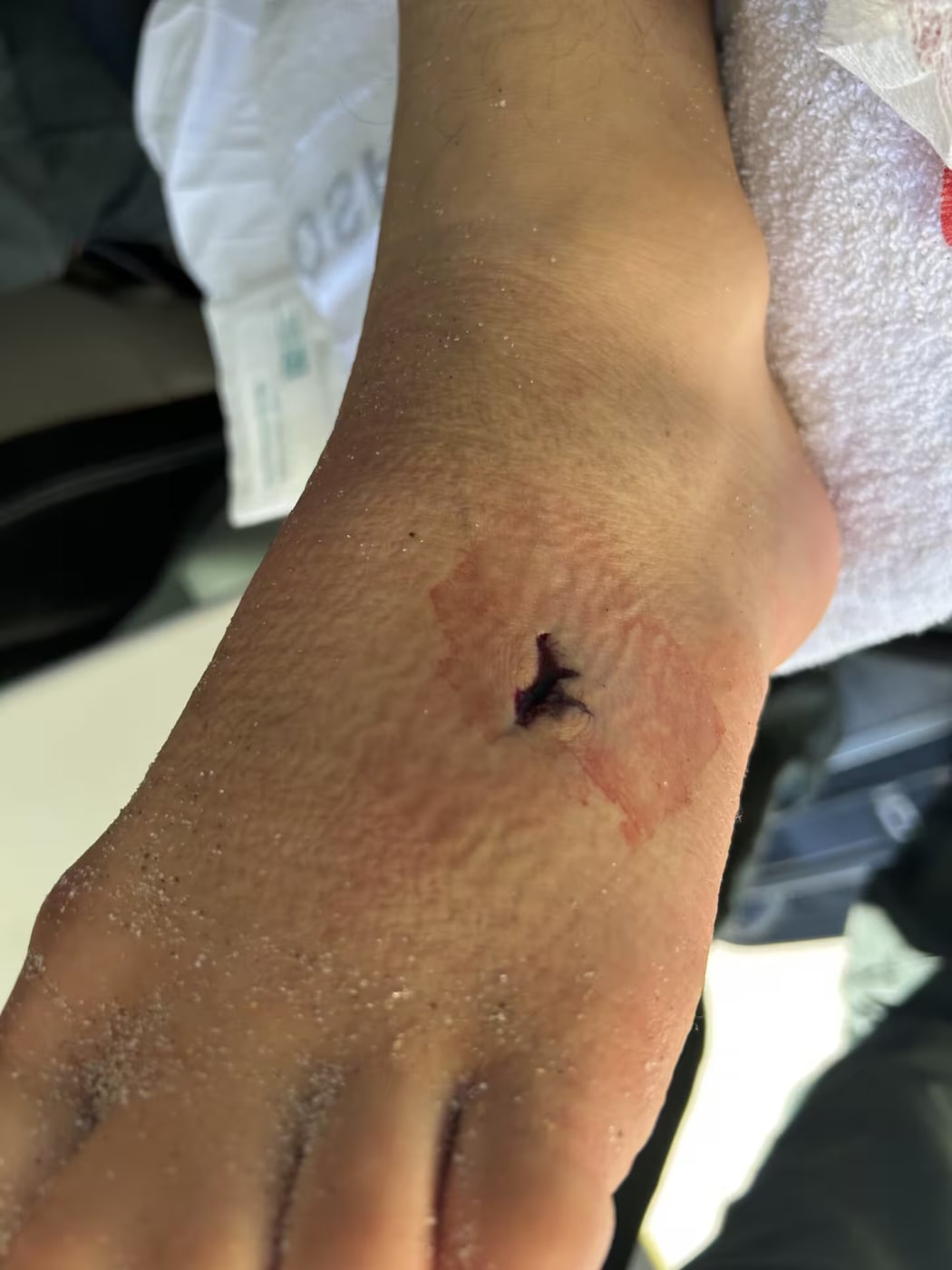
The barb went in one side, and out the other, leaving a “huge hole”.
Photo: Supplied / Open Justice
‘It just punched a hole right through’
Other beach-goers came over to help – one gave him a towel to wrap his foot, while another sprinted about 500m to a surf lifesaving tower.
“By that point, I think [other] people started realising something had happened in the water and the beach just cleared, the water just cleared.”
The surf lifesavers who turned up hadn’t seen anything like it before and radioed the main surf lifesaving club at Pāpāmoa, where a doctor and nurse were on site.
He was given pain relief and they helped him keep his foot elevated.
To begin with, it was “not horrendously sore”, but then came the “surges” of pain.
“I mean, I was able to grit my teeth through it,” he said.
Taane was in fairly good spirits – even cracking jokes. His main concerns were the pulled pork he’d put on the barbecue that morning and a jury trial due to start on Monday.
“I thought, ‘I’m probably not going to be able to do the trial’,” he said. “My partner’s just going, ‘Don’t even think about that. You’re bleeding profusely’, and at that point, looking at the foot, my pinky toe went purple and curled over,” he said.
The tendons in his foot had been severed.
He also thought about how relieved he was that his foot got the barb and not his partner’s pre-schooler.
As they waited, they were told by the surf lifesavers that orcas were swimming nearby.
“Of course, orcas feed on the stingray, so we were all thinking, ‘Oh, that’s why the stingrays were coming right up’.”
After about an hour on the beach, Taane said an ambulance arrived and took him to Tauranga Hospital.
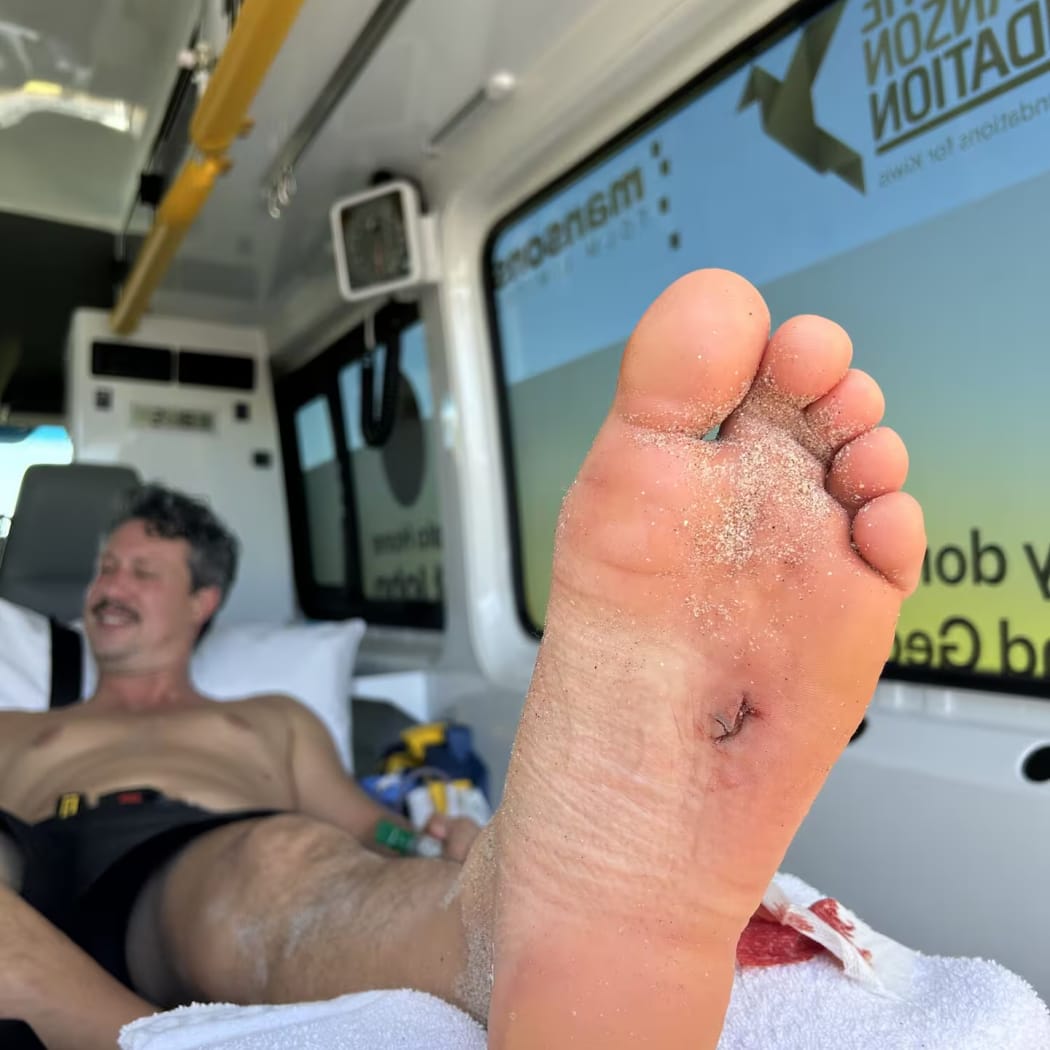
Taane was taken to Tauranga Hospital by ambulance.
Photo: Supplied / Open Justice
A surgeon cleaned out the wound with a piece of gauze, pulling it through the hole and out the other side to make sure there were no debris or barbs left inside.
“Usually, there’s like a pen-like barb still stuck in the skin,” Taane said. “I think the stingray was probably a really big one, because it just punched a hole right through… so it’s straight through and out again.”
Taane was stitched up and sent home late that night.
While the surgeon suspected severed tendons, only the small toe seemed affected and wasn’t a major cause for concern.
A week or so later, Taane’s condition deteriorated. He had very high fevers and became delirious, as a full-body infection took hold.
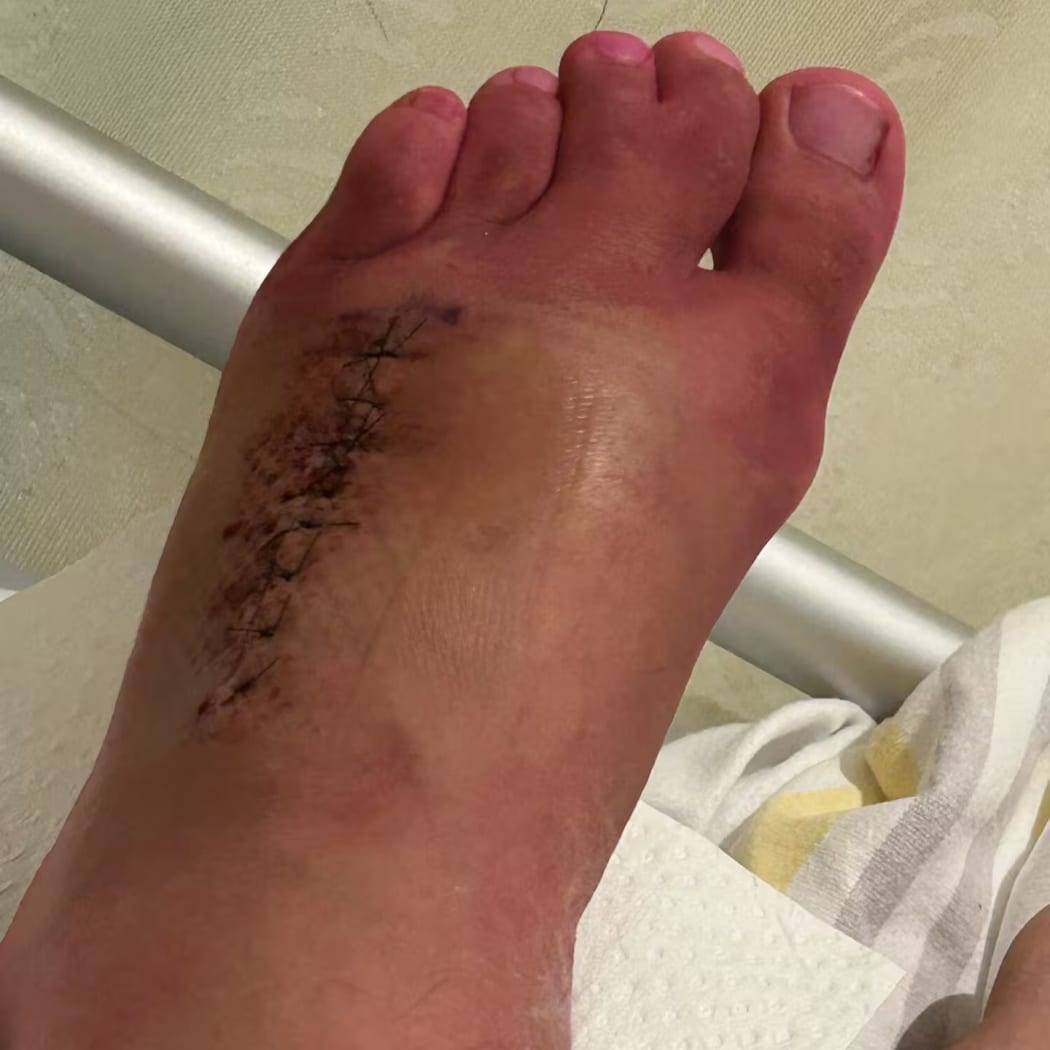
Tauranga Crown prosecutor Tobias Taane was barbed by a stingray at Papamoa Beach over Waitangi weekend.
Photo: Supplied / Open Justice
He was hospitalised immediately, “got slammed with antibiotics” and had surgery to clean the wound out.
“They re-attached my tendons, stitched it all up, discharged me at the end of the week and then basically it was just wound care for the stitching.”
After about three weeks, the stitches were taken out. Taane said he soon noticed the wound was re-opening and the hole kept getting bigger.
“Yeah, I’ve just had this hole in my foot since, I guess, mid-February.”
He has a pump attached to it, which helps it to continue to drain.
The PICO device that operates the suction has been clipped to the waistband of his suit pants, as Taane went back to the courtroom for a trial.
He hasn’t been in pain and said it felt great to be back in court.
“I missed it,” he said.
Taane, who is in his early 30s, trained as a lawyer, after an earlier career as a blacksmith and foundryman.
He’d left that line of work after a serious injury, deciding the work was too dangerous.
“I had molten metal spray on my leg, just hit me on the side of the leg,” he said, adding that it was the same leg as the foot barbed by the ray.
“That completely burnt through and just cooked a huge chunk of leg.
“Because it was so hot though, I didn’t feel anything. It just burnt through my nerves.”
It took two surgeries and about two years of recovery, until he regained feeling in that part of his leg and he wondered if that earlier damage had impacted the recovery from the stingray barb.
After two months off work, Taane began working from home, but now, three months on, he is back in the office, where he has a stingray as his desktop screensaver.
He plans to get a tattoo of a ray on his foot, once it’s healed.
‘When’s the prosecution coming for the stingray?’
During his time working from home, he’d been able to appear in court remotely and received lots of support from colleagues.
He received an email from the executive judge for the Tauranga District Court, Judge Paul Geoghegan, wishing him well for his recovery, which had been “really nice” to receive.
He had appreciated the collegiality of the Tauranga legal community.
“I had a couple of defence counsel text me or email me saying, ‘God, I heard what happened’, ‘I hope you’re all good’, or ‘When’s the prosecution coming for the stingray?'”
In Taane’s view, a “wounding with intent to cause grievous bodily harm” charge against the ray could be justified, but he conceded there would be a strong case for self-defence.
Auckland Museum marine biology curator Clinton Duffy said it certainly sounded like Taane had received a stingray wound.
He noted that first aid for stingray wounds was to stop the bleeding, then pour water as hot as the patient could bear over the wound.
This would “almost instantly stop the pain, which can be debilitating and worsen shock, as well as help clean the wound”.
No-one in New Zealand was “actively tracking” stingray incidents, as far as he was aware, nor had he noticed an increase in reports.
Duffy said three species of stingray lived in New Zealand waters – eagle rays, and short and longtail stingrays.
Eagle rays were present in shallow water, particularly in harbours and estuaries year-round, while short-tail stingrays tended to be most abundant inshore during summer.
Longtail stingrays were predominantly found offshore.
All three species were most abundant around the upper North Island and rising sea surface temperatures may mean they were becoming more prevalent around the South Island.
Stingrays were not an aggressive species and “only sting people in self-defence, generally when they are stood on”.
“Stingrays can be present almost anywhere,” he said. “Keep an eye out for them when entering the water.
“Avoid diving over or stepping on objects that look like a smooth, dark rock. It could be the back of a stingray that is partially covered with sand.
“Shuffle your feet when getting into the water to give stingrays a chance to get out of your way, before you step on them.
“When removing hooks from stingrays, flick them on to their back, so they can’t sting you, or get someone to hold the tail with a towel.”
This story originally appeared in the New Zealand Herald.