
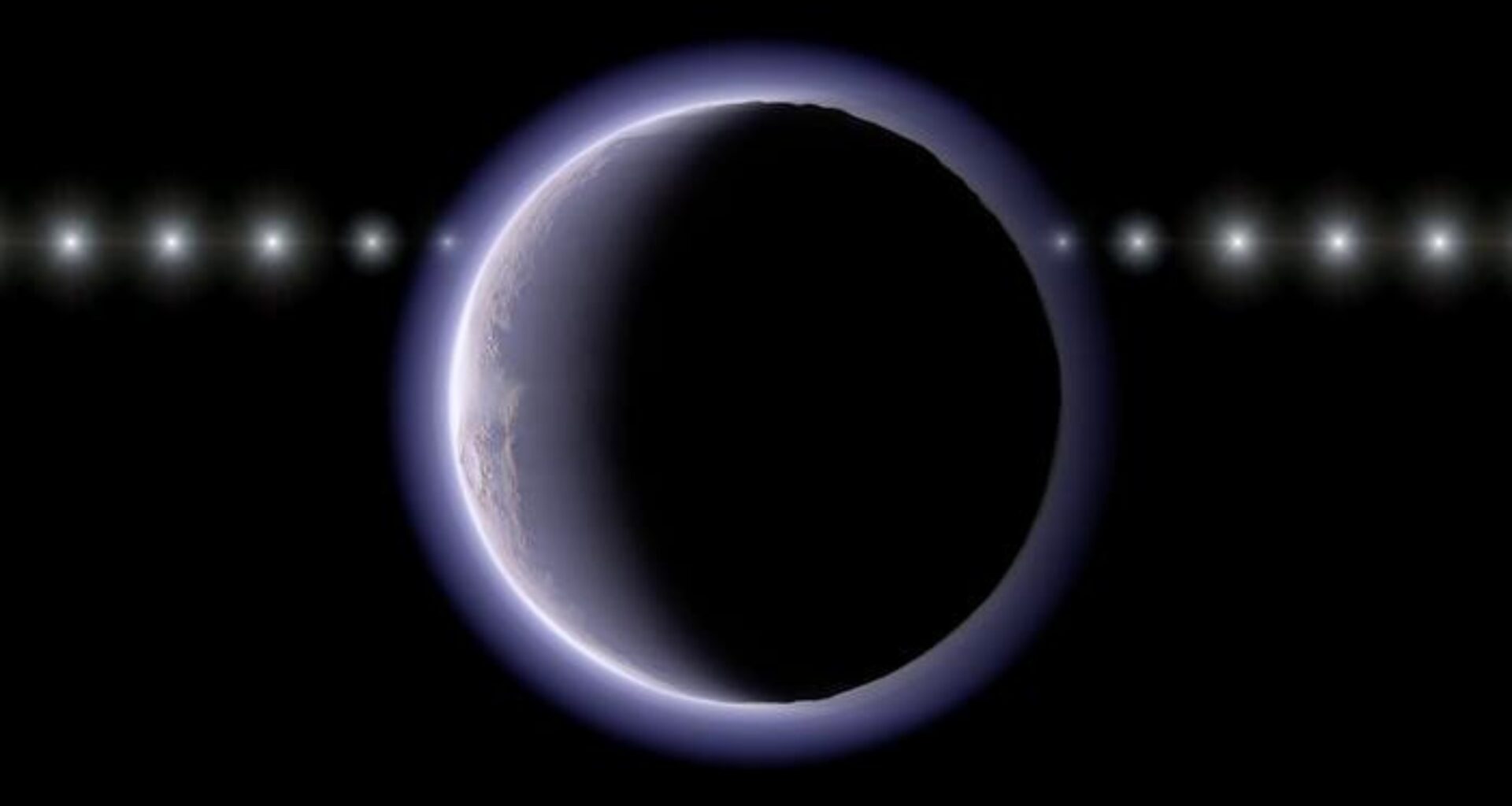
Astronomers have detected a thin atmosphere around a small icy world beyond Pluto, where gravity should not hold gas for long.
The discovery raises a big question for planetary scientists. A world that small should have lost any atmosphere long ago, unless something replenished it recently.
A star went dim

On January 10, 2024, a small icy world beyond Pluto crossed in front of a faint star as seen from Japan, turning seconds of darkness into evidence.
Ko Arimatsu is an astronomer at the National Astronomical Observatory of Japan (NAOJ).
By measuring how the star faded rather than vanished, Arimatsu showed that gas likely bent starlight at the edge.
His team saw the fading last 1.5 seconds at one station, too long for ordinary blur and too smooth for bare rock.
One event cannot answer where the atmosphere came from, but it was strong enough to make the object far stranger than its size allows.
A world that’s too small to hold onto gas
Far beyond Neptune, the Kuiper Belt holds icy bodies left from the solar system’s early years, including Pluto.
2002 XV93 is the body orbiting beyond Neptune. It is a plutino, which keeps a two-to-three orbital rhythm with Neptune. It is far smaller than Pluto, a 1,477-mile-wide icy world.
At just 310 miles across, the object is too small to hold onto gas for long because its gravity is so weak.
Gravity on a 310-mile body cannot grip molecules the way Earth or even Pluto can. At 3.4 billion miles from the Sun, 2002 XV93 is cold enough for gases to freeze, yet loose gas should drift away.
Without a fresh supply of gas, the atmosphere should survive for less than 1,000 years – a blink compared with the solar system’s 4.5-billion-year history.
That short lifetime makes the atmosphere less like an ancient feature and more like a recent event still fading.
An atmosphere that is detectable
Arimatsu’s team found an atmosphere so thin that its pressure would barely register by everyday standards.
Even so, the gas was dense enough to bend starlight as the object passed in front of a distant star.
By human standards, the atmosphere would feel almost nonexistent. Even so, it can bend starlight enough for sharp instruments to catch the change.
A stellar occultation, which occurs when a solar system object blocks a background star, can reveal shape, size, rings, and an atmosphere.
At one station in central Japan, the star’s light eased down and rose back up instead of snapping off.
Rings or dust could also dim light, but matching the data would require material packed oddly close to the surface. An atmosphere remains the cleanest explanation, although the researchers are not yet certain.
Two possible sources
A crash could have punched gas out of the ice if a small comet-like object hit 2002 XV93. Gas could also come from cryovolcanism – cold-world venting where gases or icy liquids rise through cracks instead of molten rock.
“The discovery suggests that some small icy bodies in the outer Solar System may not be completely inactive or unchanging, as previously assumed,” said Arimatsu.
Future observations need to identify the gas, not just its starlight effect.
The James Webb Space Telescope has checked 2002 XV93’s surface and found no clear frozen stores of gases such as methane, nitrogen, or carbon monoxide.
That absence weakens the simple idea that surface ice is steadily turning into gas.
A stronger spectrum could show whether the atmosphere contains one of those gases or a mix that points to a deeper source.
The role of small telescopes
Small telescopes helped make this detection possible, giving the story an unusual human edge.
At one Japanese station, astronomers used an 8-inch portable telescope, while a citizen astronomer used a 10-inch telescope.
Kiso Observatory, a mountain observatory in central Japan, added a 41-inch telescope with a fast camera.
Such campaigns matter because these rare alignments happen quickly, and no single observatory can cover the entire shadow path.
Future research directions
Repeated occultations can test whether the gas is vanishing, holding steady, or changing with the seasons.
A falling pressure would favor an impact, because crash-made gas should escape or freeze back down over years to decades.
Steady or seasonal pressure would point toward internal supply, which would make this small body more active than expected.
Either result would sharpen a basic rule of planetary science: size matters, but timing can matter too.
A 310-mile object with a thin atmosphere does not make every icy speck active, but it widens the list of places worth checking.
Follow-up can decide whether 2002 XV93 is a rare accident or a sign that small outer solar system bodies sometimes release gas briefly.
The study is published in the journal Nature Astronomy.
Image Credit: NAOJ
—–
Like what you read? Subscribe to our newsletter for engaging articles, exclusive content, and the latest updates.
Check us out on EarthSnap, a free app brought to you by Eric Ralls and Earth.com.
—–