
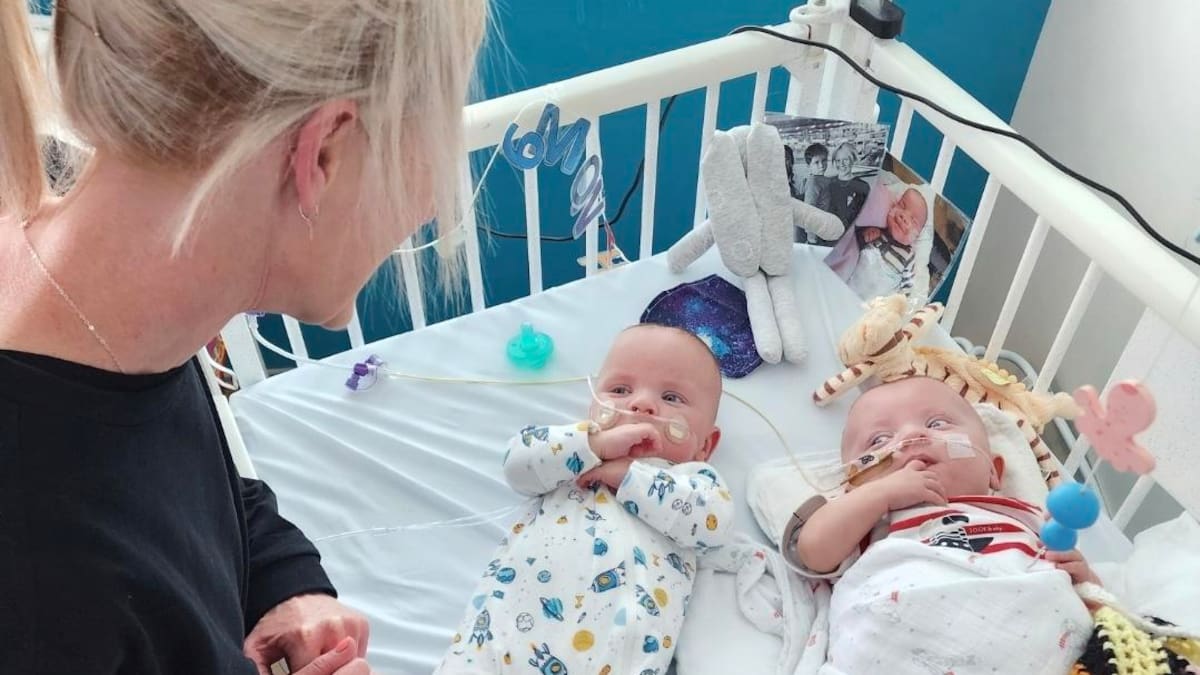
The morning after returning home, everything changed.
“I had started bleeding and thought I was losing my babies, I didn’t realise I was going into labour,” she said.
“I didn’t even know babies could be born that early.”
Louie arrived weighing just 750g, followed 21 minutes later by Ollie at 640g.
Rebecca Fitzgerald’s twin boys showed signs of twin-to-twin transfusion syndrome at 16 weeks. It is a serious condition caused by shared blood flow through the placenta. Photo / Supplied
Fitzgerald was told by doctors that her babies had a 30% chance of survival.
“You don’t think long term; you live moment to moment and just hold on to hope,” she said.
Two weeks in, Ollie remained fragile but stable.
However, his brother, Louie, became critically unwell, his stomach swelling dangerously.
Doctors suspected a serious bowel issue and made an urgent call to send Louie to Christchurch NICU for surgery.
Rebecca Fitzgerald spent the first seven months of her twin son’s life between separate NICU units in Christchurch and Dunedin. Photo / Supplied
With her sister and mum holding the fort in Dunedin, Fitzgerald made the tough call to follow Louie to Christchurch.
“You don’t know how you make a decision like that,” she said.
Louie was airlifted by helicopter. Fitzgerald followed by plane and walked into Christchurch NICU, which was over capacity, she said.
“It felt overwhelming. You realise very quickly how stretched the unit is. It was too busy for me to have Ollie there, too.”
Louie’s first surgery revealed a bowel perforation.
He was surrounded by tubes and machines, his future uncertain.
Fitzgerald waited alone in the family room.
Louie endured collapsed lungs, infections, a second major surgery and a stoma that allowed his bowel to heal outside his body.
Feeding became a daily battle, and progress was slow.
Meanwhile, because Christchurch NICU was at capacity and Ollie did not require the same level of care as Louie, Fitzgerald, a single mum at the time, was forced to travel constantly between Dunedin and Christchurch, caring for her twins in different cities.
Baby Louie was airlifted from Dunedin to Christchurch NICU as his health worsened. His first surgery revealed a bowel perforation. Photo / Supplied
She called for daily updates when she couldn’t be there, and returned home to daughter Sophie, who was one-and-a-half at the time, whenever she could.
“Once the boys were a little older, growing and feeding, missing those milestones because I would be with one and not the other, that was difficult,” Fitzgerald said.
“The only blessing I could find was knowing the NICU nurses care for the babies as their own.
“I will be forever grateful for that when I couldn’t be in two places at one time.”
Fitzgerald described the NICU as “emotionally reckless”.
“It was seeing privacy screens drawn around another incubator, or watching families enter the bereavement room,” she said.
“You don’t know if that’s going to be you. And there’s every chance it could be. There are no guarantees.”
After five months, Ollie was discharged home on oxygen.
Louie stayed another two months, most of that time in Christchurch, before he was finally well enough to return home to his brother in Dunedin.
Today, both boys are tall, strong and energetic 3-year-olds.
“They’re two very different little people. Their verbal communication is slightly delayed at this point. They’re not talking in full sentences.”
Fitzgerald said while nobody chooses the NICU, small things do matter to families spending time there with their little ones.
“We were so crammed in. We wore headphones to give the other families privacy when the doctors did their rounds,” she said.
“There were days it became a game of musical chairs just to get a comfortable chair to sit in.”
A new fundraising campaign has since been launched to enhance the hospital ward looking after the South Island’s sickest and smallest babies.
Māia Health Foundation has begun its Tiny Hands Need Big Hearts, with the unveiling of two public installations at Christchurch Hospital.
The campaign supports the refurbishment and enhancement of the hospital’s neonatal intensive care unit.
The installations behind the campaign include a major new artwork by celebrated New Zealand artist Neil Dawson, and a deeply personal Baby Wall honouring babies who have received care in the NICU.
Suspended above the hospital’s main entrance in the Waipapa building, Dawson’s new sculpture, a softly lit, 5.5m feather, has been created specifically for the site.
Designed as a welcoming canopy for all who enter the hospital, the artwork speaks to comfort, fragility and hope.
“Hospitals can be confronting places,” Dawson said.
“I wanted this work to gently soften that moment when people walk inside, to create something calm, accessible and protective.
“A feather can suggest both preciousness and lightness, but also care and comfort.
“Being part of a campaign for NICU felt incredibly meaningful.”
Positioned nearby, the NICU Baby Wall is dedicated to all the babies who have spent time in the unit, with 280 of them represented by a photograph and short story shared by their families.
Māia Health Foundation chief executive Michael Flatman said the installations bring visibility to an area of healthcare many families never expect to need, until they do.
“NICU often comes out of nowhere for families. These babies arrive early, or unwell, and suddenly parents are thrown into one of the most vulnerable times of their lives,” Flatman said.
“Tiny Hands Need Big Hearts is about rallying the community to help turn a highly clinical environment into one that also feels human, warm and supportive.
“Whatever people can give, whether it’s a little or a lot, it will make a big difference to families facing some of the toughest times of their lives.”
Māia Health Foundation chief executive Michael Flatman. Photo / Supplied
Christchurch Women’s Hospital is the main tertiary-level neonatal intensive care unit in the South Island, providing critical care for the region’s most vulnerable newborns.
Since it opened in 2005, the population has grown by nearly 26%.
While the unit is funded for 44 cots, it can care for up to 60 babies at a time.
In 2025 alone, 59 mothers shared Fitzgerald’s experience of being transferred out of the region due to capacity constraints.
The redevelopment of the NICU at Christchurch Women’s Hospital comes at a total cost of $16 million.
Health New Zealand has committed $13.9m to the upgrade, with Māia Health Foundation contributing $2.1m.
The upgrade will increase capacity to 54 neonatal cots and improve clinical care, while Māia is focused on making the space more supportive for families, including whānau rooms, overnight spaces, comfortable recliners and breastfeeding chairs.
“When you’re in survival mode, those things change how you cope,” Fitzgerald said.
Donations to Māia Health Foundation to support the NICU redevelopment can be made here.