
After shutting Foxton, 26 Seasons went on to seek opportunities overseas, using its proprietary know-how.
The company first looked at Singapore, and then the Middle East, where food security is critical and where there is a high standard of living, and a high consumption per capita basis of berries, particularly strawberries.
Leach said the Middle East was the more attractive proposition on paper, with its cheaper electricity costs, lower labour costs and more attractive premises.
“When you overlay that with the consumption per capita of strawberries and potentially other berries, then it was an environment worth exploring,” Leach said.
The company spoke to NZTE and the New Zealand Middle Eastern Business Council to gain an understanding of the region.
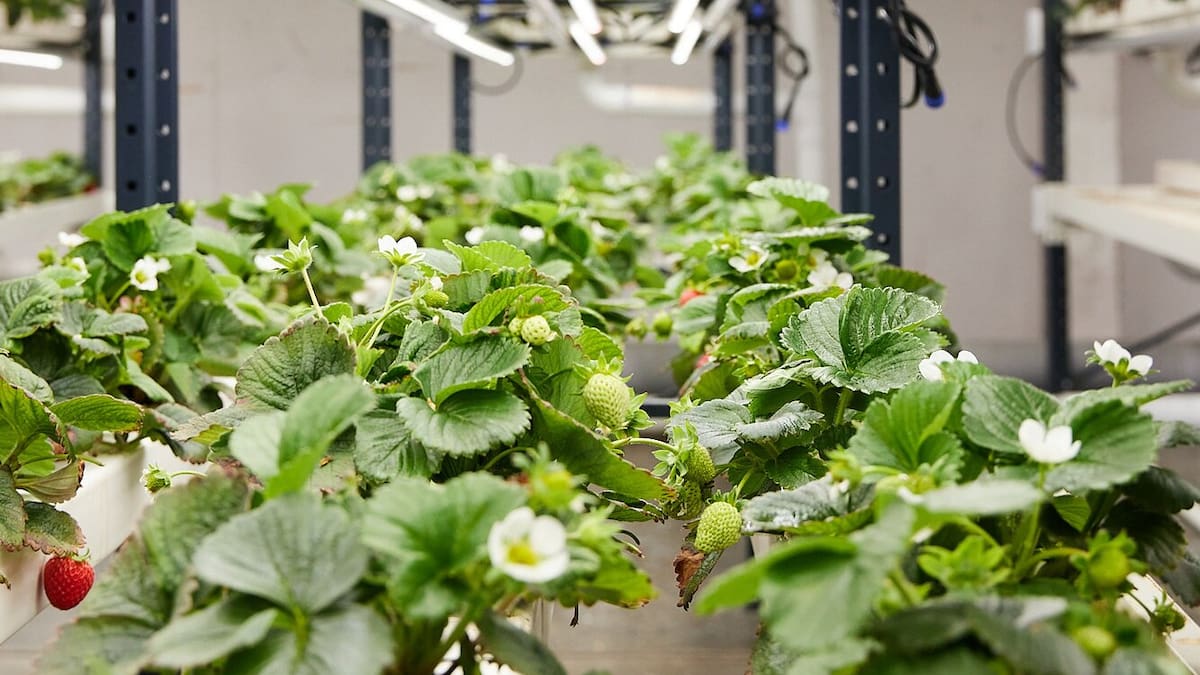
Strawberries grown by 26 Seasons for Emirates’ Bustanica. Photo / Supplied
Emirates Flight Catering already has a large vertical farm in Dubai called Bustanica, a 10,000sq m vertical farming facility producing mostly green leaf vegetables such as lettuce, primarily for the airline.
Leach said Bustanica had tried unsuccessfully to grow strawberries indoors and was looking for a partner to grow them for first-class Emirates passengers.
Co-founders Matthew Keltie, Steve Carden and Leach met with Bustanica management, who offered 26 Seasons the chance to grow strawberries in one of their rooms.
“We did that for 12 months and then, earlier this year, in January, they said now we want to commercialise with you,” Leach told the Herald.
“That means that we go from, in effect, pre-revenue to a revenue-generating business.”
He said a deal to commercialise the arrangement with Emirates Bustanica was in progress and the company was also executing terms of agreement for an operation in Qatar.
The company was in negotiations with a large grower in Abu Dhabi and was also in talks with a Saudi Arabian government entity.
Leach said 26 Seasons aimed to achieve production double that of an outdoor grower and the company will hit three times normal production this year.
As it stands, strawberries in the Middle East are grown in tunnel houses and glasshouses, but there is no year-round production.
He said the current conflict in the Middle East had served to reinforce the importance of food security.
“And countries are looking for those businesses and partners that can help them tick that box,” he said.
The company began in 2017 with an indoor vertical farm in a former Wellington nightclub and expanded last year to include microgreens – young seedlings of edible vegetables and herbs – in a converted warehouse in Penrose.
Jamie Gray is an Auckland-based journalist, covering the financial markets, the primary sector and energy. He joined the Herald in 2011.
Stay ahead with the latest market moves, corporate updates, and economic insights by subscribing to our Business newsletter – your essential weekly round-up of all the business news you need.