
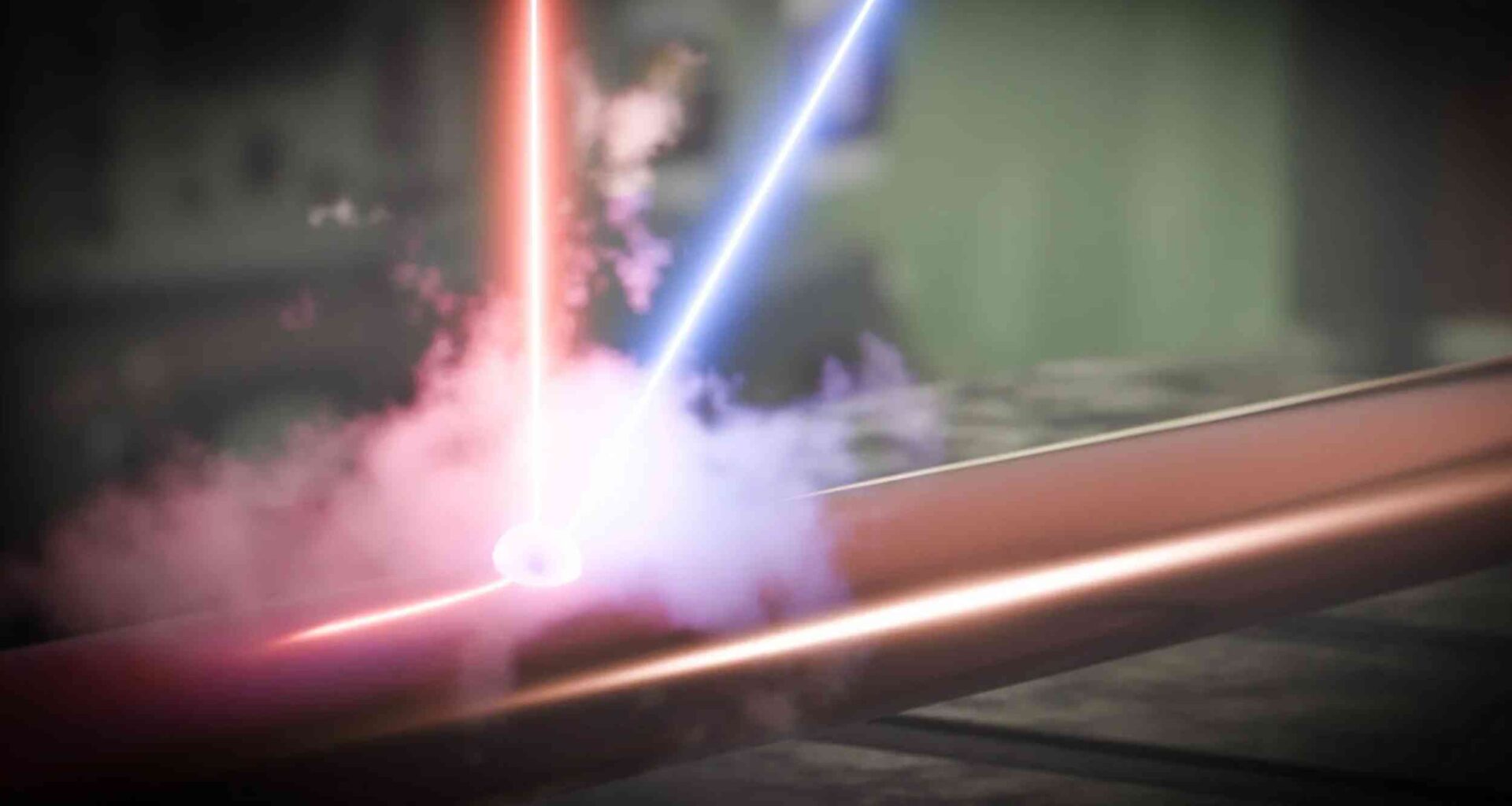
Laser fusion research has a measurement problem. The critical physics – what happens in the first trillionths of a second after a laser pulse strikes its target – has always been modeled, never directly observed.
A new experiment has now produced a direct measurement to test those models against. The target was a thin copper wire. What the data shows is not exactly what the simulations have been saying.
Filming the first picosecond

That gap is what a team at the Helmholtz-Zentrum Dresden-Rossendorf (HZDR) and the European XFEL in Schenefeld, Germany, set out to close.
They needed measurements that could follow the action step by step. How does solid metal turn into the plasma found in stars or the wreckage of a gamma-ray burst?
Speed was the obstacle. The transformation runs its course in a few trillionths of a second. To catch it, you need light pulses shorter than the changes themselves.
Dr. Lingen Huang, who heads experimentation in HZDR’s Division of High-Energy Density, led the team. Their tool was a pair of lasers, each firing pulses lasting only 25 to 30 femtoseconds.
Two lasers working together
The first laser, called ReLaX, hits the target with a brutal jolt of optical light. The second, an X-ray free-electron laser, fires X-ray flashes a moment later to peek inside the chaos.
Roll the timing back and forth between the pulses, and a movie emerges step by step. That two-laser technique is not new in principle.
What is new is the combination – an optical pulse powerful enough to create a star-like state, paired with X-rays sensitive enough to read individual ion behavior.
A previous study using copper foil ran into noisy data. Switching to a wire target solved that problem and gave cleaner signals throughout.
Wire becomes superhot plasma
The target is a copper wire about one-seventh the thickness of a human hair. Each optical pulse carries roughly 250 trillion megawatts per square centimeter.
The wire vaporizes instantly. Temperatures climb to several million degrees. Copper atoms begin shedding electrons, one after another, until each atom is stripped of most of them.
This part of the process – called ionization – had been studied for years through indirect measurements and computer models. What the team wanted was a direct look.
Tracking the charged ions
They tuned the X-ray probe to 8.2 kiloelectronvolts, an energy that resonates only with copper atoms that have lost exactly 22 electrons.
When those ions were in the plasma, the probe lit them up. Without them, the signal faded into the background noise of the measurement.
The recording shows a clean rise and fall. The ions appear at half a trillionth of a second. They peak at two and a half trillionths. By ten trillionths, they’re gone.
“No one has ever looked at this type of ionization so precisely before,” said Prof. Tom Cowan, former director of the Institute of Radiation Physics at HZDR.
Until now, that ion population curve had only existed in computer simulations. The wire experiment put it on a direct footing for the first time.
Electron waves that cascade
The simulations explain what drives the cascade. The first pulse knocks loose only a few electrons. Not many. But those electrons move so fast they tear through the wire, kicking others free as they go.
“They are so energy rich that they spread out like a wave and knock ever more electrons out of neighboring copper atoms,” said Cowan.
Simulations indicate the wave eventually runs out of energy. Electrons slowly drift back, and atoms return to a neutral state. The plasma dissipates.
What the simulations reveal
For decades, the inside of a laser-driven plasma has been more hypothesis than measurement. Models predicted temperatures, ionization depths, timescales. All of it inferred. None of it directly seen.
The new data lets researchers check those predictions directly. The team tested two competing models. One matched the recordings – the one that treated electrons as still erratic and energetic, rather than settled into predictable behavior.
That distinction is not minor. A related paper on solid-to-plasma transitions made the same point. Without the right physics built in, simulations of fusion-relevant conditions go off by huge margins.
The experiment was performed on copper wire, not the hydrogen-based fuel in actual fusion reactors. Copper makes for cleaner X-ray measurements, but hydrogen fuel ionizes differently.
Extending this approach to fusion-relevant target materials remains work for future experiments.
Toward laser fusion energy
That wire data feeds into something bigger. Laser fusion reactors – under design in the U.S., France, and Japan – heat tiny fuel pellets to plasma states very similar to the one created here.
If the simulations guiding those reactors are off by factors that direct measurement can correct, that has real consequences for engineering and design.
“This experiment demonstrates how powerful our lasers are and paves the way for future laser fusion facilities,” said Dr. Ulf Zastrau, who runs the HED-HiBEF station at the European XFEL.
What is now known that wasn’t before: a precise timeline for how an ultra-intense laser strips, heats, and releases a solid metal target.
Future reactor designs can be tested against direct measurements like these, not just indirect signals. That is a different kind of foundation to build on.
The study is published in Nature Communications.
—–
Like what you read? Subscribe to our newsletter for engaging articles, exclusive content, and the latest updates.
Check us out on EarthSnap, a free app brought to you by Eric Ralls and Earth.com.
—–