
“That’s what the Government’s working hard on at the moment,” he said.
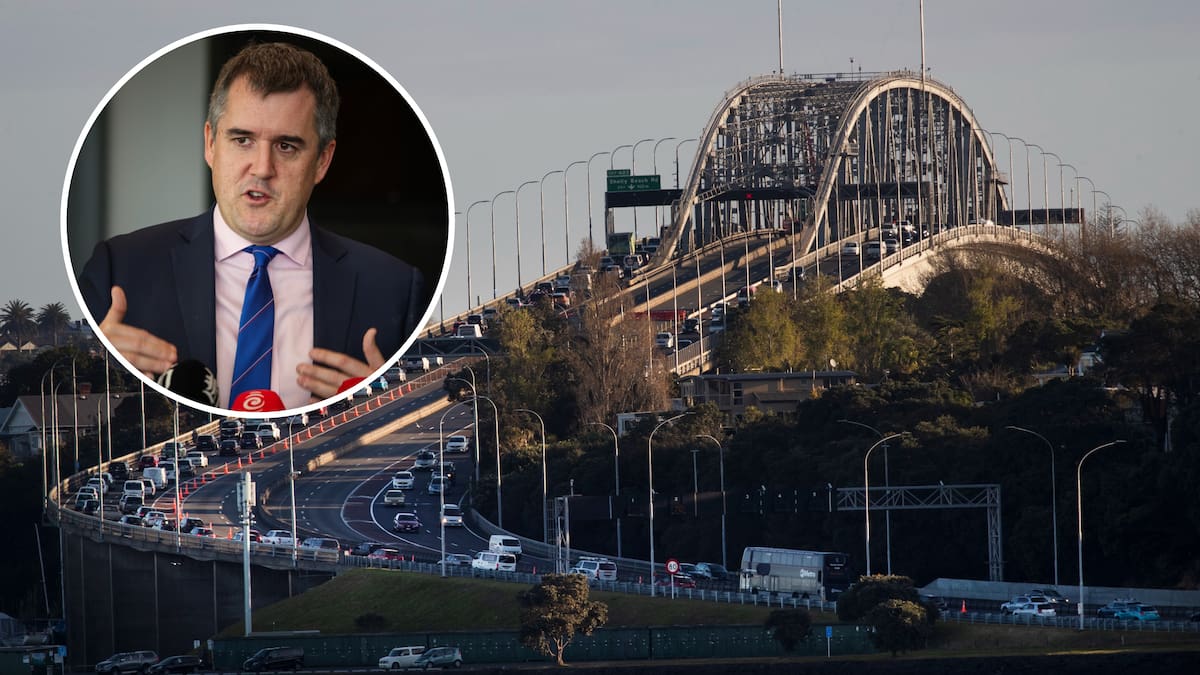
Transport and Infrastructure Minister Chris Bishop said a decision on the preferred route and method of Auckland’s proposed second harbour crossing will be made by mid-year. Photo / Jason Dorday
“We’re planning on making a decision mid this year, so the next few months, in terms of the options for basically a bridge versus a tunnel.“
Once finalised, the decision will go to the NZTA board before landing in Cabinet for approval.
Bishop said “a considerable amount of work” would then be needed around funding the crossing, and expressed his desire to reach an agreement with parties across the aisle.
“I don’t want to make a decision that … the Labour Party doesn’t support,” he said.
“We will want to take a bipartisan approach to it and act in the national interest, because what’s important is that the public have certainty around exactly what we’re doing for the future.”
While Bishop acknowledged Labour’s concerns that some projects – like those in the Government’s Roads of National Significance (RoNS) programme – have been announced without funding, he said the Government was trying to create a “long-term pipeline” that would last through changes in government.
Reports proactively released by NZTA warn the Auckland Harbour Bridge, now 67 years old, is at capacity and fraying under use. Photo / Brett Phibbs
“Arguably one of the challenges with New Zealand infrastructure over the last 10 to 20 years is that politicians have made a series of promises on both sides of the aisle, may I say … but the money’s not actually there for them,” he said.
“What we’re trying to do is be really transparent and upfront around what’s funded and what isn’t, and get that pipeline going out into the future.”
Bishop said building a second crossing will be expensive whether it’s a bridge or tunnel, so planning and funding options – through a toll or otherwise – will need to be worked through in good faith.
“We’ve got construction costs going up, we’ve got revenue declining, and we’ve got existing funding constraints.
“So I’m just being really upfront with the public about the fact that there’s not enough money in the system to do everything that people want to do.”
NZTA’s reports warn of the current bridge’s ageing infrastructure as key components reach their capacity and design life’s end.
Keeping it operational will require increasingly complex and costly maintenance, with more closures, truck limits and other disruptions potentially on the cards in the near-future.
John Tookey, a professor in construction management at AUT, told Ryan Bridge TODAY that while the immediate risk of the current bridge failing wasn’t high, NZTA’s reports highlight “simply, the fact that the infrastructure needs to be supplemented [or] replaced”.
“We’ve been saying it for 30 years,” Tookey said, adding that the reports drew attention to the bridge’s previously acknowledged weaknesses.
“The structural limits associated with the piers has been exceeded, there are massive safety margins associated with any structural solution of several times over.
“So again, immediate problem – no – but there’s only so much kicking this can down the road we can realistically do.”
NZTA completed land- and sea-based geotechnical investigations in the Waitematā Harbour at the end of last year to help inform their decision on the proposed crossing’s route and method.
Over 130 boreholes were drilled, with the harbour’s topography mapped and soil and groundwater samples collected to better understand its ground conditions.
Auckland Mayor Wayne Brown has long advocated for the crossing to be built as a bridge over Meola Reef, a partially submerged rocky lava flow extending into the water from Pt Chevalier, arguing doing so would be cheaper and more logical than other routes being considered by NZTA.
Sign up to The Daily H, a free newsletter curated by our editors and delivered straight to your inbox every weekday.