
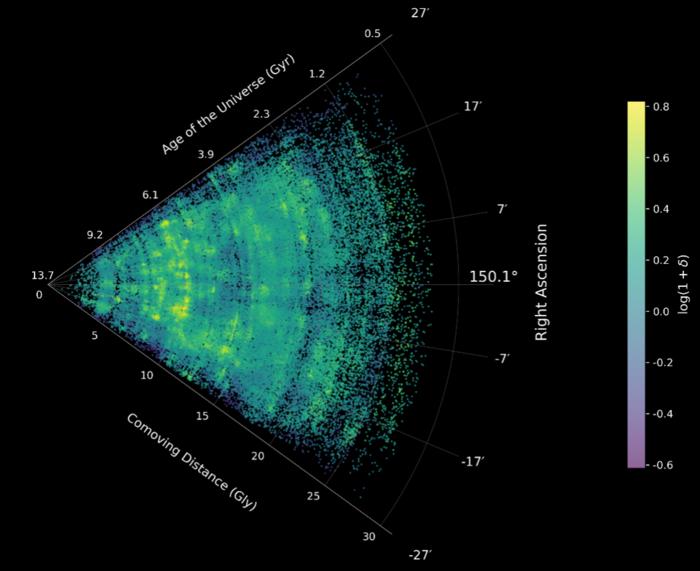
 A slice through the COSMOS-Web cosmic-web map, showing galaxies across nearly 14 billion years of cosmic history. The vertex on the left marks the present day; moving outward, each galaxy is placed at its distance in cosmic time, reaching back to when the universe was less than a billion years old. Bright yellow regions show the dense clusters and filaments of the cosmic web, while dark regions mark the near-empty voids in between.
image: ©
Hossein Hatamnia, UC Riverside.
Using the James Webb Space Telescope’s largest survey to date, astronomers have mapped the “cosmic web”, the universe’s network of dark matter and gas filaments
By leveraging the COSMOS-Web survey—the largest program ever conducted by the James Webb Space Telescope (JWST)—astronomers have traced the universe’s skeletal framework back to when the cosmos was only one billion years old.
The map traces 164,000 galaxies across 13.7 billion years of history, providing a high-resolution look at the framework of the cosmos from its infancy to the present day.
What is the cosmic web?
The cosmic web is the largest structure in existence. It is a vast, interconnected network of filaments and sheets composed of gas and dark matter. These “threads” act as gravitational highways that link galaxies together, surrounding massive, nearly empty regions known as voids. It is the underlying architecture that dictates where galaxies form and how they evolve over billions of years.
A new level of precision from the JWST
While previous telescopes like Hubble provided a “smoothed over” view of this structure, the JWST has brought the cosmic web into sharp focus. The team catalogued 164,000 galaxies, using the telescope’s infrared sensitivity to see through cosmic dust and detect faint, distant objects that were previously invisible.
The improvement in the map comes from two factors:
Depth:
JWST detects significantly fainter galaxies in the same patch of sky.
Resolution:
The distances to these galaxies are measured with unprecedented precision, allowing scientists to place each galaxy into its exact “slice” of cosmic time.
Tracing 13.7 billion years of history
The map provides a visual timeline of the universe’s growth. By studying the evolution of clusters and filaments, astronomers can see how the structure of the universe shifted from a chaotic early state into the organised web we see in the “nearby” universe today. The team even managed to resolve structures that appeared to be single blobs in older data into multiple, distinct galaxy groups.
In a commitment to open science, the research team has released the full pipeline, the galaxy catalogue, and a 3D video showing the web’s evolution to the public. This data will serve as a foundational resource for astronomers worldwide to study the birth and death of stars within these massive cosmic structures.