
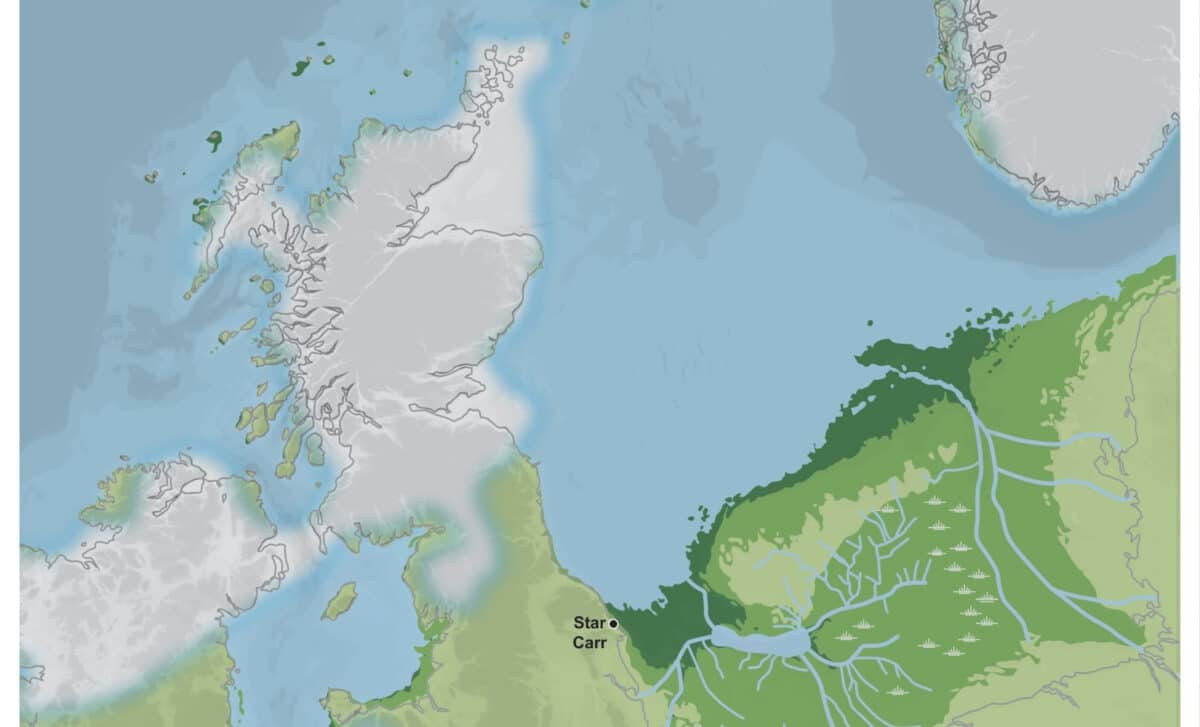
For generations, Doggerland occupied a fairly modest place in the popular retelling of prehistoric Europe, a corridor, useful for migration, unremarkable in itself. That story is now being complicated by new research drawing on ancient DNA extracted from marine mud, a technique that allows scientists to identify plant and animal species from genetic fragments preserved in layers of silt over thousands of years. The method, known as sedimentary ancient DNA or sedaDNA, is proving to be one of the more powerful tools available for reading landscapes that no longer exist.
What makes this particular study striking is not just what the DNA contains, but when it appears. Trees that researchers did not expect to find at such an early date are showing up in the record, alongside species that were thought to have disappeared from the region hundreds of thousands of years earlier. The picture that emerges is of a living, wooded ecosystem, one capable of sheltering animals, and possibly people, through some of the harshest climatic swings of the late Pleistocene and early Holocene.
A Forest Pulled Out of the Mud
The research team analyzed sedaDNA from 252 sediment samples taken from 41 marine cores along a submerged prehistoric waterway they call the Southern River, a system roughly 19 miles long with a freshwater estuary at its mouth. According to Ecoticias, the samples contained genetic traces of temperate trees, oaks, elms, and hazels, in sediments dating beyond 16,000 years ago, earlier than many pollen records from surrounding land would suggest. Lime tree DNA appeared roughly 2,000 years before equivalent records from mainland Britain.
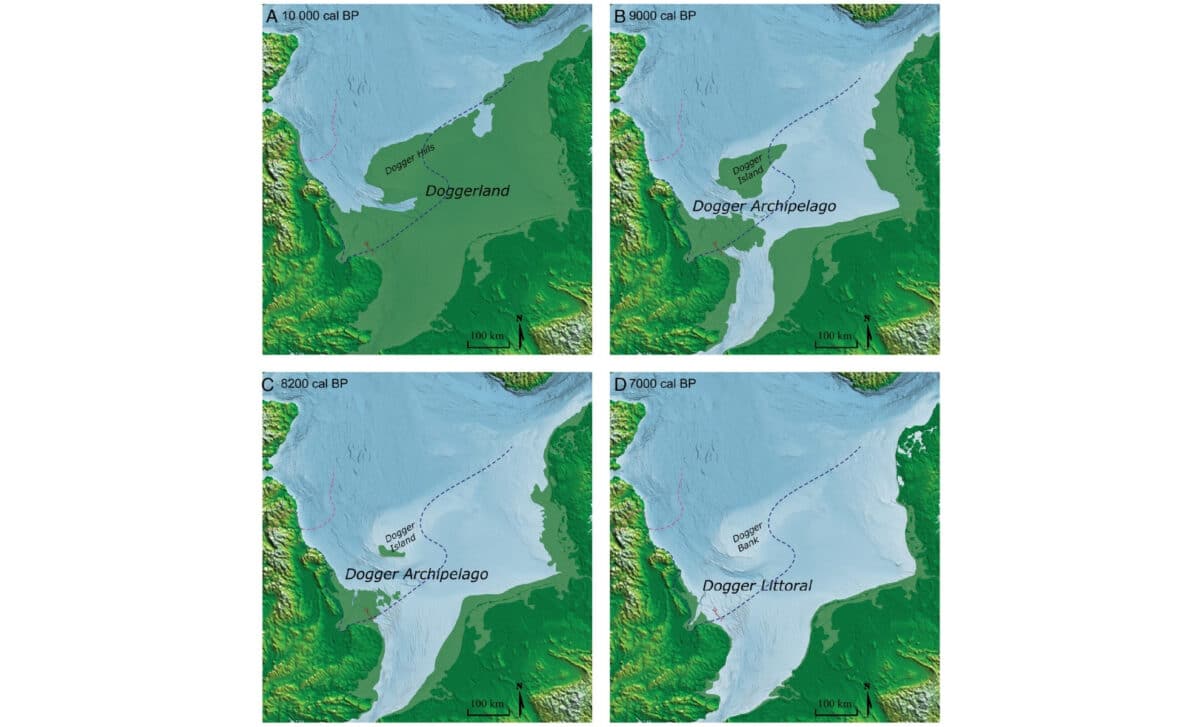 Holocene Doggerland coastline reconstructions in relation to the Southern River – © Proceedings of the National Academy of Sciences
Then there was the stranger find: DNA from Pterocarya, a walnut relative that was believed to have vanished from northwestern Europe around 400,000 years ago. Its presence in the record has yet to be fully explained. Professor Robin Allaby of the University of Warwick, one of the researchers involved, said the team “unexpectedly found trees thousands of years earlier than anyone expected,” and added that the data point to the North Sea fully forming later than previously thought.
Not all the sediment layers are equally reliable as archives, and the authors addressed that directly. Their analysis shows that silty and fine sand deposits can contain DNA signals that are 95 to 98% local in origin, while coarser sands and gravels tend to produce more mixed results, with local signals falling to between 60 and 70%. In plain terms, some layers tell a clean story, and others are considerably harder to read.
Small Refuges, Fast-Returning Forests, and a Long-Running Debate
One of the more persistent puzzles in paleoecology concerns the speed at which temperate forests recolonized northern Europe after the last ice age. Seeds do not travel quickly on their own, yet the evidence consistently shows forests rebounding at a pace that is difficult to explain if the trees had to migrate all the way from large refuges in southern Europe. The Doggerland findings feed directly into that debate.
The concept of microrefugia, small, sheltered pockets of habitat where plant species can survive hostile climatic periods, has been proposed as one answer. A south-facing slope, a sheltered valley, a wetland edge: these kinds of localized environments can maintain survivable conditions even when the broader region is too cold or too exposed for most species to endure. According to the research, the sedaDNA evidence supports the idea that some temperate species survived farther north than classical models assumed, and were therefore positioned to spread outward relatively quickly once temperatures began to rise.
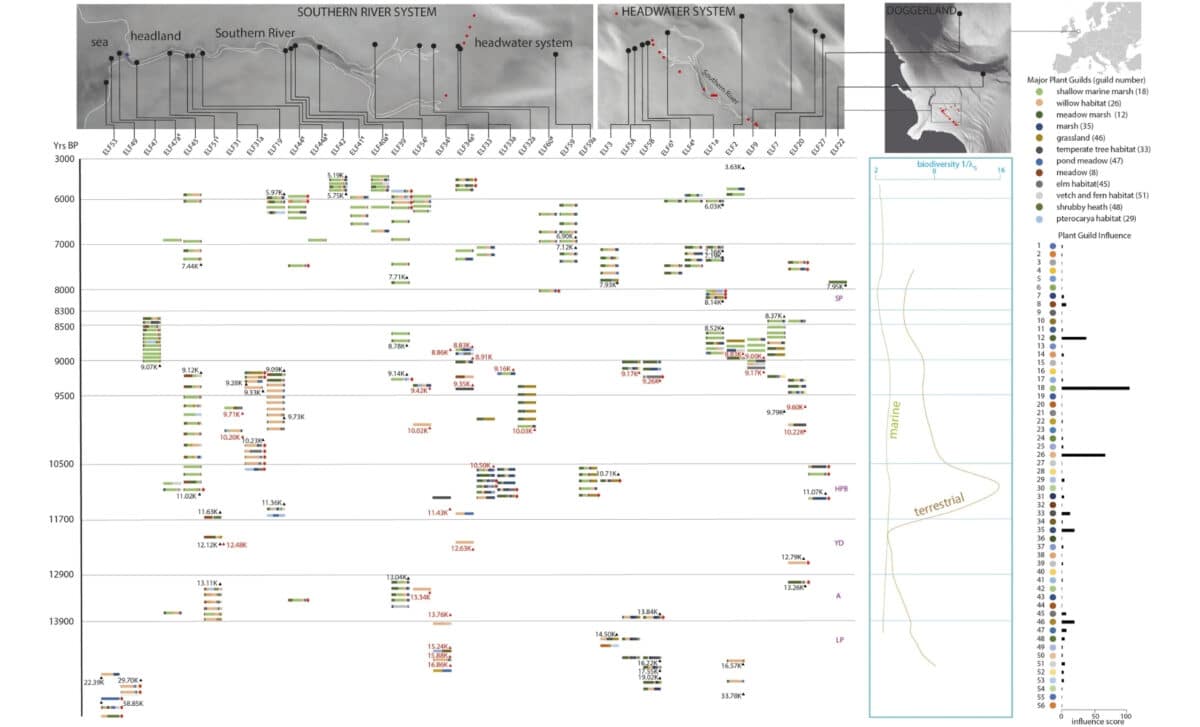 Plant guild profiles of the Southern River and Surrounding Doggerland area – © Proceedings of the National Academy of Sciences
That argument, if it holds, has implications beyond Doggerland. It suggests that the standard map of glacial refugia, anchored in the south of the continent, may be incomplete, and that the history of forest recovery in northern Europe is more geographically distributed than it appears.
A Wooded Landscape That Could Have Fed Early Communities
Doggerland did not just host trees, at least not if the broader ecosystem functioned the way forested environments typically do. The University of Warwick notes that woodland habitats in the area would have been capable of supporting forest animals such as wild boar, and this was occurring well before the rise of the Maglemosian culture around 10,300 years ago.
A worked stone tool recovered from a location near the estuary of the Southern River adds a further dimension to the picture. It is not proof of a settlement, but it places people in or near this drowned landscape during the early Holocene.
Allaby described the findings as “the best evidence that Doggerland’s wooded environment could have supported early Mesolithic communities.” The implication is that Doggerland was not a corridor people hurried across to reach somewhere else, it may have been a destination in its own right.
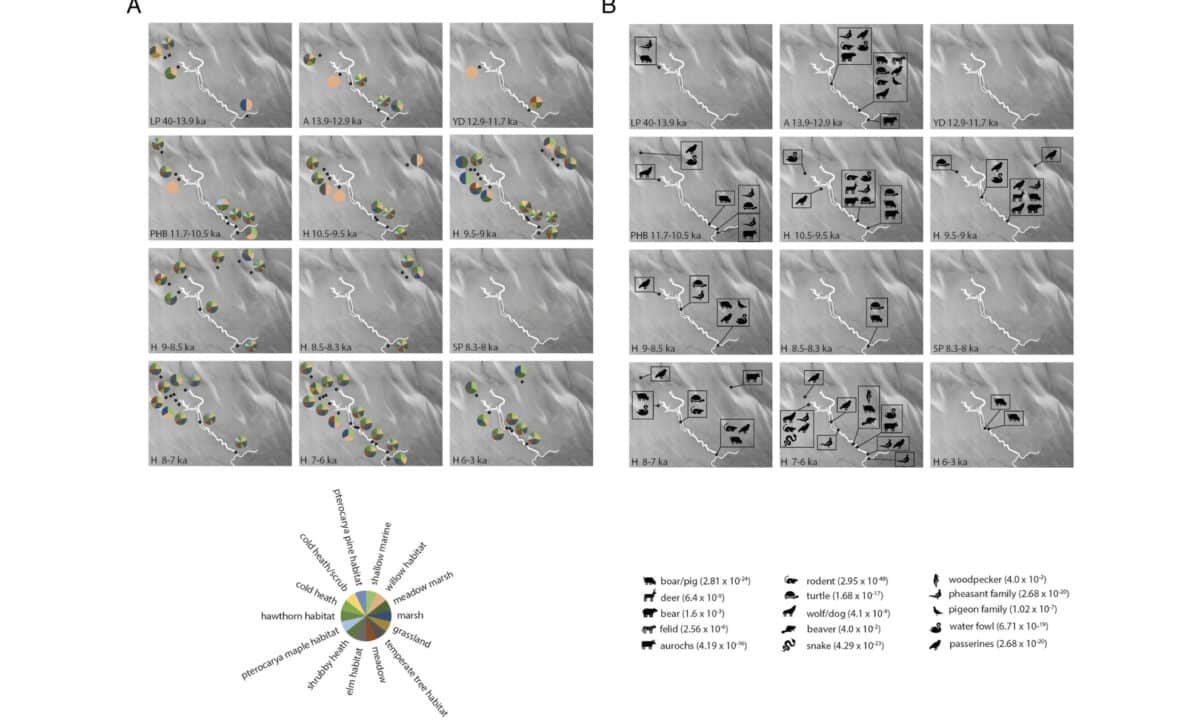 Major plant guild and animal occurrence over time in the Southern River – © Proceedings of the National Academy of Sciences
The end, when it came, was gradual rather than sudden. As sea levels rose following the last ice age, the landscape broke apart by degrees, turning a connected plain into islands and low-lying coastlines before eventually disappearing beneath what is now the North Sea. The researchers report evidence of the Storegga tsunami, a major wave event dating to around 8,150 years ago, preserved in the sediment record. They also suggest that some parts of Doggerland may have remained above water until roughly 7,000 years ago, pointing to a slower final disappearance than many previous timelines have assumed.