
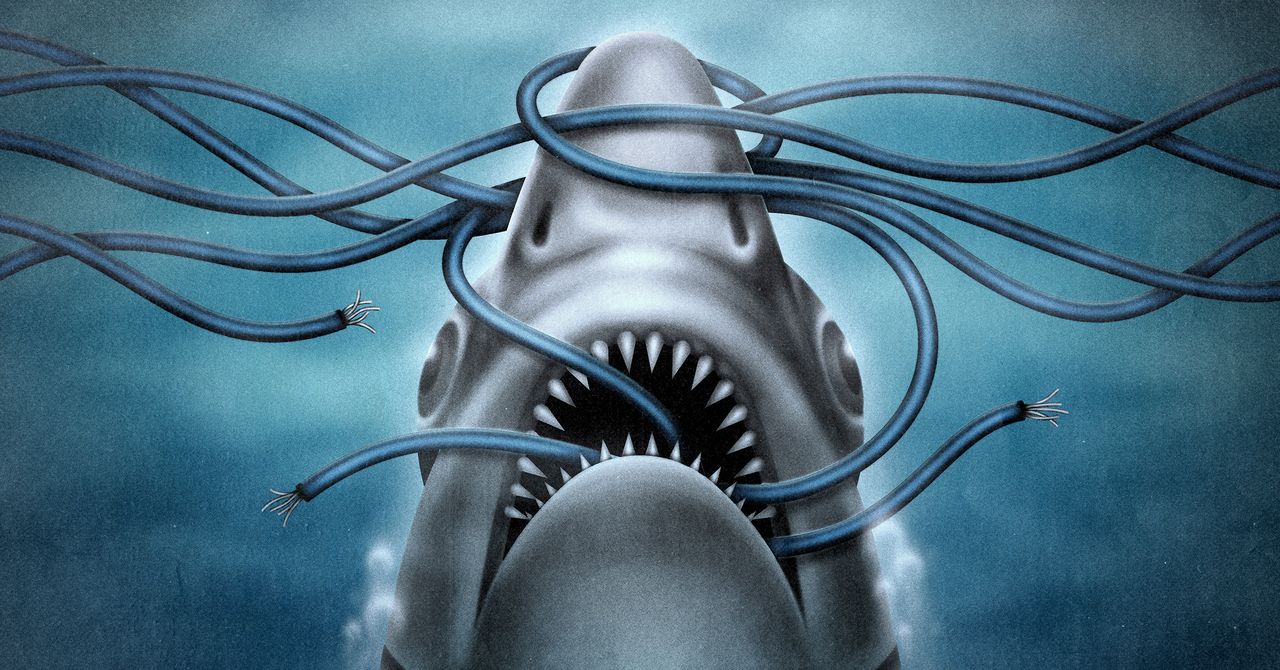
To be clear, there still isn’t consensus that the sharks caused the shunt fault. Sipress wasn’t lying about the teeth, but it’s hard to know what really happened. Stewart Ash, who was part of the UK team at STC, insists that most shark claims really are false. If the Optican-1 was installed with too little slack, though, and hung above the seafloor in some areas, a shark might’ve munched down. “While we at STC didn’t believe it,” he says, “we were swept up in the frustration or fear that sharks could interrupt these very important, brand-new cables.”
To be absolutely sure, AT&T funded research at two aquariums: in Mystic, Connecticut, and Sarasota, Florida, where researchers let some dogfish and lemon sharks get a little hungry and then tested to see if they bit any of several different cables that were emitting electrical fields in different patterns. They didn’t, except in seemingly random cases. (To be certain about this myself, I took my shark-obsessed five-year-old to a local aquarium, where we spent 15 minutes trying to figure out how a friendly 3-foot dogfish, whose mouth looks like the coin slot of an old payphone, could do more than give a cable a soft boop.) Experts also went out into the ocean and pulled different species of sharks onto the deck to force-feed them sections of cable. Sometimes they bit – wouldn’t you? But there was absolutely no pattern.
Still, in the 1980s, despite there being no firm evidence that sharks were attracted to anything specific about the cables, the teams decided it wouldn’t hurt to build TAT-8 with a layer of steel between the polyethylene insulation and the fibres. They sent shark teeth to the NYU School of Dentistry, to have moulds made and mounted onto shark-jaw simulators, which then chomped on sections of cable. The result was that lightweight deep-sea fibre was produced, from the start, with what they called “fish-bite protection”, which helps against abrasions and other types of everyday damage that can happen in the sea .Turns out, we owe sharks a thank you, and probably an apology for the force-feeding.
It’s morning in Leixões. On the deck of the Maasvliet, I hover over a pile of TAT-8’s repeaters. A long-haul submarine telecommunications cable needs repeaters to boost the optical signal to cross the distance, and TAT-8 had more than 100 of them, each encased in a watertight, pressure-tested housing that could survive up to 8,000m down. A rubberised cone stretches from each side of the repeater, sheathing the cable, making the whole piece about 2m long. In a pile, they look like a dead kraken, ready for one last writhe on the dewy deck.