
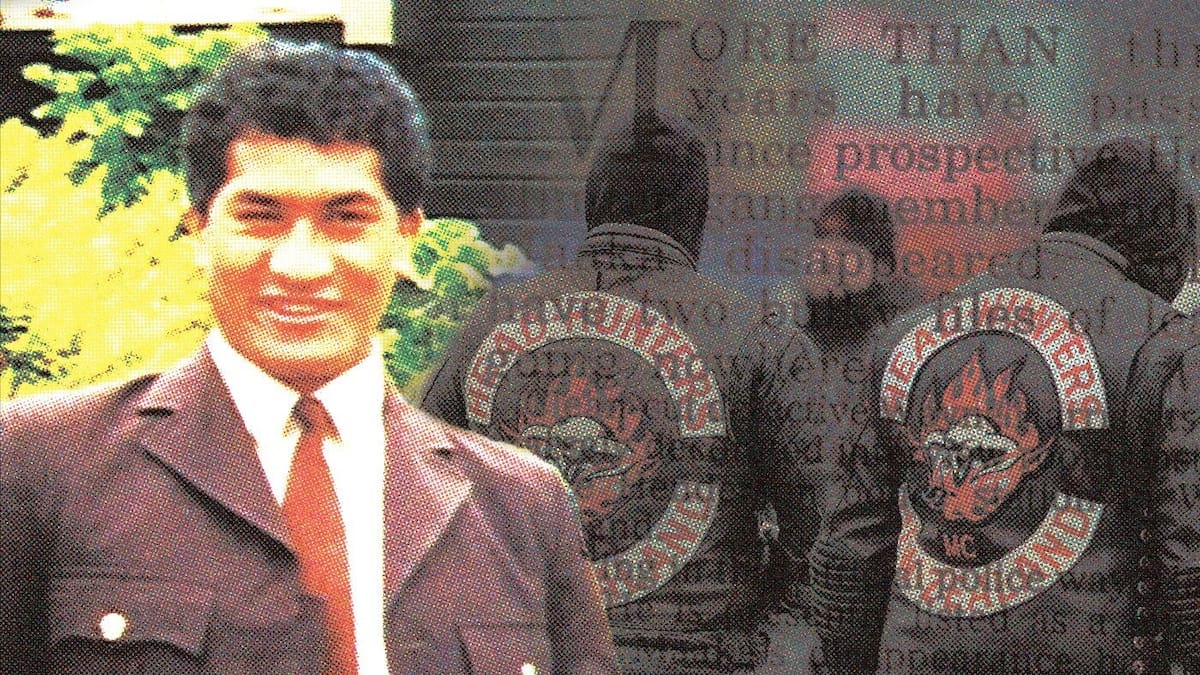
Andrew Maaka – criminal, father of three, a man with dreams of wealth but no obvious legal way of achieving them – vanished in November 1991. He is 33 if still alive, a big Māori with a panther tattooed on his left upper arm. No reported sighting of him has been confirmed.
Like a suicide, a disappearance tortures those left behind trying to pull explanations out of the air.
Maaka’s sister Atawhai Benefield lives with her husband John and their five children, aged 2 to 15, in Birkdale on Auckland’s North Shore. She is a child care worker and John is a civil engineer and, on Saturdays, a periodic detention supervisor. On two evenings the couple clear time in the bustle of family life to talk of the missing man.
“Andrew and I were like that,” says Atawhai, crossing one finger over another. “We were really, really close.”
In 1995, Herald journalist Paul Pankhurst investigated Maaka’s disappearance and the family’s search for answers.
She rang the police in February 1992 to report her brother missing. Now, fear jostles with hope at the Benefield home.
There is a moment when John says: “He’s not with us now.”
Atawhai: “But how do you know? You’re only assuming.”
Later she says: “There’s always hope for me, I feel he’s still out there, I sit down and I think to myself that he was clever. Very clever.”
In another conversation she says: “He had good natural instincts … he could smell trouble a mile away.”
She hopes her brother disappeared to escape some sticky situation and is simply incommunicado.
Not everyone will grieve if Andrew Maaka is dead – and the Benefields know that.
John: “We’re not trying to say he was a knight in shining armour. He was a bloody crook. He was a violent man.”
But that harsh judgment stands alongside better family memories of Maaka, just hanging out, doting on his nephews and nieces.
Atawhai: “I can see him sitting here, playing the guitar, having a few beers.”
John: “He was never malicious to us.”
Maaka and one of his children. Photo / NZ Police
Andrew Michael Maaka was born at Kawakawa in the Bay of Islands, of Ngatihine descent, the eldest of three boys in a family of six. His sister says he was the product of a tough upbringing.
After leaving Bay of Islands College he shifted from job to job as farm hand, bakery worker, freezing worker, security guard and, finally, plastics factory worker.
He lived in Kawiti, Whangārei, Moerewa, Wellington and – from the late 80s – Auckland. Along the way he fathered three children by three women, and began collecting convictions for burglary, receiving and assault.
“Put it this way,” his sister says. “He was a bit of a character. He was always on the go. He was always one step ahead of everyone, even the law,” she laughs.
Maaka wanted wealth – now. John Benefield: “I think he was trying to get where he wanted to go. He wasn’t patient enough to do it by the hard grind, like the rest of us. I think he tried that – but things weren’t happening fast enough for him.”
Sometime in 1990 or 1991 Maaka became a “prospect” for the Head Hunters, a tightly knit interracial gang – the group prefers the term “motorcycle club” – of roughly two dozen full or “patched” members. The “patch” features a horned skull surrounded by flames.
Its headquarters and social meeting place is a building in an industrial area not far from the main shopping strip of Great North Rd. The gang’s roots are in the Glen Innes of the late 60s and early 70s. The president since the late 80s has been long-time member Dave Smith, aged 39, sometimes in the news as a competition-winning Harley Davidson enthusiast.
When the Western Leader newspaper profiled the Head Hunters in 1992, Smith spoke of ambitions for both the gang – such as buying a farm in the country to set up a motorcycle racing venue – and for the members’ children.
“Most of our kids are in the top stream at school. None are hitting the streets or sniffing glue.”
The police hear the gang is looking at buying a hotel out of Auckland. It has had investment interests in food and entertainment businesses. Members have also been involved in debt-collecting.
When the Western Leader reporter asked Smith whether he and the gang were into illegal activities, he said: “That’s like asking a man if he masturbates.”
The reporter retorted: “Well, if he’s honest, he will say ‘yes’.”
Smith laughed.
The Head Hunters headquarters in Henderson, Auckland, where Maaka was last seen in 1991.
It is fair to say the gang retains an aura of menace. “A fairly tough lot,” says one criminal lawyer. “They don’t take many prisoners.”
The police believe Maaka lived at the gang headquarters and at the Scenic Drive, Titirangi, address of one of the members.
After joining, Maaka kept clashing with the police. Detective Harris says: “Inquiries up to the time of his disappearance tended to confirm that he was involved in a number of … in criminal activity, yeah.” This included “suspected drug-related activity.”
Maaka also repossessed cars. In March 1991 he and a member of the gang were arrested on charges of robbing a man of a 1973 Holden Statesman. The charges were dismissed.
A criminal lawyer who had dealings with Maaka calls him “a hothead.”
One Tuesday afternoon in 1991 a police patrol pulled over a car in which Maaka was a passenger on Te Atatu Rd. Police files say Maaka became “extremely abusive” when a constable tried to get the driver’s details. He “kept screaming at the constable that when he saw him off duty he was going to waste him – and demanding that the constable fight him.”
Maaka confronted the constable on the street. Pushing at the constable’s chest, he said: “You want to have a go, let’s do it.” Arrested, he was “extremely violent,” kicking and punching two constables. Handcuffed, he spat. This all led to fresh charges.
When he went missing he faced charges of assault, assault on police, threatening behaviour, threatening to kill, and resisting arrest.
Maaka told his sister and brother-in-law that as a “prospect” he served – not always happily – under one particular patched gang member at any time. He said one of these men stood over him and took a four-wheel-drive Maaka had repossessed.
When Maaka went missing, he was facing charges of assault, assault on police, threatening behaviour, threatening to kill, and resisting arrest.
When Maaka saw the Benefields he was often in a hurry, dashing in and out. They wondered whether he was doing deals – maybe selling drugs – outside his gang involvement.
There was some tension over his idea of the gang being his family. John Benefield: “I straight away said, ‘Well, what are you doing at my dinner table?’”
The last few times the Benefields saw him, he looked thinner, drawn, and the couple later wondered whether he had been taking hard drugs.
Atawhai last saw her brother when he visited on the Labour Weekend of 1991. A member of the gang waited outside. In the kitchen, Maaka grabbed and hugged his sister, an unusual thing for him.
“I said, ‘Are you alright? You’re not in deep trouble are you?’ – something to that effect.” He laughed it off.
On bail, Maaka last reported to the police on the morning of November 4, 1991. The police established he went to a Guy Fawkes party at the Head Hunters’ headquarters the next night. He arranged to meet some people the next day but never showed.
The mother of his youngest child reported that in a “strange” final telephone call in November, Maaka said he would always love them both. He missed his daughter’s fifth birthday the following year.
The police later discovered that the black-and-white Chryiser Valiant Maaka sometimes drove had been sold outside the gang headquarters in December.
After the Benefields reported Maaka missing the police searched the gang headquarters and the Titirangi property – finding a gun and drugs concealed up a tree – and traced the car.
Harris: “Many of Maaka’s criminal associates have been spoken to during the inquiry … most are particularly unhelpful.”
There was “little or no” co-operation from the gang. One member claimed never to have heard of Maaka.
“To date there are no firm leads as to why he disappeared or who – if anyone – was involved,” Harris says.
Maaka with one of his daughters. Photo / NZ Police
The Benefields did some amateur sleuthing. John and one of Maaka’s brothers followed up tips that the missing man had connections with clubs in the Fort St red light district and with an address in Manurewa. Nothing turned up. They hoped to hear from the gang but never did.
Atawhai and Maaka’s former defacto wife visited clairvoyants. John had disturbing dreams. In one, Maaka was shot; in another, his body flew out of the water like a whale. John: “It was starting to get stressful … we had our family to think about.”
It was time to ease off.
Atawhai: “We were breathing him all the time. We had to stand back from it.”
The addition of a daughter helped the family to heal and to come to terms with the disappearance.
Head Hunter leader Dave Smith would not be interviewed for this story. He did not appreciate being approached at his Onehunga home, the first of three approaches I made to the gang.
Standing in the doorway, mobile phone to his ear, he told me: “You’re out of line. Right out of line.”