
There’s a new launcher in town.
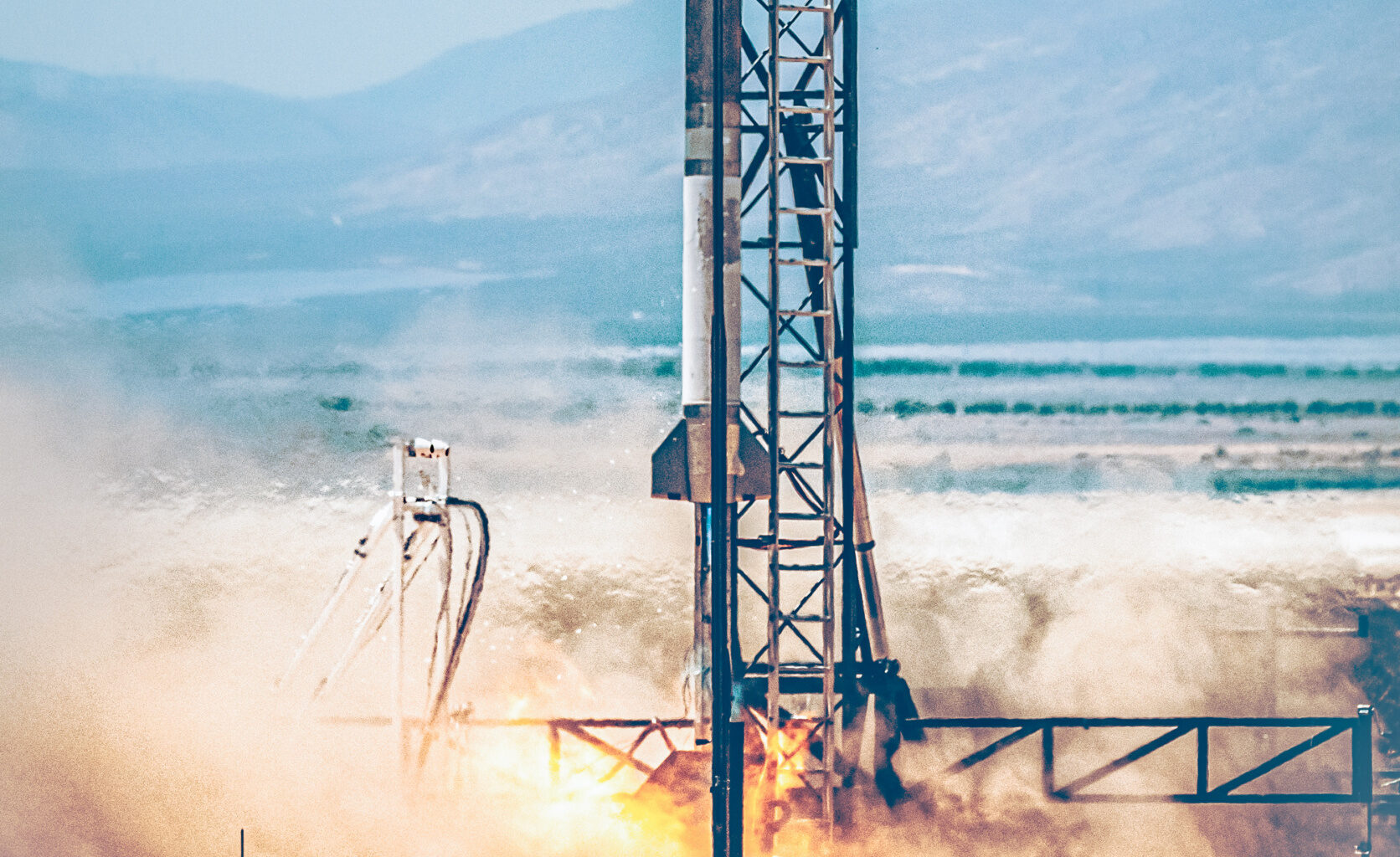
CO-based startup LEAP notched a successful first flight of its Bullfrog suborbital launch vehicle over the weekend, opening the door for up to four more flights this year. It marks one of the first major steps towards a 2028 first flight of its upgraded orbital launch vehicle, called Bighorn.
First time for everything: Bullfrog lifted off from the Friends of Amateur Rocketry pad in Mojave, CA on Sunday, demonstrating a wide array of new tech for the first time, including:
Bullfrog’s thermal protection system, and a GNC system provided by WarpWare;LEAP’s proprietary dual-mode rocket engine that combines boost and vacuum-optimized modes, compressing what is effectively a two-stage system into one;In-house built fuel tanks, using a proprietary forming method, costing just ~$5,000 per tank, according to CEO Chris Beckman.Containerized, transportable launch operations that allowed the rocket to fly less than 30 hours after arriving at the range. Beckman expects future set-ups to take between 12-24 hours.
The rocket reached a maximum altitude of ~40km—a limit set by regulatory limitations at the launch range, though Beckman said flight data showed Bullfrog could’ve reached a max altitude of ~175km.
“We now have validated all of our main system requirements at TRL nine—the engine, the tanks, the avionics, all the critical components we designed in house. From here on out, it’s really just about scalability,” he said.
Meet LEAP: Founded in 2022, LEAP isn’t just building rockets to add to the world’s orbital launch capacity. The company is targeting a new market of rocket-fueled logistics, where customers can deliver critical payloads—think resupplying soldiers or distributing humanitarian aid—anywhere in the world at a rapid pace.
Bullfrog has a small payload capacity of 100 lbs, and is focused on demonstrating point-to-point logistics, hypersonic testing, and suborbital R&D payloads.LEAP’s upgraded Bighorn vehicle is being designed to both access orbit and break into the contested logistics market with greater mass.
Bighorn is designed to carry 1,000 kg of payload up to 7,000 km, or 350 kg of payload to LEO, for $5-10M per launch. The company has funds (from a seed round last April, and follow up round in December) to support operations through three launches of Bighorn, according to Beckman.
What’s next: LEAP’s goal is to churn out 30 rockets per year at its facility in the Rockies. Ultimately, LEAP wants to build as many as six manufacturing facilities around the world to be able to deliver payloads anywhere on the planet. LEAP is in talks with locations in Scotland, Australia, and Alaska to kick things off, Beckman said.
After Bighorn, LEAP plans to scale its ambitions to include a single-use spaceplane, called Puma, and a medium-lift vehicle, called Springbok.
Related Stories

Fenix Space is one step closer to leaving the world behind.
Plans for expansion include building a new satellite sensor factory outside DC, and nearly doubling Scout’s headcount in the next 18 months.
Under the agreement, announced today, the Luxembourg-based company will develop an architecture and use-case road-map for orbital data centers.

Swiss startup DPhi Space hosted Liquid AI’s large language model to analyze an EO image—without first transmitting the image to the ground. That was the first public result of DPhi’s second mission, Clustergate-2, which rode to orbit on a Momentus Vigoride 7 sat in March. The transmission, which was announced today, signifies a new age…
More Stories
 Image: The White House
President Donald Trump likes expensive things. So he’s probably going to love the latest Congressional Budget Office (CBO) report, which estimates the Golden Dome missile-defense system could cost $1.2T over the next 20 years.
The estimate is an order of magnitude larger than the $185B figure proposed by Golden Dome chief Gen. Michael Guetlein in March—in large part because of the “limited information available” about the architecture of the missile defense system. The report explains the discrepancy in one of two ways:
The estimate: Luckily for the US space industry, the cost to acquire and operate a fleet of space-based interceptor (SBI) satellites accounts for ~70% of the estimate.
Load More