

LC Fiber Optic Adapters Market Forecast and Outlook (2025-2035)
The LC fiber optic adapters market is valued at USD 871.1 million in 2025 and is expected to reach USD 1,378.9 million by 2035, growing at a CAGR of 4.7%. From 2021 to 2025, the market grows steadily, from USD 692.4 million to USD 871.1 million, with annual increments through USD 724.9 million, 759.0 million, 794.6 million, and 832.0 million. This growth phase reflects increasing demand for fiber optic connectivity in telecom, data centers, and enterprise networks, as well as a rise in high-speed internet adoption and digitalization efforts.
Quick Stats for the LC Fiber Optic Adapters Market
LC Fiber Optic Adapters Market Value (2025): USD 871.1 million
LC Fiber Optic Adapters Market Forecast Value (2035): USD 1,378.9 million
LC Fiber Optic Adapters Market Forecast CAGR: 4.7%
Leading Mode Type in LC Fiber Optic Adapters Market: Single-mode (60%)
Key Growth Regions in LC Fiber Optic Adapters Market: Asia Pacific, North America, and Europe
Key Players in LC Fiber Optic Adapters Market: Corning, SENKO Advanced Components, Optcore, Amphenol, Molex, Fibertronics
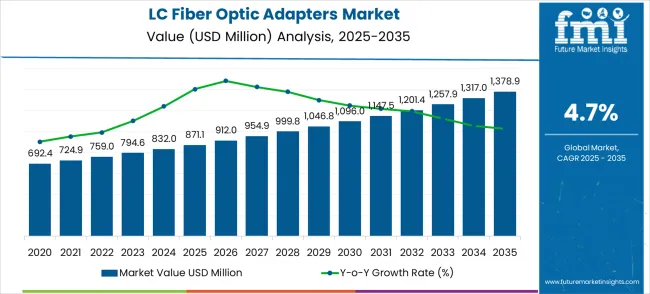
Between 2026 and 2030, the market continues to show solid growth, expanding from USD 912 million to USD 1,096.0 million. The intermediate years see gradual increases through USD 912.0 million, 954.9 million, 999.8 million, and 1,046.8 million. The surge in global broadband infrastructure expansion and the increasing deployment of 5G networks drive the demand for LC fiber optic adapters during this period. Between 2031 and 2035, the market reaches USD 1,378.9 million, with incremental growth through USD 1,147.5 million, 1,201.4 million, 1,257.9 million, and 1,317.0 million. The final years see the benefits of fiber optic advancements in high-capacity, low-latency data transmission, contributing to a steady growth trajectory.
LC Fiber Optic Adapters Market Key Takeaways
Metric
Value
Estimated Value in (2025E)
USD 871.1 million
Forecast Value in (2035F)
USD 1,378.9 million
Forecast CAGR (2025 to 2035)
4.7%
From 2030 to 2035, the market is forecast to grow from USD 1,096.0 million to USD 1,378.9 million, adding another USD 282.9 million, which constitutes 55.7% of the overall ten-year expansion. This period is expected to be characterized by the expansion of 5G network deployments and edge computing infrastructure, the development of advanced high-density connectivity solutions and ultra-low loss adapters, and the growth of specialized applications for cloud computing and artificial intelligence workloads. The growing adoption of hyperscale data centers and distributed network architectures will drive demand for LC fiber optic adapters with enhanced performance and scalability features.
Between 2020 and 2025, the LC fiber optic adapters market experienced steady growth, driven by increasing digital transformation initiatives and growing recognition of LC adapters as essential components for achieving high-density fiber optic connectivity and network performance optimization in modern telecommunications and data center infrastructure. The market developed as network engineers and data center architects recognized the potential for LC adapters to enable space-efficient connectivity while supporting high-speed data transmission and network scalability requirements. Technological advancement in fiber optic connector design and precision manufacturing began emphasizing the critical importance of maintaining signal integrity and connection reliability in high-performance network environments.
Why is the LC Fiber Optic Adapters Market Growing?
Market expansion is being supported by the increasing global demand for high-speed connectivity and the corresponding need for efficient fiber optic infrastructure that can support bandwidth-intensive applications, enable network scalability, and maintain signal integrity across various telecommunications, data center, and enterprise network applications. Modern network operators and infrastructure providers are increasingly focused on implementing connectivity solutions that can support growing data traffic, enable network densification, and provide reliable performance in demanding network environments. LC fiber optic adapters’ proven ability to deliver high-density connectivity, maintain signal quality, and support network scalability makes them essential components for contemporary fiber optic networks and telecommunications infrastructure.
The growing focus on digital transformation and cloud computing is driving demand for LC fiber optic adapters that can support high-bandwidth applications, enable network optimization, and facilitate seamless connectivity in complex network architectures. Network providers’ preference for connectivity solutions that combine high performance with space efficiency and installation simplicity is creating opportunities for innovative LC fiber optic adapter implementations. The rising influence of 5G networks and edge computing is also contributing to increased adoption of LC fiber optic adapters that can provide reliable connectivity without compromising network performance or scalability requirements.
Segmental Analysis
The market is segmented by mode type, application, and region. By mode type, the market is divided into single-mode and multimode. Based on application, the market is categorized into data centers, telecommunications, industrial automation, and others. Regionally, the market is divided into Asia Pacific, North America, Europe, Latin America, and the Middle East & Africa.
By Mode Type, the Single-mode Segment Leads the Market with 60% Share
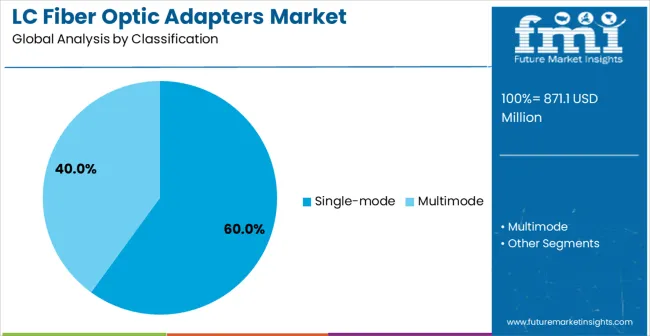
The single-mode segment is projected to maintain its leading position in the LC fiber optic adapters market in 2025, with a 60% market share. Network operators and telecommunications providers increasingly utilize single-mode LC adapters for their superior transmission characteristics, extended reach capabilities, and versatility across long-haul and metropolitan network configurations. Single-mode fiber technology offers proven performance advantages, providing high-bandwidth transmission and long-distance connectivity in diverse telecommunications and data center applications. As the backbone of modern fiber optic network infrastructure, single-mode fiber supports the highest bandwidth capacity and has an established performance record. Continued investments in single-mode fiber systems by network operators and data center providers further drive adoption, positioning these adapters as critical components for scalable, high-performance network strategies.
Superior transmission characteristics for high-bandwidth and long-distance applications.
Proven scalability and high bandwidth capacity for diverse network architectures.
Essential for long-haul and metropolitan network configurations, ensuring reliable connectivity.
By Application, the Data Centers Segment Dominates Market Demand with 45% Share
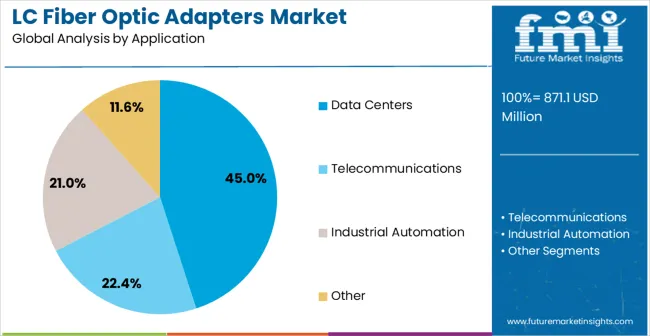
The data centers application segment is projected to represent the largest share of LC fiber optic adapter demand in 2025, capturing 45% of the market. Data center operators prefer LC fiber optic adapters due to their space-efficient design, high-density connectivity capabilities, and ability to support bandwidth-intensive applications. These adapters play a critical role in modern cloud computing facilities, hyperscale data centers, and enterprise server environments. The growing need for scalable network architectures and operational efficiency drives the demand for high-density connectivity solutions. The segment benefits from continuous innovations in data center technologies and specialized solutions that enhance network performance and scalability. As data centers evolve and bandwidth demands increase, the data center segment will remain a dominant driver of LC fiber optic adapter market growth, supporting advanced connectivity and infrastructure optimization strategies.
Space-efficient design for high-density connectivity and optimized data center operations.
Supports high-bandwidth applications and scalable network architectures for large-scale computing.
Integral to the infrastructure of modern data centers, ensuring performance and efficiency.
What are the Drivers, Restraints, and Key Trends of the LC Fiber Optic Adapters Market?
The LC fiber optic adapters market is advancing steadily due to increasing demand for high-speed connectivity and growing adoption of fiber optic infrastructure that provides enhanced bandwidth capacity and network performance across diverse telecommunications and data center applications. The market faces challenges, including intense price competition and margin pressure, technical requirements for precision manufacturing and quality control, and the need for compatibility with evolving network standards and connector technologies. Innovation in high-density connectivity solutions and advanced materials continues to influence product development and market expansion patterns.
Expansion of High-Density Connectivity Solutions and Advanced Materials
The growing adoption of high-density connectivity technologies and advanced material innovations is enabling network providers to achieve superior space utilization, enhanced connection density, and improved signal performance for demanding network applications. High-density connectivity systems provide improved infrastructure efficiency while allowing more connections per unit area and consistent performance across various network configurations and application requirements. Manufacturers are increasingly recognizing the competitive advantages of high-density capabilities for infrastructure differentiation and space optimization.
Integration of Smart Network Management and Monitoring Systems
Modern LC fiber optic adapter manufacturers are incorporating intelligent network management technologies and monitoring capabilities to enhance connection visibility, enable proactive maintenance, and provide comprehensive network performance optimization through integrated monitoring and management platforms. These technologies improve network reliability while enabling new applications, including predictive maintenance and automated network optimization. Advanced integration also allows network operators to support comprehensive infrastructure management and performance optimization beyond traditional passive connectivity approaches.
Analysis of the LC Fiber Optic Adapters Market by Key Countries
Country
CAGR (2025-2035)
China
6.3%
India
5.9%
Germany
5.4%
Brazil
4.9%
USA
4.5%
UK
4.0%
Japan
3.5%
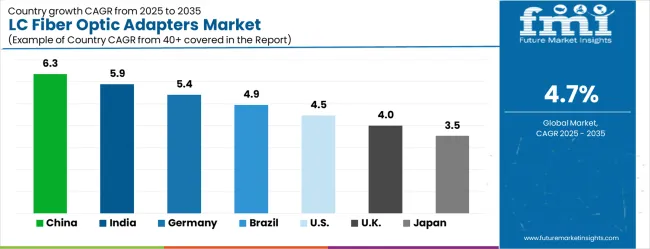
The LC fiber optic adapters market is experiencing solid growth globally, with China leading at a 6.3% CAGR through 2035, driven by the expanding telecommunications infrastructure, growing data center construction, and significant investment in 5G network deployment and fiber optic connectivity advancement. India follows at 5.9%, supported by rapid digitalization initiatives, increasing internet penetration, and growing adoption of fiber optic technologies in telecommunications and enterprise networks. Germany shows growth at 5.4%, emphasizing advanced network technologies and precision fiber optic component manufacturing. Brazil records 4.9%, focusing on telecommunications infrastructure modernization and data center expansion initiatives. The USA demonstrates 4.5% growth, supported by the established data center industry and focus on network infrastructure upgrades. The UK exhibits 4.0% growth, emphasizing telecommunications excellence and fiber optic network advancement. Japan shows 3.5% growth, supported by advanced networking technologies and precision connectivity component development.
The report covers an in-depth analysis of 40+ countries with top-performing countries highlighted below.
LC Fiber Optic Adapters Market Opportunities in China
The LC fiber optic adapters market in China is expected to grow at a CAGR of 6.3% from 2025 to 2035. With the continuous expansion of China’s telecommunications and data center industries, the demand for fiber optic components, including LC fiber optic adapters, is on the rise. The increasing digital transformation, adoption of 5G networks, and growth in cloud infrastructure require high-quality, reliable fiber optic adapters to support faster, more efficient communication. The rapid growth of Internet-of-Things (IoT) devices and the need for more efficient data transmission across various sectors such as healthcare, education, and government contribute to the market’s growth. China’s leadership in manufacturing and technology innovation further supports the demand for fiber optic solutions, ensuring the country remains a key player in the global fiber optic adapter market.
Expanding telecommunications and data center industries driving market growth
Increasing adoption of 5G and IoT devices boosting demand for adapters
Strong manufacturing base ensuring steady supply of fiber optic solutions
LC Fiber Optic Adapters Market Expansion in India
Demand for LC fiber optic adapters in India is forecast to grow at a CAGR of 5.9% from 2025 to 2035. As the country continues to digitize its economy and improve its internet infrastructure, there is growing demand for fiber optic solutions, especially in sectors like telecommunications, data centers, and enterprise IT. The Indian government’s push to expand broadband connectivity and increase internet access in rural and remote areas is a major factor contributing to the market’s expansion. The increasing number of cloud services, data storage requirements, and the adoption of 5G networks in India are further boosting the demand for fiber optic components like LC adapters.
Government initiatives for broadband connectivity driving adoption of fiber optic solutions
Expansion of data storage and cloud services contributing to higher demand
Rising adoption of 5G networks and IoT devices fueling the market
LC Fiber Optic Adapters Market Outlook in Germany
LC fiber optic adapters market in Germany is expected to expand at a CAGR of 5.4% from 2025 to 2035. Germany, as a leading European economy, has a well-established telecommunications infrastructure that demands high-quality fiber optic components. The country’s rapid adoption of 5G technology, coupled with its growing data center industry, is driving the need for efficient and reliable fiber optic solutions. Germany’s automotive industry, which is increasingly adopting connected vehicle technologies, also requires fast and reliable communication systems supported by fiber optics. As digital transformation continues across various sectors, including manufacturing and healthcare, the demand for LC fiber optic adapters will grow.
Strong 5G adoption and expanding data centers fueling market growth
Growing automotive sector requiring fiber optic solutions for connected technologies
Digital transformation in industries like healthcare and manufacturing driving demand
LC Fiber Optic Adapters Market Trends in Brazil
The LC fiber optic adapters market in Brazil is projected to grow at a CAGR of 4.9% from 2025 to 2035. As the largest economy in Latin America, Brazil is witnessing an increase in its telecommunications infrastructure to meet the growing demand for fast, reliable internet services. The government’s efforts to expand broadband connectivity and improve internet speeds, especially in underserved areas, are positively impacting the market. Brazil’s industrial sector, particularly in energy, manufacturing, and agriculture, is also adopting digital solutions that require high-performance fiber optic networks. The increasing usage of fiber optics in cloud computing and IoT applications is further driving the demand for LC fiber optic adapters.
Government efforts to improve broadband infrastructure expanding market potential
Growing adoption of fiber optic networks in industrial sectors boosting demand
Increased use of IoT and cloud computing driving need for efficient adapters
LC Fiber Optic Adapters Market Adoption in the USA
The LC fiber optic adapters market in the USA is anticipated to grow at a CAGR of 4.5% from 2025 to 2035. The USA continues to be a major consumer of fiber optic technology due to its highly developed telecommunications, data center, and cloud industries. The demand for LC fiber optic adapters is driven by the need for faster internet speeds, lower latency, and efficient data transmission across various sectors, including government, healthcare, and financial services. The rapid expansion of 5G networks and IoT applications in the country is contributing to the demand for fiber optic components.
High demand for fiber optic solutions driven by advanced telecommunications and data center industries
Expansion of 5G networks and IoT applications boosting market demand
Need for low-latency, high-speed communication systems driving adoption of fiber optic adapters
LC Fiber Optic Adapters Market Growth in the UK
The LC fiber optic adapters market in the UK is forecasted to expand at a CAGR of 4.0% from 2025 to 2035. As the UK accelerates its digital transformation, the demand for reliable fiber optic solutions continues to increase. The government’s push to enhance broadband connectivity and the rapid rollout of 5G networks are key factors driving the market. The UK’s growing data center and cloud computing industries require high-performance fiber optic components, including LC adapters, to support their infrastructure. The demand for fiber optic solutions is also rising in sectors such as healthcare and education, where reliable, fast communication networks are critical.
Government initiatives for broadband expansion driving market adoption
Growth in data centers and cloud services increasing the need for fiber optic adapters
Rising demand in healthcare and education sectors pushing market growth
LC Fiber Optic Adapters Market Insights in Japan
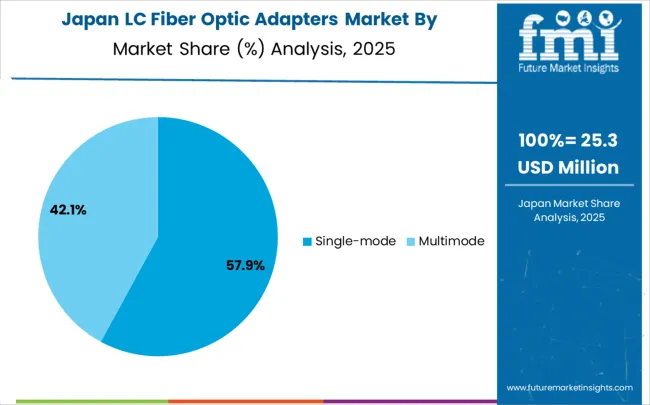
The LC fiber optic adapters market in Japan is expanding at a CAGR of 3.5% from 2025 to 2035. Known for its technological innovations, Japan is experiencing significant demand for fiber optic solutions, particularly in its telecommunications, automotive, and manufacturing sectors. The country’s commitment to expanding 5G networks and the increasing adoption of IoT applications are major contributors to the market’s growth. Japan’s focus on high-speed internet and low-latency communication is driving the need for efficient and reliable fiber optic adapters. As digitalization progresses in Japan, the demand for these components will continue to rise.
Rapid 5G rollout and IoT adoption driving fiber optic solutions demand
High-speed communication needs in telecommunications and manufacturing sectors expanding market
Increased demand for low-latency, high-performance solutions supporting growth
Europe Market Split by Countries
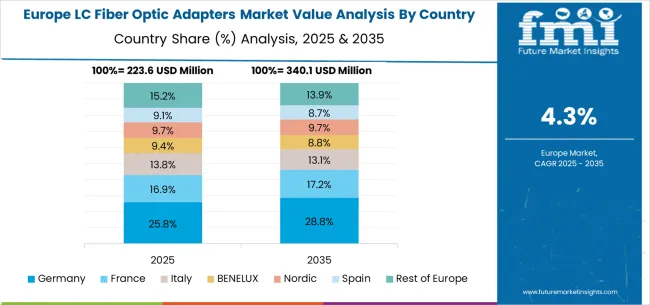
The LC fiber optic adapters market in Europe is projected to grow from USD 300.7 million in 2025 to USD 463.8 million by 2035, registering a CAGR of 4.4% over the forecast period. Germany is expected to maintain its leadership position with a 26.0% market share in 2025, moderating slightly to 25.8% by 2035, supported by its strong telecommunications sector, advanced network infrastructure, and comprehensive fiber optic connectivity ecosystem serving major European markets.
The United Kingdom follows with 21.0% in 2025, projected to reach 20.8% by 2035, driven by established telecommunications excellence, a comprehensive network modernization framework, and advanced connectivity infrastructure programs. France holds 18.5% in 2025, rising to 18.7% by 2035, supported by telecommunications infrastructure leadership and growing adoption of advanced fiber optic connectivity technologies. Italy commands 14.0% in 2025, projected to reach 14.1% by 2035, while Spain accounts for 9.0% in 2025, expected to reach 9.1% by 2035. The Netherlands maintains a 4.5% share in 2025, growing to 4.6% by 2035. The Rest of Europe region, including Nordic countries, Eastern Europe, and other markets, is anticipated to maintain its position, holding its collective share at 7.0% by 2035, attributed to increasing telecommunications modernization and growing fiber optic connectivity adoption across emerging network markets implementing advanced connectivity standards.
Competitive Landscape of the LC Fiber Optic Adapters Market
The LC fiber optic adapters market is characterized by competition among established telecommunications component manufacturers, specialized fiber optic connectivity companies, and integrated network solution providers. Companies are investing in advanced fiber optic technology research, precision manufacturing, quality assurance, and comprehensive product portfolios to deliver reliable, high-performance, and cost-effective LC fiber optic adapter solutions. Innovation in high-density connectivity, advanced materials, and precision manufacturing technologies is central to strengthening market position and competitive advantage.
Corning leads the market with comprehensive fiber optic solutions, offering advanced LC adapters with a focus on signal integrity and network performance optimization across diverse telecommunications and data center applications. SENKO Advanced Components provides specialized fiber optic connectivity products with an focus on precision manufacturing and high-density applications. Optcore delivers innovative connectivity solutions with a focus on data center and enterprise network requirements. Amphenol specializes in comprehensive connectivity technologies with focus on reliability and performance. Molex focuses on advanced connectivity solutions with focus on innovation and network optimization. Fibertronics offers specialized fiber optic products with a focus on precision and application versatility.
LC Fiber Optic Adapters Market – Stakeholder Contribution Framework
LC fiber optic adapters represent a critical connectivity component within telecommunications and data center infrastructure, projected to grow from USD 871.1 million in 2025 to USD 1,378.9 million by 2035 at a 4.7% CAGR. These precision-engineered connector interfaces-primarily single-mode configurations for long-distance, high-bandwidth applications-enable high-density fiber optic connections in data centers, telecommunications networks, and industrial automation systems. Market expansion is driven by accelerating data center construction, 5G network deployment, cloud computing infrastructure growth, and increasing demand for bandwidth-intensive applications requiring reliable, space-efficient connectivity solutions.
How Telecommunications Regulators Could Enhance Network Infrastructure Development?
Fiber Infrastructure Standards: Establish comprehensive technical standards for fiber optic connectivity, including LC adapter specifications, performance requirements, and interoperability guidelines that ensure consistent network quality and facilitate equipment compatibility across different vendors and applications.
5G Network Deployment Support: Develop regulatory frameworks and permitting processes that accelerate fiber backhaul infrastructure deployment, including streamlined rights-of-way access, tower co-location policies, and infrastructure sharing arrangements that reduce deployment costs and timeline barriers.
Digital Infrastructure Investment: Create investment incentives, tax benefits, and regulatory support for telecommunications providers upgrading network infrastructure with high-performance fiber optic connectivity that supports next-generation services and bandwidth requirements.
Quality Assurance Requirements: Implement mandatory testing and certification protocols for fiber optic components used in critical network infrastructure, ensuring LC adapters meet stringent performance, reliability, and durability standards for telecommunications applications.
International Harmonization: Coordinate with global regulatory bodies to develop unified standards for fiber optic connectivity components, enabling economies of scale in manufacturing and facilitating international trade in telecommunications equipment and infrastructure.
How Industry Standards Organizations Could Advance Technology and Interoperability?
Connector Performance Standards: Develop rigorous specifications for LC adapter insertion loss, return loss, durability, and environmental performance that ensure consistent quality across manufacturers and enable reliable network performance in diverse operating conditions.
High-Density Integration Guidelines: Establish standards for high-density fiber optic connectivity solutions, including spacing requirements, thermal management considerations, and cable management protocols that optimize data center and network equipment design.
Testing and Certification Protocols: Create comprehensive testing procedures for LC adapter performance validation, including automated testing requirements, quality control processes, and certification criteria that ensure products meet industry performance expectations.
Emerging Technology Integration: Guide development of next-generation LC adapter technologies, including bend-insensitive fiber compatibility, ultra-low loss specifications, and high-temperature operation capabilities that support advanced network applications.
Interoperability Assurance: Develop cross-vendor compatibility testing programs, reference designs, and interface specifications that ensure LC adapters from different manufacturers work seamlessly together in complex network environments.
How Component Manufacturers Could Drive Innovation and Market Leadership?
Advanced Manufacturing Precision: Invest in ultra-precision manufacturing technologies, automated quality control systems, and advanced materials science that enable production of LC adapters with superior optical performance, dimensional accuracy, and long-term reliability.
High-Density Solution Development: Engineer innovative LC adapter designs supporting maximum port density, improved thermal management, and enhanced serviceability that address space constraints in modern data centers and network equipment.
Performance Enhancement Technologies: Develop next-generation LC adapters with ultra-low insertion loss, enhanced return loss performance, and improved durability characteristics that support demanding applications and extend equipment lifecycles.
Smart Connectivity Integration: Incorporate intelligent monitoring capabilities, diagnostic features, and IoT connectivity that enable real-time performance monitoring, predictive maintenance, and automated network management through connected LC adapter systems.
Sustainable Manufacturing Practices: Implement environmentally responsible production processes, recyclable materials, and sustainable packaging that address growing corporate sustainability requirements while maintaining cost competitiveness and performance standards.
How Data Center Operators Could Optimize Infrastructure Efficiency?
Strategic Connectivity Planning: Develop comprehensive fiber infrastructure strategies incorporating LC adapter density optimization, future capacity planning, and modular expansion capabilities that support growing bandwidth demands and equipment evolution.
Performance Monitoring Systems: Implement advanced monitoring and management platforms that track LC adapter performance, identify potential issues, and optimize network connectivity through real-time visibility and predictive analytics capabilities.
Standardization Programs: Establish unified LC adapter specifications, approved vendor lists, and quality requirements that ensure consistent performance, simplify procurement processes, and reduce compatibility risks across data center facilities.
Maintenance Excellence: Develop specialized maintenance procedures, cleaning protocols, and replacement programs specific to LC adapter maintenance that maximize uptime, prevent signal degradation, and extend connector lifecycles.
Capacity Management Optimization: Utilize data analytics and capacity planning tools to optimize LC adapter utilization, predict future connectivity requirements, and plan infrastructure upgrades that support business growth and technology evolution.
How Network Equipment Manufacturers Could Enhance System Integration?
Design Integration Excellence: Develop network equipment with optimized LC adapter integration, including improved port density, enhanced cooling solutions, and simplified cable management that maximize performance and serviceability in demanding applications.
Quality Partnership Programs: Establish strategic relationships with LC adapter manufacturers for joint product development, quality assurance collaboration, and performance optimization that ensures optimal compatibility and system-level performance.
Testing and Validation: Implement comprehensive system-level testing programs that validate LC adapter performance in actual network equipment applications, ensuring reliability and performance under real-world operating conditions.
Technical Support Services: Provide comprehensive installation guidance, troubleshooting resources, and performance optimization consulting that help customers achieve optimal results with LC adapter implementations in complex network environments.
Innovation Collaboration: Partner with component manufacturers on next-generation connectivity solutions, emerging technology integration, and advanced system architectures that push the boundaries of network performance and capability.
How Investors and Financial Enablers Could Support Market Evolution?
Technology Innovation Funding: Finance development of breakthrough LC adapter technologies, including advanced materials research, precision manufacturing automation, and next-generation optical performance capabilities that maintain competitive differentiation.
Manufacturing Scale Investment: Support production capacity expansion, automation upgrades, and quality system enhancements that enable manufacturers to meet growing demand while maintaining cost competitiveness and quality standards.
Market Expansion Capital: Provide funding for manufacturers expanding into emerging markets, establishing regional production facilities, and developing localized solutions that address specific market requirements and cost structures.
Research and Development Partnerships: Fund collaborative initiatives between component manufacturers, network equipment companies, and research institutions focused on advancing fiber optic connectivity science and next-generation network architectures.
Digital Infrastructure Investment: Support telecommunications providers and data center operators in large-scale infrastructure upgrades that drive demand for high-performance LC adapters while enabling advanced network services and capabilities.
Key Players in the LC Fiber Optic Adapters Market
Corning
SENKO Advanced Components
Optcore
Amphenol
Molex
Fibertronics
CommScope
L-com
Alantek
Techlogiks
Leviton
Digisol
Schneider Electric
Precision Fiber Products
US Conec
Furukawa Electric
WCFO
Huber+Suhner
Suncall
Rosenberger
OPTOKON
Sylex
Prysmian
Panduit
Radiall
Belden
SANWA
T&S Communications
YOFC
HYC
Scope of the Report
Items
Values
Quantitative Units (2025)
USD 871.1 million
Mode Type
Single-mode, Multimode
Application
Data Centers, Telecommunications, Industrial Automation, Others
Regions Covered
Asia Pacific, North America, Europe, Latin America, Middle East & Africa
Countries Covered
China, India, Germany, Brazil, the United States, the United Kingdom, Japan, and 40+ countries
Key Companies Profiled
Corning, SENKO Advanced Components, Optcore, Amphenol, Molex, and Fibertronics
Additional Attributes
Dollar sales by mode type and application category, regional demand trends, competitive landscape, technological advancements in fiber optic systems, high-density connectivity development, precision manufacturing innovation, and network performance optimization