
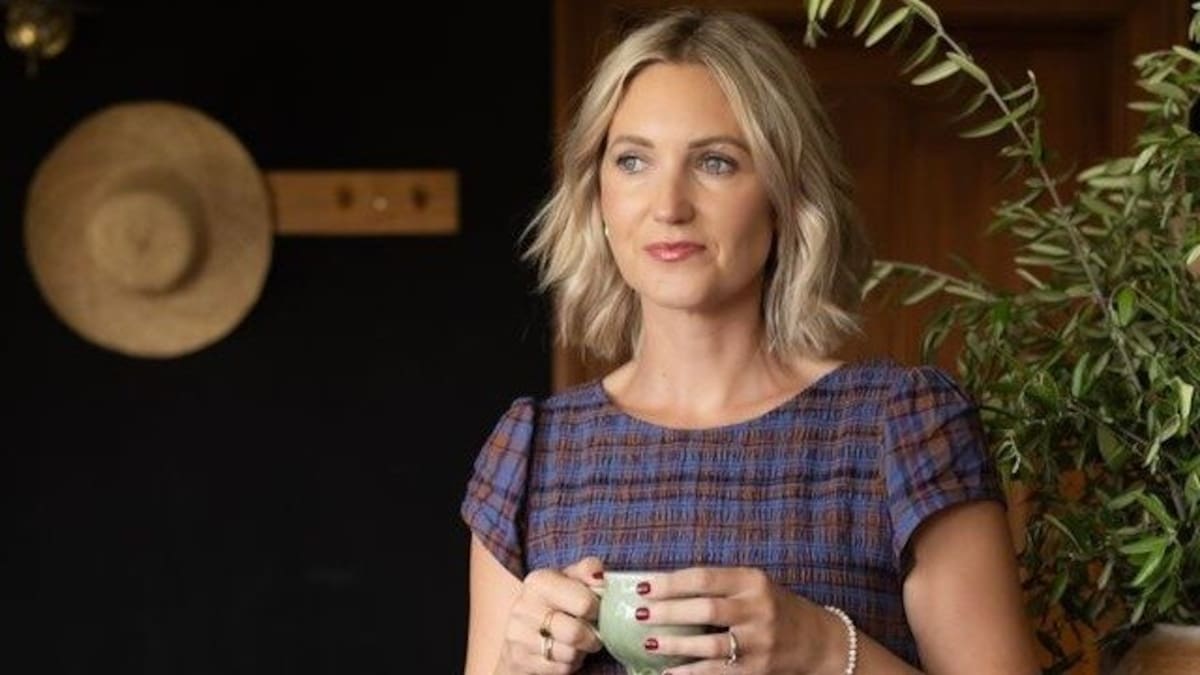
“I’m really grateful to be feeling well and healthy and have my energy back again,” she said.
“Even though my scans are clear, I’m really prioritising any kind of preventative stuff for any recurrence.”
While undergoing treatment, she grew Odi and created educational content on her social media channels.
“I definitely had to sit down for a short period of time while I went through some treatments, but it’s also enabled us to build a team,” she said.
Urlich started Odi from her kitchen table in Havelock North nearly five years ago, using her own children as “taste-testers” while developing wholefood-based products for babies and young children.
“It’s actually great having real-life taste-testers, and they can be the fussiest ones as well,” she said.
Now the brand is stocked in major supermarkets and independent health food stores across New Zealand.
Gina Urlich with Odi products, now stocked in supermarkets and health food stores across New Zealand.
Urlich said her long-term goal was to reduce diet-related disease and improve children’s health outcomes.
“Having an impact on children’s health is having an impact on the future of New Zealand,” she said.
“We would really love to see regulations put in place that support children’s health.”
Urlich said stronger nutritional standards and clearer food labelling were needed.
“The exposure across multiple everyday foods that are marketed for children is what worries me,” she said.
“Some of these in other countries come with a warning label, but in New Zealand, we don’t have any regulations. And in fact, we do the opposite. There’s a lot of health halos on these products.”
Urlich said she regularly saw parents confused by marketing terms such as “natural”, “organic” and “no added sugar”, which did not automatically mean a product was nutritious.
She encouraged families to look closely at ingredient lists and prioritise foods with iron, protein and healthy fats, especially for babies and young children.
“From 6 months, iron becomes non-negotiable for brain development,” she said.
Food Standards Australia New Zealand (FSANZ) said certain categories of baby food products, including baby formula, infant cereals and ready-to-eat infant foods, already had rules around nutrients and labelling.
However, the agency said there are currently no minimum nutrition requirements for general commercial foods marketed as suitable for infants and young children.
FSANZ also said claims such as “no added sugar” must meet specific rules, while terms like “natural” and “organic” are covered under consumer protection laws.
The agency said reviews into children’s food regulations and front-of-pack labelling systems, including the Health Star Rating system (HSR), were already underway.
“The HSR system is an interpretive front-of-pack labelling system that summarises a food’s overall nutritional profile using a simple star rating,” it said.
“It is intended to be used by consumers in conjunction with other information available on food labels, including the Nutrition Information Panel.”
Ulrich said she had seen the impacts of poor nutrition first-hand through her clinical work, including behavioural struggles, low energy levels, eczema, allergies and dental decay in children.
The ideal lunchbox, she said, should focus mainly on whole foods like fruit, boiled eggs, carrot sticks, hummus and whole grains.
Gina Urlich with her youngest daughter, Billie Urlich, 6, preparing healthy lunchboxes for the family.
Ulrich said healthier eating was not about perfection, but gradual changes.
“A lot of these foods have the perfect combination of sugar, salt and flavours, which makes them very addictive,” she said.
“I don’t want to put too much pressure on parents that they have to change everything overnight. It’s just slow changes day to day. So, if they’re having a daily yoghurt, how can we switch that to something that doesn’t have the added preservatives and sugar?”
Gina Urlich having dinner with her family at home. The mother of four continues balancing preventive treatment, business and writing a book about her personal journey.
Alongside preventive treatment, motherhood and running a growing business, Urlich has also added another project to her routine: writing a book.
“That’s just a bit of a passion project in the background for me,” she said.
“Sharing the enormity of what I’ve been through has been quite healing.”