

Analysis: The latest estimates of New Zealand’s proven gas reserves are a grim sight for industries and businesses dependent on abundant and cheap supply.
Released Thursday, the figures show proven reserves have tumbled for the fifth consecutive year, down to just 605 petajoules (PJ). That’s a 25 percent decline from last year’s 808 PJ and a decline of two thirds since 2021.
Half of the fall is clearly explained. New Zealand produced just over 100 PJ of gas last year. The rest, however, has vanished from our underground reservoirs without ever so much as glimpsing the business end of a production tube.
In fact, in the past four years, proven reserves have fallen by 1055 PJ – and we’ve produced just 518 PJ of gas in that time. What’s going on?
Put simply, it turns out we have far less commercially recoverable gas than we once thought.
Since 2021, 538 PJ of proven reserves have been downgraded to merely probable or possible. That’s greater than the amount of gas burned over that period.
Perhaps the largest losses have come from the Pohokura field, which came online 20 years ago. It was for a time New Zealand’s biggest producer, overtaking the country’s largest field, Maui.
By 2017, Pohokura was producing 10 terajoules every hour – enough to fuel the country’s accommodation and food services sector for a day and a half.
The next year, it suffered an unplanned outage and never really recovered. According to Thursday’s figures, Pohokura now produces just 50 terajoules a day – taking 24 hours to provide what it used to in five hours. The Maui field, too, began to tail off. It’s now expected to close this year.
Part of this decline has been offset by unexpected additional production in other fields, like Mangahewa and Turangi, but the overall story is one of a rapid collapse in reserves. Gas production has fallen from a post-Pohokura peak of 207 PJ in 2014 to just 104 PJ last year – the lowest level since 1983.
New Zealand’s reserves are given three grades: Proven, meaning there’s a 90 percent chance they’ll be produced; probable, meaning there’s a 50 percent chance they’ll be produced; and possible, which have just a 10 percent chance of coming to market. Then there are contingent resources – known reserves that aren’t commercially recoverable.
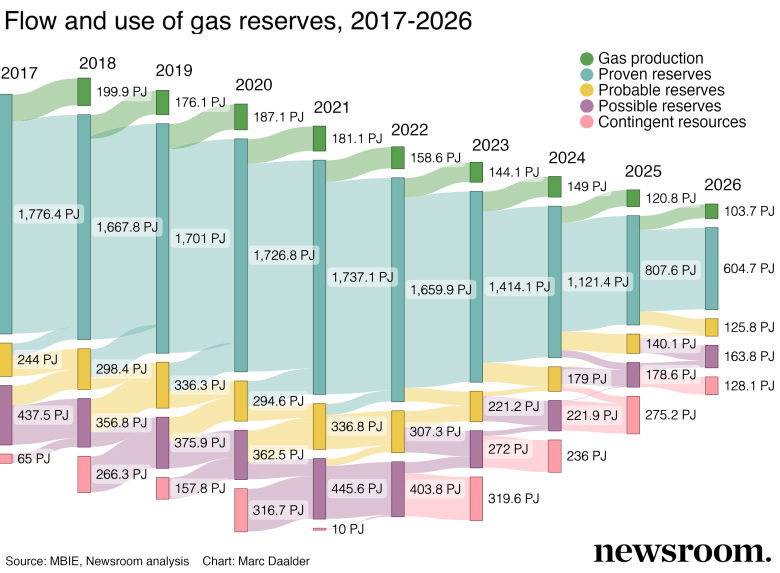
Generally, as proven reserves are produced, operators drill new wells to upgrade probable reserves to replace them. Over time, gas flows up the categories, from contingent to possible to probable to proven and then, ultimately, to production.
That pattern began to reverse in 2022, when 102 PJ of proven reserves were downgraded to probable, 188 PJ of probable down to possible and 320 PJ of possible were deemed no longer commercial.
Since then, each year has seen a downgrading of gas reserves. In 2024, for the first time, more proven reserves were downgraded than actually produced.
The trend slowed slightly last year due to aggressive investment in new development, but 99 PJ of proven reserves and 113 PJ of probable reserves were still downgraded.
The Government and fossil fuel lobby were quick to announce on Thursday that these latest figures were evidence of the need to double down on gas.
“Lower reserves mean New Zealand needs to go all in on petroleum,” said Energy Resources Aotearoa, the oil and gas industry group.
Energy Minister Simeon Brown said the figures reinforced the need for the Government’s $200 million subsidy for offshore oil and gas development and investigation of a gas import terminal.
Both pointed to the previous government’s oil and gas ban, blaming it for the present decline.
But that ban only came into effect in 2018. No offshore gas field has ever moved from receding an exploration licence to production in less than a decade in New Zealand, meaning we’re still two years out from when such gas might be coming online even if there had been a find in a block offered that year – and it’s worth noting there wasn’t a commercial find of offshore gas for nearly two decades before the ban was implemented either.
By 2028, when such a find might have come to market under the most optimistic assumptions, officials now expect New Zealand will be producing just 65 PJ a year. The damage will already have been done, with two thirds of the gas demand that existed a decade ago having now converted to other energy sources or closed down.
Could the ban be responsible for the present situation because it chilled the market, leading to less investment in new development? It’s certainly a theory worth exploring – but it doesn’t hold up under investigation.
In the five years before the ban was introduced, the industry drilled 37 development wells at a cost of $1.4 billion. In the five years after the ban, the industry drilled 54 such wells at a cost of … $1.4 billion.
That does not give the impression of a chilled market, by any means.
Indeed, nearly $2 billion has been spent on drilling since the ban was imposed with relatively little to show for it. Development of some fields has slightly stemmed the bleed from gas reserves in recent years but they are still depleting rapidly – primarily from reevaluation rather than production and use.
It is becoming increasingly apparent that New Zealand just doesn’t have a great gas resource. It’s there, it just by-and-large costs more to produce than people are willing to pay for it.
We got lucky with Maui and have done well with what was available from Pohokura, Kupe and a handful of other large fields. But billions of dollars have been spent looking for more and we just haven’t found it.
The choice facing New Zealand now is whether to double down and throw another couple billion dollars (including $200 million of taxpayer money) at it, leaving gas users to fend for themselves as prices rise and supply dwindles; or whether to admit there’s no future in gas.
In its annual report on the New Zealand economy last year, the OECD urged the latter.
“Given limited opportunities in Taranaki and high-risk prospects elsewhere, the likelihood of major new discoveries is low. Experience in New Zealand and OECD countries shows that large developments rely on foreign joint ventures, which are unlikely to return without compelling prospects,” it found.
“Affordability will remain elusive without breaking the gas-electricity price link by scaling non‑gas long‑duration firming, expanding demand response and strengthening competition.”
The traditional elements of the energy trilemma – security, affordability and sustainability – no longer need to be traded off against one another but are now aligned.
New Zealand can pursue a future of cheaper energy, unconstrained by geopolitical chaos, by seeking power from the sun and the wind. Or we can try drilling … again.