
Day 2 of the Auckland Writers Festival was a massive success, pretty much entirely so, as thousands made their way to the Aotea Centre and packed out events both obscure and populist, with a radical change in the complexion and age of the demographic. Opening day, on Friday, was 97.8 per cent white and 65 per cent pensioned. Saturday’s average age dropped to approximately 49.6 and whitey formed approximately 71 per cent. And so it was younger and more diverse and more exciting, the festival really hitting its stride, events for kids, musical interludes, books flying out the door, signing queues stretching towards the door, plus I found a secret cache of chocolate lamingtons and looted it like a good ‘un.
I attended four events, one compulsorily so: my own session at 1pm, talking about Polkinghorne matters at a sold-out event in the Hunua Room. I repeat the exercise on Sunday, at 10m, as the only author with two sessions on the same subject. Such is the enduring appeal of the murder trial I wrote about in my book Polkinghorne. I expect there will be a change of pace at tomorrow’s event. The chair is criminal defence lawyer Lorraine Smith. Lorraine is a sweetheart of defence law, a living saint who always believes in the rights and presumption of innocence of not just her own clients but everyone charged with a serious crime. The chair on Saturday was another lawyer, Lady Deborah Chambers KC. She had it in for Polkinghorne, who was found not guilty of murder at his remarkable trial in 2024. She wasn’t having a bar of my open mind about the verdict. She went about it with blazing charisma. What a star she is, a girl of the golden east (Remuera), a Lady of the Realm who is at once regal and a shitstirrer; what I’m trying to say is that she stole my own show. Fortunately there was a long signing queue after the event. Everyone was very nice and I had a good chat with a key prosecution witness who had known “Polk” very well, before what happened, before he was shunned for the rest of his natural life.
The undoubted star of the day was Witi Ihimaera. Everyone was talking about him. They talked about him with shining eyes. He has published a new memoir, Te Kaikaukau | The Swimmer: I te Ao o te Reo, but he is not so much an author these days as a cultural figure of immense importance. I can testify to Witi as a natural phenomena in daily life. We both live in the same neighbourhood (postcode 1011) and every time I run into him at the shops I feel in the presence of someone special, a wise, gentle, considerate village elder. I was told that he radiated charisma with extreme force at his event on Saturday morning. He talked about his life, his journey between Pākehā and Māori, between youth and old age. He honoured the memory of his father when he stood with chair Stacey Morrison and led her into song. Stacey cried, Witi cried—apparently everyone was in tears. The extraordinary beauty of it continued after his event at the signing table. He signed his new memoir his memoir Te Kaikaukau | The Swimmer: I te Ao o te Reo for 90 minutes. 90 minutes! In all my years of mooching around the AWF, the only other writers I can think of who have attracted such devotion and patience are Haruki Murakami and the since-cancelled Neil Gaiman.
I missed Witi’s 10am event at the immense Kiri Te Kanawa Theatre. I was at a strange and kind of unsatisfying event elsewhere. Luke Kemp is the author of Goliath’s Curse: The History and Future of Societal Collapse. Yes, catchy title, and I was further impressed when chair Julia Wheeler told the audience he works at the Centre of Existential Risk at Cambridge. Where do you work? As well, Kemp looked like one sexy motherf**ker with his tan, his firm jaw, his dark hair—there was a resemblance to Tom Cruise, the Tom Cruise of Top Gun (original version). He wore jeans and an open-necked white shirt. He sat with his legs apart. He leaned forward. He talked at length, giving long answers, always engaged with the subject. What I’m saying is that he was a bit of a bore.
It was lecture, thankfully interrupted and lightend by Wheeler, a former BBC journalist who was funnier than Kemp, better spoken with her posh King’s English. Kemp is Australian. He tended to swallow his vowels, and his monologues had a slurring quality. But he had plenty of zingers in his central thesis that the cradles of civilisation were actually f**ked and laid down the framework for our current empires, which are f**ked. “Ancient Egypt,” he said, “is a story of organised crime, not a story of civilisation.” And this, on ancient Rome: “It was essentially a pyramid scheme.” And this, on Trump’s America: “It’s a thermo-nuclear monarchy.” Kemp came across as an academic who wrote advertising copy. He had a good line that contradicted the notion that billionaires isolated in bunkers have the right idea on how to survive an apocalypse. “It’s actually going to be,” he said, “survival of the friendliest.” Sharing resources, making alliances. In the meantime, life is one polycrisis after another.
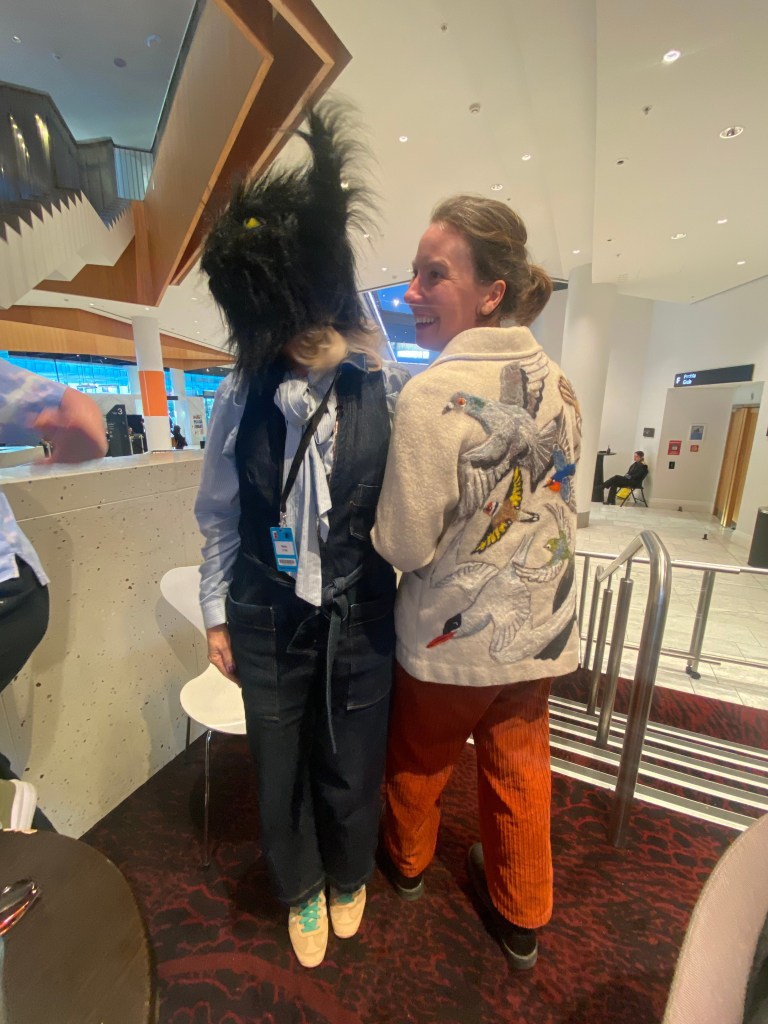 Children’s authors Stacy Gregg, wearing a cat’s head that she modelled at her event for young readers, and Giselle Clarkson, wearing a jacket that she felted with pictures of birds.
There are an incredible 157 events at the 2026 AWF. Aotea Centre would collapse into chaos but for the steady nerves and calming intelligence of the volunteer staff, who direct traffic and make the trains run on time. They set the tone for the festival. Backstage, tech people sorted out headsets; in the VIP lounge and writers room, caterers prepared a great big helping of roasted agria sweet potatoes with parsnip, carrot, lettuce, cranberries, toasted almonds and balsamic vinegar. I gave it a wide birth. My only fuel was black filter coffee, Peroni, chocolate lamingtons, and something somebody gave me to stay alert before my Polkinghorne session—I had woken up at 4:30am, was unable to get back to sleep, and was exhausted by the time of my 1pm event. I put in a call to a mobile pharmacist and bounded onto the stage like a good ‘un.
I ran into Simon Wilson later in the afternoon, and congratulated him for his handling of Ian McEwan on Friday night. I asked him about his daring idea to quote a damning review of McEwan’s latest novel (“melodramatic”) quite early in their session. “Yeah, thanks, Simon,” said McEwan, with a sour twist of his mouth. It could have torpedoed the hour to come but Wilson was confident that his guest would take it in his stride. He did. Many chairs veer to the middle of the road and only ever praise, flatter, agree. It can be a terrible bore. Huzzah to Wilson for his challenging tactic.
A different style was in place on Saturday when Petra Bagust chaired Mick Herron (Slow Horses) and Catherine Chidgey. Once upon a time Bagust was the coltish, hollering presenter of some youth TV show. Late-period Bagust radiates a sense of gracious living. She is kind, understanding, an Aunt of the Nation. She modelled loose fabrics onstage at the Hunua Room in a curious session devoted to failure. But not really failure. It was about failure in the past tense, failure from the past, that has since been navigated and reckoned with and transformed into success. Hm. Interesting concept for an event. Herron talked about a terrible time in his life when he was stuck in a dead-end job and no one wanted to publish his fiction and he was in a dying relationship. He was depressed for four years. God, what a total loser he was! I could have listened to this kind of thing for hours.
Chidgey returned to a lesson from childhood. “Mum always said to me and my sister, ‘Just do your best. That’s all we want.’ But there was always an undercurrent of win. Succeed. I felt it was an unspoken tension.” She also summoned the present, talking of how her latest novel The Book of Guilt was shortlisted for this year’s $65,000 Acorn prize at the Ockhams, but failed to win at Wednesday night’s ceremony. She was expecting it. She had recently been invited to a writers residency in a cottage on Bowen Island by the director of the Vancouver literary festival, Lesley Hurtig, who was also a judge of the 2026 Acorn prize. Chidgey said, “My first thought was not, ‘Oh yay’, but that Lesley was offering it as a consolation because I wasn’t getting the Acorn.”
Throughout the hour, Bagust drew out other, equally candid reflections and stories. On a chocolate lamington scale of 10 being a feast and 1 being a swizz, I rate her 10 chocolate lamingtons. I rate Simon Wilson 10 chocolate lamingtons, too. Julia Wheeler: 10 chocolate lamingtons. Lady Deborah Chambers: 10 chocolate lamingtons plus extra cream. The chairing standard at 2026 AWF may not be uniformly high but generally it has been outstanding. There are 64 more events tomorrow, Sunday, ending with Noelle McCarthy chairing Dame Jacinda Ardern. More excellence to come.
A review of Day 3 at the Auckland Writers Festival will be published on Sunday night.