
“Immigration New Zealand may also cancel or lift any period of prohibition and grant a temporary visa to allow them to return to New Zealand as a witness in a prosecution.”
The decision has disappointed Matt Robson, a specialist immigration lawyer who only recently became involved in the case. He believes that deporting his new client could jeopardise the prosecution.
“In my experience, whistleblowers are not deported,” said Robson, a former MP and minister in the Labour-Alliance Government between 1999 and 2002.
“He’s come forward to expose some serious wrongdoing, then been allegedly kidnapped and assaulted. The police have charged that person, so now he’s a witness for the Crown.
“In this case, it seems the authorities involved in the decision-making are undermining the integrity of the law.”
Robson plans to write to the ministers with oversight for the three relevant agencies involved – police, Inland Revenue and Immigration NZ (INZ) – to seek a co-ordinated response.
“If my client is deported, the risk of witness intimidation or harm is very real.”
A decision on any fresh application for a visa will be made by National MP Cameron Brewer, who recently replaced Penk as the Associate Immigration Minister.
A Herald investigation previously revealed that more than $3 million went through the bank accounts of an illegal migrant who was paid in cash as an under-the-table orchard labourer.
The money was deposited into his accounts in sums of up to $10,000 nearly every day over a six-month period, then withdrawn as cash by the “money mule” on behalf of a group he called The Syndicate.
But when he threatened to expose the tax evasion scam, the “money mule” claimed he was kidnapped in November 2023, assaulted and told to keep quiet or he would be killed.
With the encouragement of a supporter, the 33-year-old approached Inland Revenue and was interviewed about the tax scam by Tauranga-based investigators the following month.
He also told them about the kidnapping and was reassured that they would refer his complaint to the police for further investigation, as Inland Revenue had a duty to report serious harm.
However, Inland Revenue did not report the alleged kidnapping.
The lack of disclosure from Inland Revenue meant that Tauranga police did not learn about the alleged kidnapping until 18 months later, when the Herald started asking questions about the case.
The delay has hindered the eventual police investigation and disappointed the alleged victim.
In February, a 36-year-old man was charged with wounding and kidnapping offences. He was granted interim name suppression and released on bail after surrendering his passport.
Two other men were listed on court documents as co-defendants.
One of the men is dead, and the other no longer lives in New Zealand.
The case has illustrated poor information-sharing between government agencies; a widespread weakness highlighted as the greatest barrier to New Zealand’s ability to tackle organised crime, according to a panel of experts advising the Government last year.
“This is a textbook example,” Steve Symon, chairman of the ministerial advisory group on organised crime, has previously told the Herald.
“Sadly, this is almost a cliche in terms of a breakdown in communication between agencies. A situation like this needs a combined team effort between Inland Revenue, police and Immigration New Zealand … so a complainant can come forward and know they’re going to be safe.”
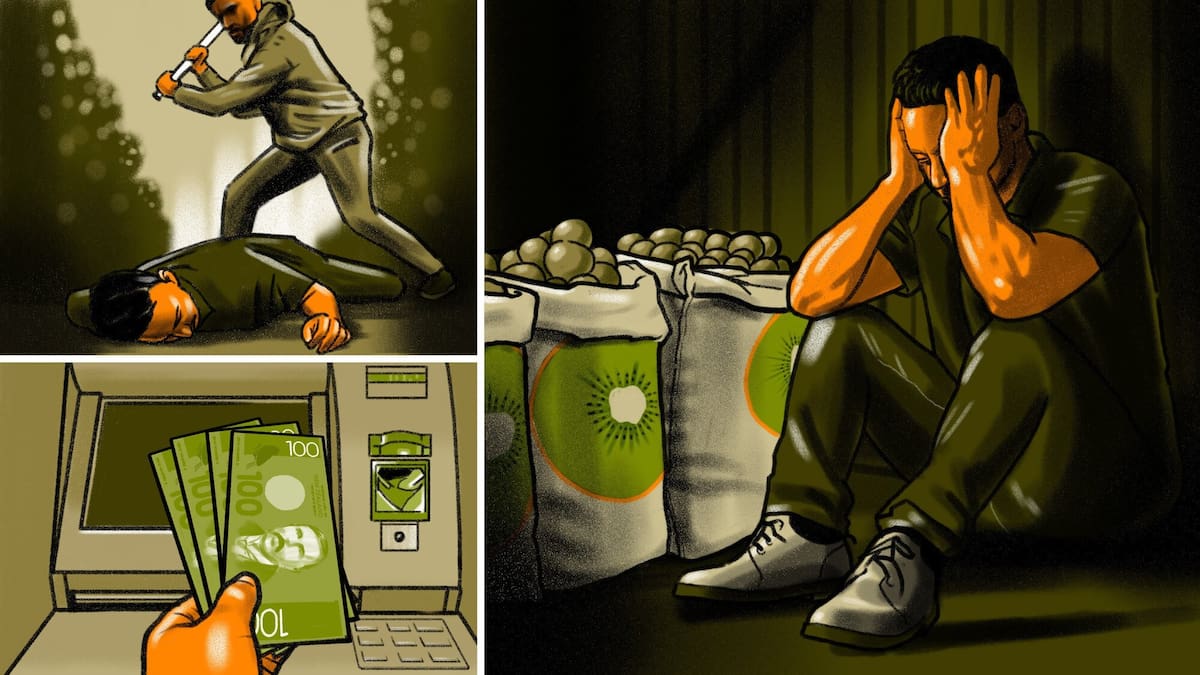
The illegal overstayer who was allegedly kidnapped after threatening to expose a tax evasion scam in the kiwifruit industry is now set to be deported. Illustration / Paul Slater
The alleged kidnapping victim, who wants to be identified only by his surname, Singh, entered New Zealand on a student visa in 2015.
The following year, INZ conducted a routine check on the academic documents included in his visa application.
The application stated that he had completed a Bachelor of Business Administration from the University of Lucknow, but routine checks later confirmed this was false.
Singh told the Herald that he did complete the degree, but from a less prestigious university in India.
However, he said that the false information in the visa application was supplied by an immigration adviser in India, who charged him about $30,000 for his services.
Despite acknowledging the “difficult situation” that Singh faced, INZ said this was no excuse.
“All visa applicants must ensure that all information and documents presented are genuine. Providing false information to an immigration officer is a criminal offence under the Immigration Act 2009,” said Janine Parsons, operations director for Northern Pacific.
“To make an application, all applicants sign a declaration stating that the contents of their application are true and correct and acknowledge the consequences of providing false and misleading or fraudulent information to an immigration officer.
“Applicants must also inform INZ if there is an agent acting on their behalf, so we can check if that agent is licensed or exempt.”
The failure to do so meant Singh could not meet the character grounds needed for a post-study work visa.
His application was declined in June 2017, and he has lived in New Zealand illegally since.
Singh said he was also under pressure to repay the $30,000 debt owed to the immigration agent in India.
So he started working for a subcontractor who supplied labourers for kiwifruit orchards across the Bay of Plenty. He was paid $18 an hour in cash under the table.
Struggling to make ends meet and repay the debt, Singh was introduced to someone in the kiwifruit industry who offered a way to make extra money.
That is how he agreed to allow more than $3m to be deposited into his bank accounts as part of the alleged tax evasion scam.
“I thought I would be safe in New Zealand if I talked to the authorities [police and Inland Revenue],” Singh told the Herald. “Now I am very scared of being deported.”
Jared Savage covers crime and justice issues, with a particular interest in organised crime. He joined the Herald in 2006 and has won a dozen journalism awards in that time, including twice being named Reporter of the Year. He is also the author of Gangland, Gangster’s Paradise and Underworld.