
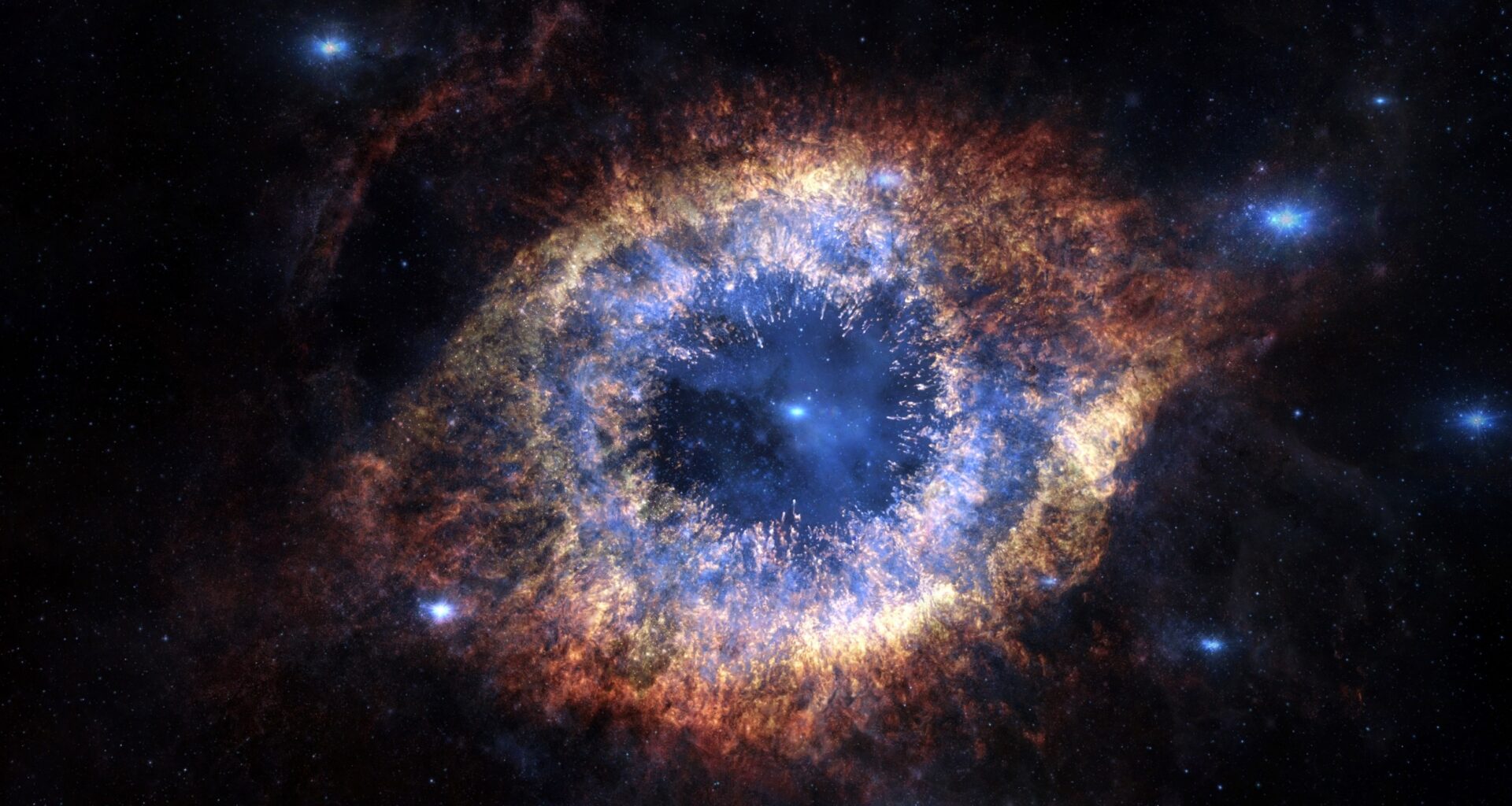
The Solar System is not drifting through empty space. Right now it’s traveling through the Local Interstellar Cloud, a region of thin gas and dust about 30 light-years wide that sits between the stars.
That cloud is made of something. Traces of it have been accumulating in Antarctic ice for tens of thousands of years – and a new study has just found them.
Iron from exploding stars

These atoms are a form of radioactive stardust known as iron-60, created inside massive stars and blasted into space when those stars explode as supernovae.
Iron-60 decays with a half-life of 2.6 million years, meaning none from Earth’s formation should still exist today. Any atoms detected now must have arrived relatively recently in cosmic time.
Geological records show two supernova hits millions of years ago, captured in deep-sea crusts and ocean sediments by an earlier study.
But no nearby star has exploded in the last few hundred thousand years. So when fresh iron-60 turned up in Antarctic surface snow less than 20 years old, the obvious source was missing.
A traveling solar system
Our Solar System entered the cloud tens of thousands of years ago and will exit in a few thousand years. Right now, we sit near its edge.
Dr. Dominik Koll, a physicist at the Helmholtz-Zentrum Dresden-Rossendorf (HZDR) in Germany, suspected the cloud itself was the missing reservoir. The idea was simple.
If the cloud held onto iron-60 from an ancient stellar explosion, Earth would scoop up some of that material on the way through. The hard part was proving it.
Reading a frozen archive
Proving the link required the right kind of ice. Surface snow could only show that the dust is arriving now – not whether it had been arriving for tens of thousands of years.
To test whether the cloud has been depositing iron-60 the whole time, the team needed material from when the Solar System was first entering its outer reaches.
The Alfred Wegener Institute supplied an ice core from the European EPICA project, dating between 40,000 and 80,000 years old.
If iron-60 was a steady gift from the cloud, it should appear in the ice core. It was there, but fainter than in younger ice. That gap is telling.
“This suggests that we were previously in a medium with lower iron-60 content, or that the cloud itself exhibits strong density variations,” said Koll.
A signal that varies
Until now, the simplest explanation for the iron-60 in fresh snow was a slow trickle from those million-year-old supernovae. The new measurement closes that door.
The influx changes over tens of thousands of years, a blink on cosmic timescales. That speed rules out anything as slow as a multi-million-year-old explosion still raining material on Earth.
Getting from raw ice to a measurable result took a year of patient work. About 660 pounds of ice traveled from Bremerhaven to Dresden, where it was melted, filtered, and chemically processed down to a few hundred milligrams of dust.
To verify nothing slipped away in those steps, the team checked the sample against beryllium-10 and aluminium-26, two other radioactive tracers whose expected concentrations in ice are well established.
The numbers held. The iron-60 count would be real, not an artifact of leaky chemistry.
Atoms in a haystack
For the final measurement, the dust traveled to the Heavy Ion Accelerator Facility at the Australian National University – currently the only machine in the world sensitive enough for the job.
Electric and magnetic filters sorted the atoms by mass until just a handful of iron-60 remained out of ten trillion.
“It’s like searching for a needle in 50,000 football stadiums filled to the roof with hay. The machine finds the needle in an hour,” said Annabel Rolofs of the University of Bonn.
Studying our cosmic neighborhood
The result links something near to something ancient.
The gas and dust around us appears to carry the chemical fingerprint of a star that exploded long before our species existed.
For astronomers, the implication is concrete: the Local Interstellar Cloud is not a featureless puff of gas but a record-keeper, its density imprinted in Antarctic ice over the past 80,000 years.
The cloud’s structure can now be tested more directly using Antarctic ice as a physical record.
Researchers can pair astronomical observations of the cloud’s edges with the ice’s record of when the Solar System crossed them.
Looking for older ice
The team is already going deeper. Through the Beyond EPICA – Oldest Ice project, the Alfred Wegener Institute is helping recover even older ice.
The researchers are searching for the missing baseline – ice from before the Solar System entered the cloud at all.
“This means that the clouds surrounding the Solar System are linked to a stellar explosion. And for the first time, this gives us the opportunity to investigate the origin of these clouds,” said Koll.
The study is published in the journal Physical Review Letters.
—–
Like what you read? Subscribe to our newsletter for engaging articles, exclusive content, and the latest updates.
Check us out on EarthSnap, a free app brought to you by Eric Ralls and Earth.com.
—–