
This Wellington commuter town of 2700 formerly served as the place you drove through to get to Greytown or Martinborough. So in 2014, founders and locals Peter and Mary Biggs and a handful of like-minded neighbours sat down and had a yarn.
Booktowns, Mary explains, share a common DNA. “They’re small rural towns, usually surrounded by beauty, an hour or two from a major city, with their best days supposedly behind them.” Featherston ticked every box. “When we presented the idea to the mayor of South Wairarapa District, she leaned back in her chair and said, ‘Thank God. No one knows what to do with Featherston’.”
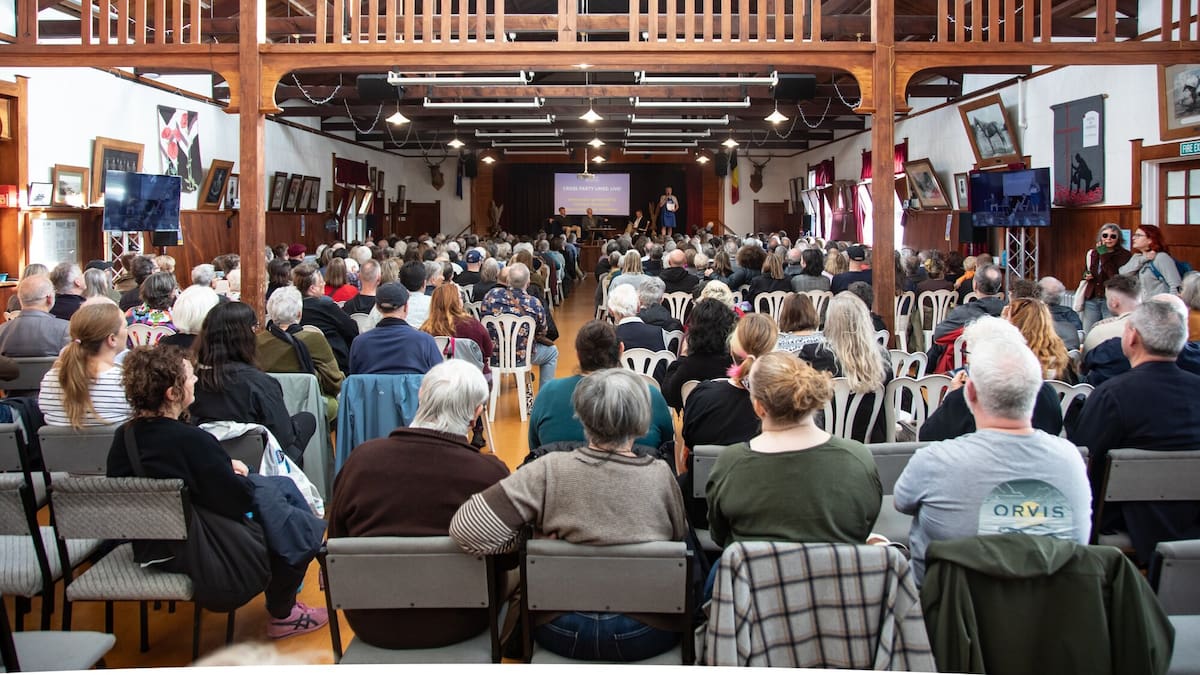
The first festival, in 2015, was tiny, with about 2000 visitors and 15 events. This year, between May 8-10, more than 10,000 people attendedacross 47 events with 72 writers, storytellers and “provocateurs”.
The Dickensian Bookshop is one of eight stores now trading in Featherston’s book precinct. Photo / Kathy Young
When Featherston Booktown began there was one bookshop in the town. Now there are eight. According to Peter Biggs, affectionately known as Biggsy, the three-day festival generates an estimated $2.74 million in annual economic benefits.
Award-winning novelist Catherine Chidgey said to me during the festival, “You feel like you’re in on a special secret when you come to Featherston”. So what is it they are putting in the water over there? The answer seems to be a sense of community and inclusivity. Tamariki from local schools perform the kapa haka at the opening night. A fish and chips supper is prepared from a caravan out the back of the Anzac Hall. About 140 volunteers mobilise across the town. This year, All Blacks’ coach Gilbert Enoka drew an 400-strong crowd to the opening event.
Festival-goers queue outside the Anzac Club as Featherston’s booktown draws thousands. Photo / Lucia Zanmonti
Over the course of the weekend, the audience (roughly 50 per cent rural and 50 per cent urban, according to Biggsy) come along to listen to a wide range of writers, from best-selling authors like Chidgey to emerging new voices such as Joseph Trinidad. There are poets, historians, journalists and politicians. Biggsy calls it a refusal to programme for only a small, elilte, urban, bourgeois audience. Panel discussions going on while the Zip and the pie-warmer are humming in the corner. Meanwhile, in one of the school classrooms, people settle in for one of Dominic Hoey’s “How to Write Good” workshops, while the poster on the wall reads “Attitude is a little thing that can make a big difference”. The craft of the book is also central to the festival, with workshops available on book-binding, paper- and press-making. There are events for young people too, including a nature walk and talk.
Award-winning novelist Catherine Chidgey speaks at the Featherston Booktown Festival. Photo / Lucia Zanmonti
“We’re ruthlessly mainstream,” says Biggsy. “But at the same time, ruthlessly provocative and ruthlessly focused on high-quality programming,” The formula – judging by the packed rooms – is working.
Jordan Hamel, the festival’s director, calls it a “place-shaping mechanism” for Featherston. “Sessions are scattered across halls, schools and community spaces. You navigate the festival on foot. The town is the venue.” It’s small enough to feel like you can get your arms around it, and big enough to feel like you’re part of something bigger. This is a town celebrating what it loves about itself and celebrating the power of words and books, to connect people.
Featherston Booktown merch reflects the festival’s growing pull as a literary destination. Photo / Kathy Young
One volunteer I spoke to said, “People love it. We’ve all experienced that feeling of going on holiday and getting a different take on life. Well, Featherston Book Festival is like that. You’re in a new place to hear bold conversations, fresh ideas and all these amazing writers speak, and you just feel uplifted.”
The conviction at the festival’s heart — that the human voice behind words matters — is one its organisers hold fiercely. “I don’t see [AI] as a viable threat, because I don’t see it ever replacing the human voice,” says Jordan. “When we read, we read for the story, but we also read for the person behind the story.” Peter is more blunt. “Literature and art need to be the last remaining place where human beings can relate to each other as human beings — to create things that move and inspire and confront other human beings.”
This is, ultimately, what I came to Featherston for. The decision to travel, the act of arrival, the minor disorientation of being somewhere new, all add to the experience. Being somewhere in person matters. You come to be moved.
Featherston, with its festival and bookshops, sense of nostalgia and incredibly hospitable community, is proof that the arts, and books in particular, can make our communities, and our country, a better place. It’s worth showing up for.
Details
Featherston is 50 minutes by car from Wellington, or one hour by train from Wellington Railway Station.
Upcoming literary events
Marlborough Book Festival A long weekend of captivating conversations with authors and writers.
Marlborough July 24-26 | marlboroughbookfest.co.nz
WORD Christchurch: The South Island’s anchor literary festival, offering Ōtautahi audiences access to New Zealand and international writers across a week of events.
September 1–6 | wordchristchurch.co.nz
Verb Wellington Readers & Writers Festival: Wellington’s festival of books and ideas returns after a year’s hiatus. The celebrated LitCrawl — a literary pub crawl across the capital’s independent venues — follows on Saturday 14 November 2026.
September 11–13 | verbwellington.nz
Hawke’s Bay Readers & Writers Festival: The programme will launch in July, with a great range of local and national guest authors set to be there.
October 9-11 | hbreadersandwriters.co.nz
Little Yarns Festival of Reading for Kids: Building on the success of its Inspire a Child to Read initiative, this event takes place this year instead of the Yarns in Barns Wairarapa Festival of Reading, which will return in 2027 as part of Hedley’s Books 120-year anniversary celebrations.
October 12-17 | yarnsinbarns.co.nz/inspire-a-child-to-read-initiative
Dunedin Writers & Readers Festival: The southern city’s biennial celebration of words returns after its October 2025 edition. Check for dates.
Ōtepoti, 2027 | dunedinwriters.co.nz