
I prefer Android over the iPhone because it’s an open platform. This is the same reason why many developers choose to create apps for Android. Now, a small but growing number are opting out of putting their apps onto the Play Store, and I can’t say I blame them.
Google is adding restrictions on how apps can be installed on Android
Even apps never intended for the Play Store are encouraged to be verified with Google
Google says that it is taking steps to protect people from ransomware and scams by changing the process for installing apps from anywhere outside the Play Store. Any apps installed from other sources now need to be verified with Google, and the credentials required have increased. In the past, developers needed a developer account (costing $25), some identity information, payment information, and contact info in order to distribute via the Play Store.
Now the identification requirements are stricter, and they extend to anyone wanting to distribute apps on Android at all, regardless of where the app is downloaded, including the various alternatives to the Play Store. These requirements include:
Full legal name
Physical address
Email and phone number
Government-issued ID (driver’s license, passport, etc.)
Proof of address (utility bill, bank statement, etc.)
Once verified, apps are given IDs that are tied to the developer at the OS level, not only in the Play Store.
Developers who don’t want to provide this information to Google can still distribute their software, but their apps will be blocked for anyone who hasn’t opted in to Android’s new “Advanced Flow,” a process that requires not only flipping a few toggles, but also waiting 24 hours.

7/10
SoC
Google Tensor G4
Display
6.3-inch Actua display
The Google Pixel 10a is a barely updated version of the Google Pixel 9a, with a slightly brighter screen and an upgrade from Gorilla Glass 3 to Gorilla Glass 7i. Google has shaved the remaining few millimeters from the camera bump, making it completely flat. Unlike prior versions of the Pixel a series, this model year does not share the same Tensor processor as the mainline Pixel 10.
Fortunately, this wait is only a one-time deal (per phone), so it’s only an inconvenience in the initial days after buying a phone, when you feel motivated to de-Google the one you already have, or when someone simply introduces you to a cool indie app.
Some developers have been very vocal about their disapproval
More may stop uploading their apps to the Play Store altogether
If you visit F-Droid’s website or open the Android app, you will see a banner across the top with the following message:
“F-Droid is under threat. Google is changing the way you install apps on your device. We need your help.”
These words are followed by a link to Keep Android Open. That page has a giant banner counting down to the day your phone will stop being yours. The language in this open letter repeats the information I’ve shared above, but with scarier verbiage. Several dozen organizations have signed the letter, ranging from the e Foundation and LineageOS to the TOR Project, Brave, the OpenStreepMap Foundation, the GNOME Foundation, and the Electronic Frontier Foundation. You’ll be hard-pressed to find an open source project or advocacy organization in favor of the change.
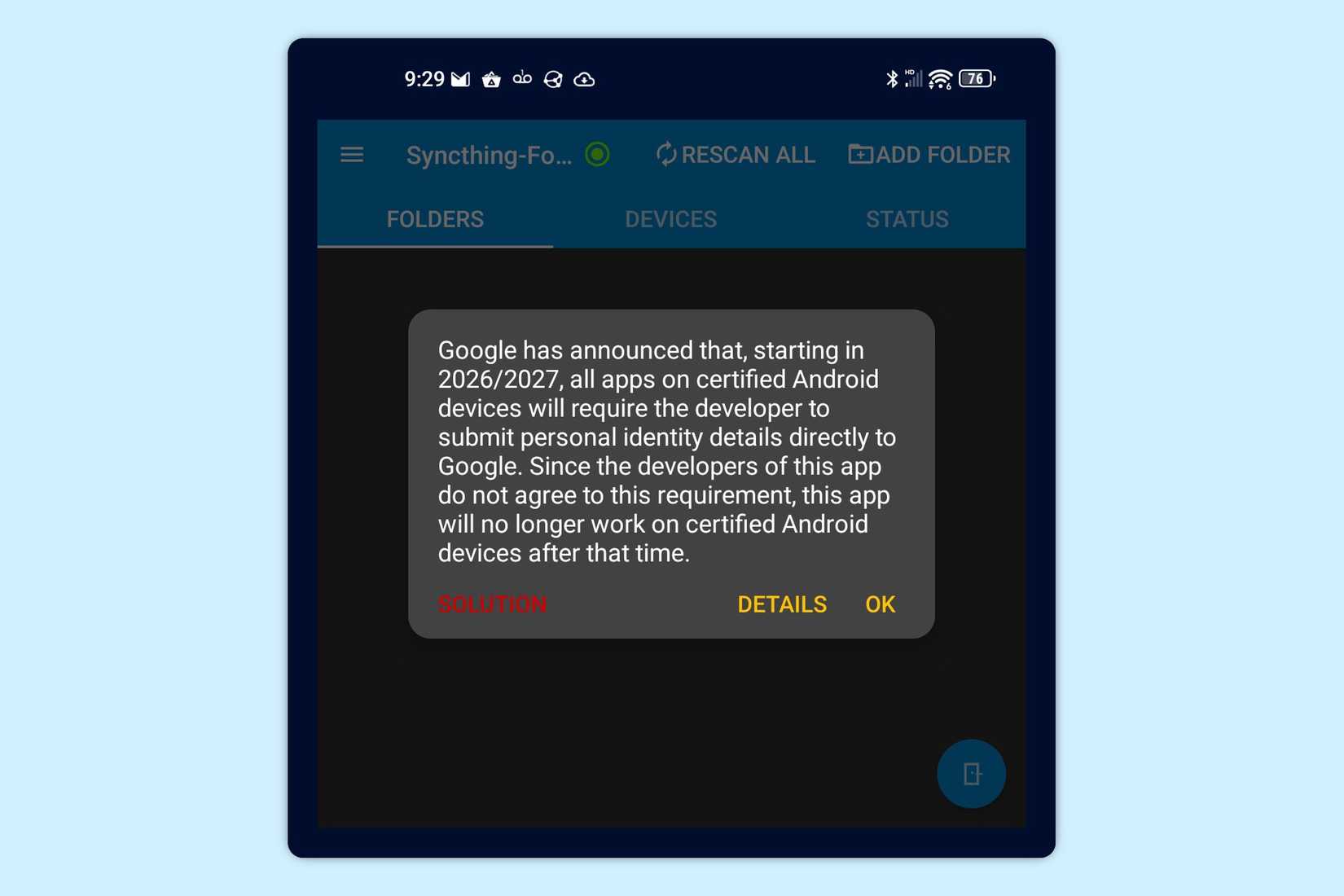
When I recently installed Syncthing-Fork, I was greeted with a pop-up (pictured above) warning about its imminent disappearance from the Play Store. I’ve installed Syncthing-Fork on a few other devices in the days since, and I no longer receive the pop-up. Still, it got me wondering. Then, when I went searching for Breezy Weather, I saw its developer had posted a similar message to the project’s GitHub page.
Breezy Weather is in the company of other killer apps that are already absent from the Play Store. After all, it’s the free and open source software community that is most put off by the idea that someone should need to create an account to download an app, which is why app stores such as F-Droid and Flathub function without one. The idea that developers need to provide their ID to a company in order to share apps with others is just as off-putting.
More apps already skip the Play Store than in times past
I personally now get most of my apps from outside of Google’s app store
The idea that developers would not put their apps in the Play Store was once more difficult for me to believe. Whenever I checked out F-Droid, the apps there were also available from Google Play, so there seemed to be little practical reason to keep both stores installed. The only purpose to using F-Droid was to preserve privacy or, simply, due to personal values.
That is increasingly less often the case. F-Droid now has a growing catalog of software that isn’t available on Google’s store. Casually scrolling through the newly updated apps in F-Droid today, I see Launcher314, BeatBridge, Audile, Fokus Launcher, and Txori. These are all nifty little apps that aren’t in the Play Store.
The reason Syncthing-Fork is a fork is that the developers of the original Syncthing Android app already find Google’s existing requirements to be not worth the effort, and I wonder how many more will join their ranks. If your goal isn’t to make a business out of the app you’ve created, or you’re only trying to serve a relatively small audience, why put up with Google’s whole song and dance? Toss the app up on GitHub, upload a version to F-Droid, and call it a day.
Many of my favorite apps are passion projects made with love by some independent developer who has no commercial ambition. Google’s efforts are making Android a more restrictive platform for developers to support, and in the process, the Play Store ironically continues to become a place filled with more tracking, ads, and other slop from app developers looking to monetize their efforts.
Google’s Advanced Flow is only required to install unverified apps. As an F-Droid user, I’ll see how long before I eventually have to turn it on. I understand the need to protect people from the scams outside the Play Store. Unfortunately, these are the same people that I don’t feel comfortable encouraging to browse the Play Store either. Ironically, in a move to make Android safer, more of the safe apps are actually leaving the Play Store, increasing the likelihood that we all install ad-packed, tracking-filled, and notification-spamming alternatives in their wake.