
He said Queenstown currently had “a car for every resident”, with private vehicle ownership fundamentally unsustainable as the district expanded.
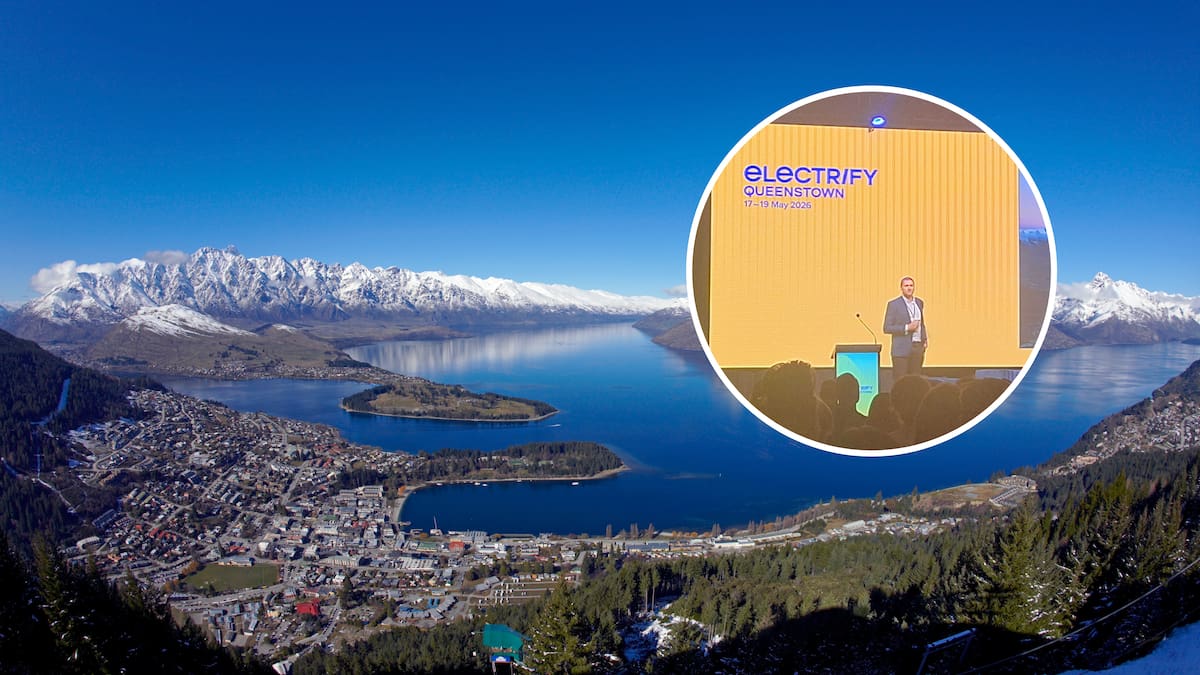
Southern Infrastructure Ross Copland told Electrify Queenstown the district would need to “double our infrastructure in the next 15 years” as population and visitor growth continues to outpace planning and delivery. Photo / Ben Tomsett
“It’s actually a 1.1-to-1 ratio of private vehicles to residents in this region,” he said.
“Is that scaleable?”
Copland said only 2% of Queenstown’s vehicle fleet was electric, despite New Zealand having abundant renewable electricity resources.
He said multiple infrastructure forecasts showed demand consistently outstripping planning assumptions.
Ross Copland. Photo / Mark Tantrum
“We’ve now done 12 business cases which all conclude broadly the same thing. We have not taken any action.”
The comments came during the business, innovation and policy day of Electrify Queenstown, a three-day conference focused on electrification, energy resilience and low-emissions transport.
The sold-out event attracted about 400 attendees across government, business and infrastructure sectors, with speakers including Climate Change Minister Simon Watts, Rewiring Aotearoa chief executive Mike Casey and inventor Dr Saul Griffith.
Copland used the conference to promote the idea of a gondola-style transport network for Queenstown, describing aerial cable systems as a proven way to reduce pressure on the district’s constrained roads.
Southern Infrastructure is backing a proposed cable car network for the resort town, while Christchurch-based company Whoosh announced on the conference’s opening day that Queenstown business leaders would fund a feasibility study into its proposed autonomous elevated pod transport system.
An artist’s impression of the Queenstown Cable Car, backed by Southern Infrastructure.
Copland said multiple transport technologies would likely be needed.
“This is not the only transport solution Queenstown needs,” he said.
“There’s some amazing work that’s been going on with electric foiling ferries, with autonomous vehicles, with the team at Whoosh developing a really interesting homegrown technology here in New Zealand.”
Copland said the district needed integrated ticketing and co-ordinated planning to reduce reliance on private vehicles as the population grew.
“If half of those people didn’t buy a third vehicle or swapped out one of their existing vehicles to one of the new residents of Queenstown, we are going to double in size in 15 years,” he said.
“That’s what we need to manage our transport capacity effectively.”
Copland also criticised the pace of infrastructure delivery in New Zealand, pointing to lengthy planning and consenting processes.
He said Queenstown’s district plan review had already taken 15 years, despite legally needing to be updated every decade.
“We’re not designed to move at pace.”
Copland warned that corridor protection for future transport and electricity infrastructure was becoming increasingly difficult as development intensified and environmental protections constrained route options.
Still, he said electrification remained one of New Zealand’s biggest economic opportunities.
“There is absolutely everything we need.
“We’ve got an abundant resource base to be able to electrify our entire economy and then some.”
Ben Tomsett is a multimedia journalist based in Dunedin. He joined the Herald in 2023.