
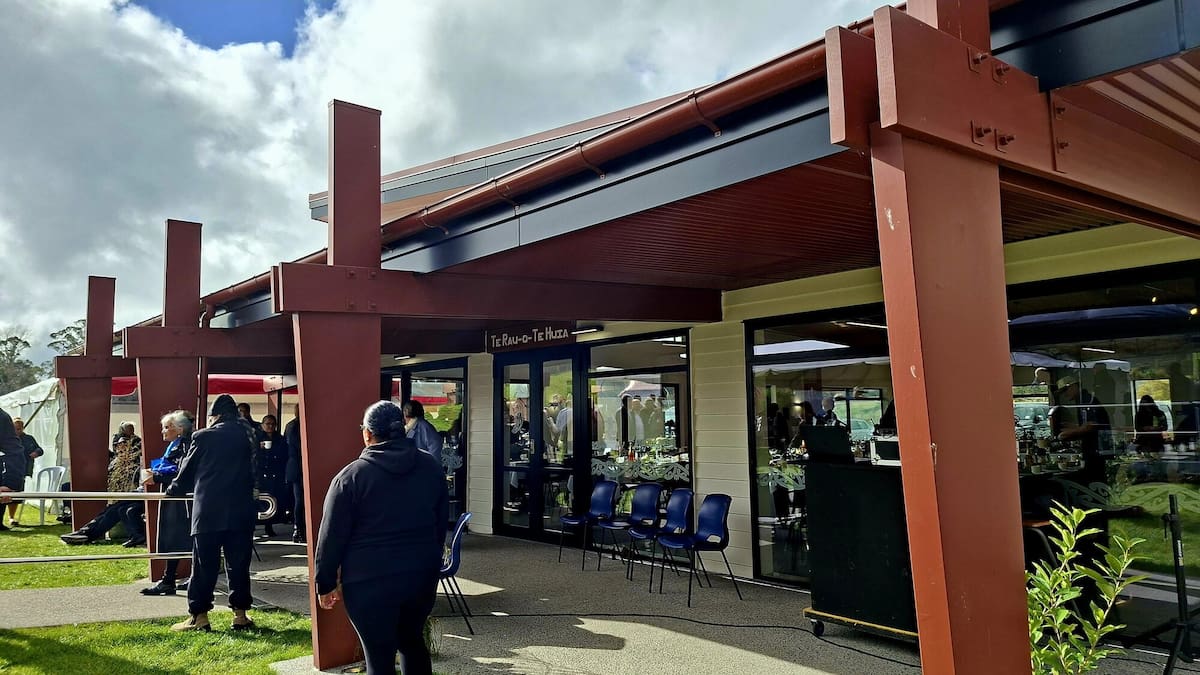
The costs were covered by central government through Oranga Marae, Te Puni Kōkiri, and the hapū itself.
Redirecting gambling proceeds
Left; the old wharekai. Right; the wharepuni (meeting house) at Ōruanui Marae. Photo / Te Kapa o Te Rangiita ki Ōruanui hapū.
Oranga Marae is the name of a government fund dedicated to marae projects, upkeep and rebuilds.
However, its Māori name conceals its true origin – Lotto.
The Department of Internal Affairs (DIA) told Local Democracy Reporting it granted Te Kapa o Te Rangiita ki Oruanui Hapu Trust $1,760,903 for the rebuild through Oranga Marae Lottery Grants.
Des Barres said in light of the gambling plight among Māori, her hapū trust had no qualms about applying for assistance.
“It’s [gambling] a scourge that affects our people, hoping to double their pensions,” Des Barres said.
“We’re [Māori] the biggest [patrons] of that system.”
DIA also confirmed another $242,891 was provided to the hapū by Te Puni Kōkiri to assist with the rebuild.
Not a doorknob to show for it
Taupō District Council received an application for resource consent for the rebuild in September 2010.
Approval came after a month, but funding wouldn’t come for another six years.
“Since the 2016-17 financial year, there have been four grants made to Te Kapa o Te Rangiita ki Oruanui Trust,“ a DIA spokesperson said.
“The first grant was a feasibility study to build a new marae; the second and third grants were professional fees pre-build.”
Des Barres said: “After the feasibility study and the other grants, $200k had been spent without a single doorknob to show for it!”.
After that initial work, required by the DIA to approve further funding, the project came to a standstill, with no further funds coming from DIA.
But the hapū persevered until the final grant of $1,760,903 was received for the wharekai rebuild and the kitchen fitout, seven years later.
Des Barres thanked everyone who had contributed to every stage of the marae renovations.
An act of kindness repaid
This wharepuni at Nukuhau Pā was gifted to Ngāti Rauhoto and Ngāti Te Urunga by Te Kapa o Te Rangiita ki Ōruanui over 100 years ago.
When a marae closes, the people of that marae must find an alternative venue for their activities.
Events such as tangihanga (funerals), weddings, wānanga (symposiums), hapū consultations and legally mandated annual general meetings must be held elsewhere.
This is when the people of Nukuhau Pā, Ngāti Rauhoto and Ngāti Te Urunga stepped in to help, repaying an act of kindness which took place over a 100 years ago.
When the original wharepuni (meeting house) at Nukuhau was lost to fire in the 1900s, the people of Ōruanui gifted them one of theirs .
So when Ōruanui marae closed two years ago, Nukuhau Pā was made available to the descendants of the ancestors who “lent” them their wharepuni.
Nukuhau Pā chairman Dominic Bowden congratulated Ōruanui on the completion of the upgrades.
“It was a privilege to share our pā with you during the redevelopment period.
“The whanaungatanga (kinship) between our marae runs deep and we look forward to strengthening it.”
Ōruanui Marae – future emergency hub?
Ōruanui marae from Ōruanui Rd, Ōruanui, Taupō. Photo / Dave Davies.
Kylie Leonard, Taupō East Rural Ward councillor, attended the re-opening and paid tribute to everyone involved in the rebuild.
“I’m grateful and proud of the trustees and everyone else who contributed to the construction of this beautiful wharekai,” Leonard said.
“The work of people like this often goes unrecognised. Marae play an important role in every community they’re established in, especially rural wards like mine.”
One such important role could be a Civil Defence Community Emergency Hub.
“We’re probably the biggest non-commercial building on Ōruanui Road … and we just see that it’s the perfect place for a Civil Defence Hub,” De Barres said.
She said she was disappointed when the DIA declined their application to fund an emergency equipment container three times.
DIA confirmed the hapū trust had applied to the Cyclone Gabrielle Appeal Trust in 2024.
They state the hapū trust application was denied because it didn’t fit the criteria.
Bronson Perich is a Local Democracy Reporting journalist for Taupō and South Waikato based at the Waikato Herald.
– LDR is local body journalism co-funded by RNZ and NZ On Air.