
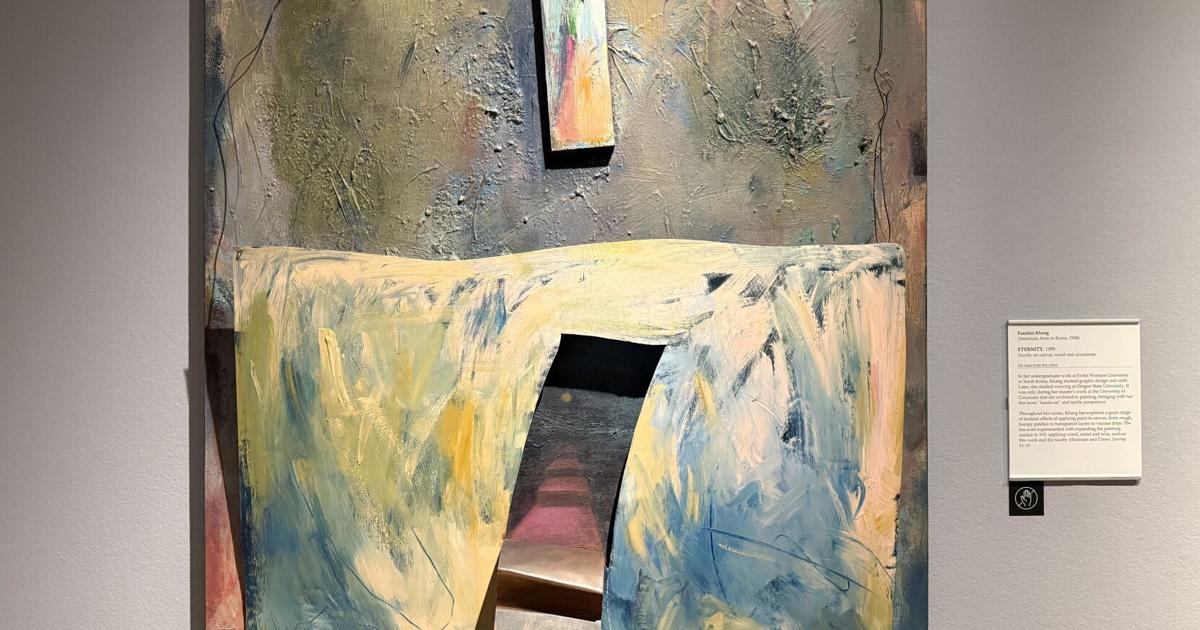

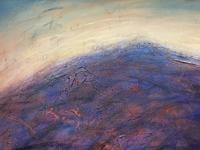
A detail of “Psalm 121” by Eunshin Khang features textured paint and hangul, the alphabet used to write the Korean language. HANNAH KASPER/CONTRIBUTED
Through Sunday, June 7, Cincinnati-based artist Eunshin Khang is featured in the focus exhibition, “Symbols of Hope: Eunshin Khang,” on view downstairs in the Linda Lombard and Paul Marshall Gallery at the Dayton Art Institute.
Born in Seoul in 1948, Khang has lived most of her adult life in Cincinnati and taught for a decade at Miami University’s School of Art. The exhibition surveys work spanning the 1980s to present.
In her undergraduate work at Ewha Womans University in South Korea, Khang studied graphic design and craft. Later, she focused on weaving at Oregon State University. During graduate study at the University of Cincinnati, she shifted to painting, carrying over an emphasis on texture and material. Her paintings incorporate sand and paper, and at times extend dimensionally through the use of wood, metal, and wire.
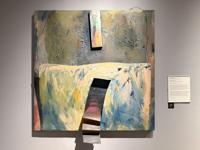
Some of Eunshin Khang’s paintings, like “Eternity” (1999), incorporate three dimensional materials like wood and aluminum. HANNAH KASPER/CONTRIBUTED
Dreamlike landscapes populate her abstract canvases, reflecting interior states of mind. Memory, nature, and spirituality serve as points of departure in works aimed at creating a sense of peace. Khang employs her memory and imagination to transpose a physical place into a loosely defined environment.
“The landscape I paint is imaginative, universal. I try to keep it simple to give more impact,” said the artist.
Several paintings echo the visual language of Color Field painting, with broad expanses of saturated color and atmospheric shifts in tone that highlight the quality of the paint itself. Two paintings from the exhibition hang in the museum’s modern art wing alongside works by Helen Frankenthaler and Kenneth Noland.
At times, the meditative stillness of the paintings recall the spiritual ambitions of Mark Rothko, though Khang’s imagery remains more explicitly tied to landscape and symbolic form.
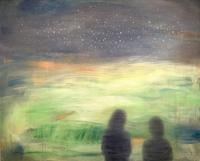
Eunshin Khang, “Green Pasture #2”, 2014, Acrylic on canvas, 48 x 60 inches. On view in “Symbols of Hope: Eunshin Khang” at the Dayton Art Institute. HANNAH KASPER/CONTRIBUTED
Circular shapes recur throughout the exhibition, referencing what Khang describes as “a symbol of oneness, cosmos, inner peace.”
“A journey through the world in relation to the Divine” is how Peter Doebler, Kettering Curator of Asian Art at the DAI, described the themes. Doebler’s background is in art and religion, specifically Japanese and Buddhist aesthetics.
Though Seoul is framed by mountains, Khang favors circles over peaks.
“The circle shape is gentle and embracing,” Doebler said. explaining that the theme of hope is reflected in these colors and shapes, yet is left open-ended for viewers.
Several works explore movement across physical, psychological, and spiritual space. In “Passage No. 3,” a tall vertical band functions like a portal, suggesting movement from darkness into light.
Khang, who is a member of collectives including the Creative Asian Society and Cincinnati Asian Art Society, incorporates written language into her paintings, using hangul, the alphabet of the Korean language.
In “Mountain of Words” (2001) she includes passages from the biblical book of Psalms in the background, turning scripture into a kind of emotional landscape. Sometimes the texts are reflected in the title, like “Green Pasture #2”, which alludes to Psalm 23 — “The Lord is my shepherd, I shall not want. He maketh me to lie down in green pastures. He leadeth me beside the still waters.”
Calligraphy is an art form that has been practiced by East Asian cultures for centuries, and Khang’s gestural brushstrokes draw on her training in the written art form. She notes how her work has evolved over time as she has crossed cultures.
“As an Asian American artist practicing over forty years in Cincinnati, I’ve had the privilege to experience Asian art as well as Western art. Over the years, I expanded my paintings from using Asian calligraphic brushstrokes to painting abstract images. I feel that at this globalized time paintings that show merged cultures are important,” said Khang.
If You Go
Location: The Dayton Art Institute, 456 Belmonte Park North, Dayton.
Hours: Wednesday: 11 a.m.-5 p.m., Friday-Saturday: 11 a.m.,-5 p.m., Sunday: Noon-5 p.m., Thursday Extended Hours: 11 a.m.-8 p.m. Closed Monday and Tuesday.