
Back to Article List
The Moon sits between bright Venus and Jupiter in the evening sky, tracing out the plane of the ecliptic for all to see.
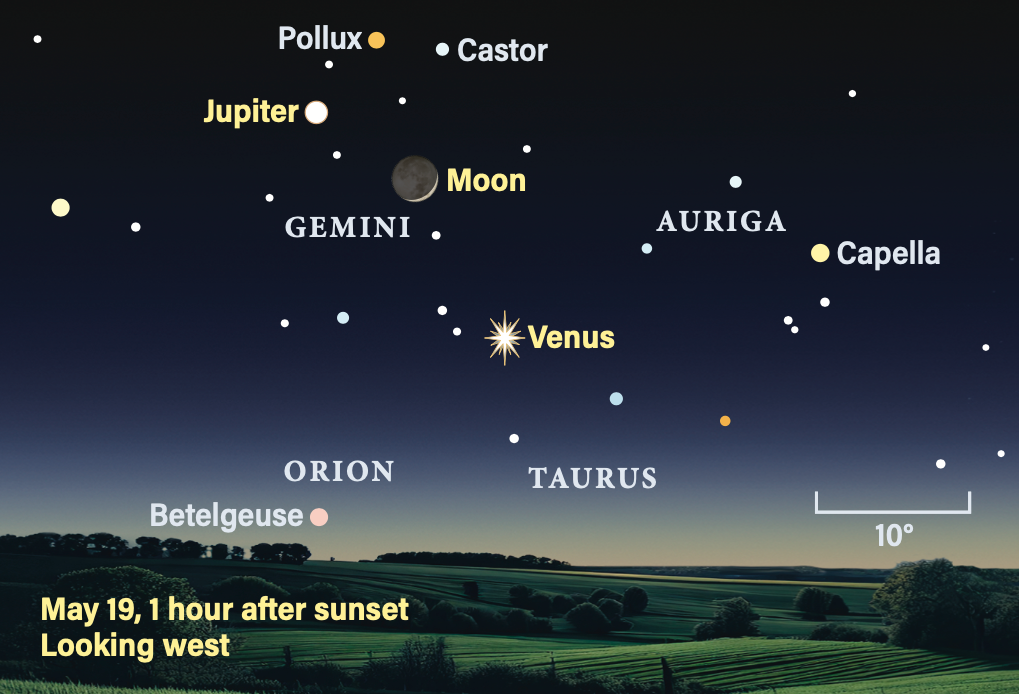
By May 19, Venus has entered Gemini, which also currently houses Jupiter. The two planets will continue to close in for the rest of the month. Credit: Astronomy: Roen Kelly
Looking for a sky event this week? Check out our full Sky This Week column.
May 18: The Moon hangs with Venus
Venus has now entered Gemini and the Twins host two planets: brighter Venus near their feet, and mighty Jupiter near their heads. The Moon has also moved, outpacing Venus so that our satellite now hangs suspended with Jupiter to its upper left and Venus to its lower right. Together, the three bodies easily trace out the line of the ecliptic in the sky — the plane of our solar system.
As the sky darkens, you might try to glimpse open cluster M35 with binoculars or a telescope. Glowing at magnitude 5.3, this bright, young grouping of stars lies just 1.3° southeast of Venus tonight. You may catch them together in the same field of view, especially in binoculars or at lower magnification in your telescope.
Keep an eye on this region of the sky for the remainder of the month. Venus will trek upward, closing in on Jupiter and ending May about 8° from the gas giant. The pair will come even closer and undergo a conjunction next month.
Sunrise: 5:41 A.M.
Sunset: 8:12 P.M.
Moonrise: 8:00 A.M.
Moonset: Midnight
Moon Phase: Waxing crescent (16%)
*Times for sunrise, sunset, moonrise, and moonset are given in local time from 40° N 90° W. The Moon’s illumination is given at 10 P.M. local time from the same location.