
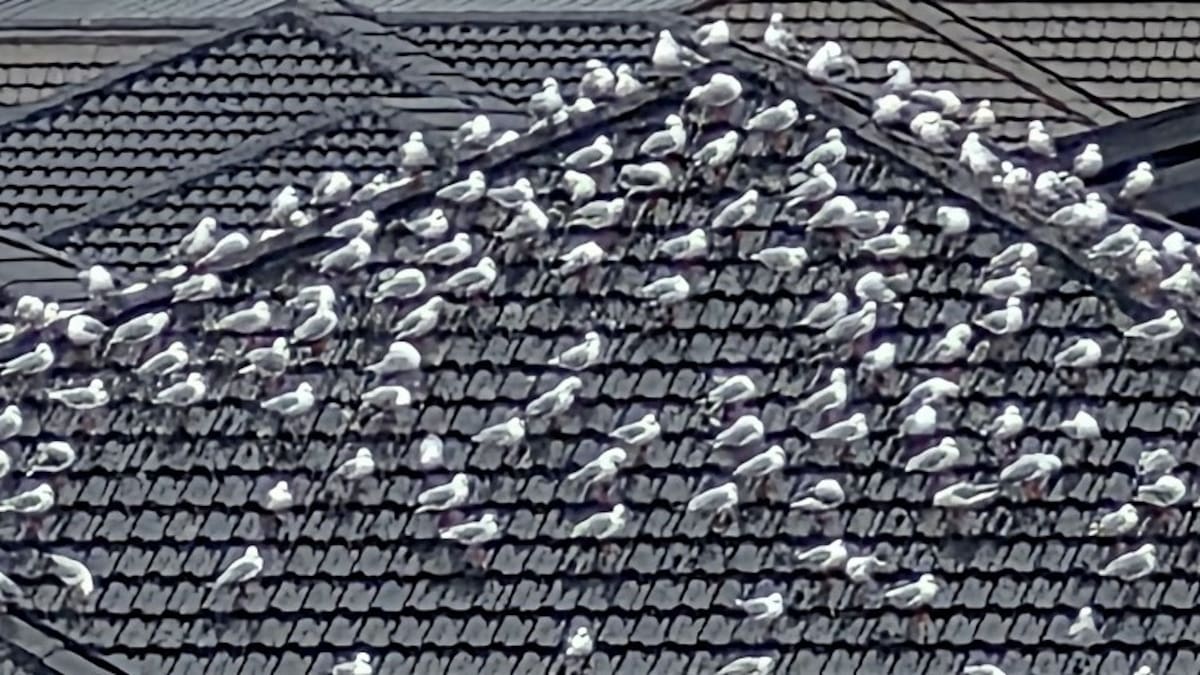
“It’s crazy,” he said.
Dixon, whose home overlooks a small lake, said the phenomenon is recent and unlike anything he has seen before.
The birds were gathering in large numbers on the roofs of two properties on the opposite side of the water.
Each afternoon about 4pm, the gulls choose another house to converge upon shifting about the neighbourhood, Dixon said.
He said others living nearby — up to 300m away — had also noticed the spectacle, watching flocks circling and clustering overhead.
Although the birds were not a direct nuisance at his property, Dixon said concerns were growing among neighbours.
The main issue is the volume of droppings accumulating on roofs and around homes, he said.
He pointed to houses where white seagull droppings are evident, raising concerns about gutter damage and cleanliness.
Southall praised council’s response to the issue, saying he and his wife were putting the pamphlets in letterboxes.
The council said the pamphlets were a new initiative developed because of the residents’ offer to distribute them.
It said it received nine complaints about seagulls in the past 12 months from across the district, with no clear concentration in any one area.
The council said the issue involved a mix of gull species and appeared ongoing rather than seasonal or temporary.
A council spokesperson acknowledged the birds could be a nuisance and pose minor public health risks, particularly through droppings.
Whangārei District Council developed this pamphlet after a complaint about seagulls from a Totara Parklands resident, who agreed to help with a letterbox drop.
It’s evident where the gulls have been. Photo / supplied
Local roofing expert Beldon Taylor, managing director of Taylor Roofs, confirmed the birds’ highly acidic waste could “etch away” protective roof coatings, causing corrosion and rust.
Other roofing materials, such as concrete, were also vulnerable to long-term exposure, he said.
Not all Totara Parklands residents are concerned about the birds and not all are visited by them.
In online discussions, some residents supported Southall’s concerns and the pamphlet drop, saying it was a good way to address the problem without any household feeling targeted.
Others said the seagulls were part of the natural environment and should be left alone.
Another person said he was tempted to order a big serving of fish and chips and deliberately serve it to the birds.
A Northland Regional Council spokesman said seagulls are the responsibility of the Department of Conservation (DoC).
It’s evident where the gulls have been. Photo / supplied
Two of New Zealand’s three native gull species – the red-billed gull or tarāpunga (pictured here) and the black-billed gull or tarāpuka – are protected under the Wildlife Act 1953.
DoC Treaty partnership kaiarahi matua for Whangārei District, Matiu Mataira, said because red-billed gulls and black-backed gulls are protected under the Wildlife Act 1953, DoC’s role is focused on conservation and management rather than direct control or removal in response to nuisance issues.
Under the Wildlife Act, penalties for harming, killing or disturbing protected seagulls or their nests include fines of up to $100,000 and two years in prison.
“These species are a quintessential part of Aotearoa New Zealand’s natural environment,” Mataira said.
“They are highly adaptable and occupy a wide range of habitats – from coastal breeding and feeding areas through to urban, suburban and commercial centres. Their presence in towns and cities is not unusual.”
He said nuisance issues were often linked to human behaviour, particularly the intentional or unintentional feeding of birds.
Feeding gulls can change their natural behaviour, encouraging them to gather in larger numbers, become more confident around people, and rely on human food sources.
Mataira said DoC’s advice to the public is to avoid feeding gulls or leaving food scraps accessible, secure rubbish and food waste, and support council messaging about reducing attractants.
He said DoC was not aware of a high volume of formal complaints in Whangārei at this stage but noted such issues were usually reported to and managed by councils.
Sarah Curtis is a news reporter for the Northern Advocate, focusing on a wide range of issues. She has nearly 20 years’ experience in journalism, most of which she spent court reporting in Gisborne and on the East Coast.