
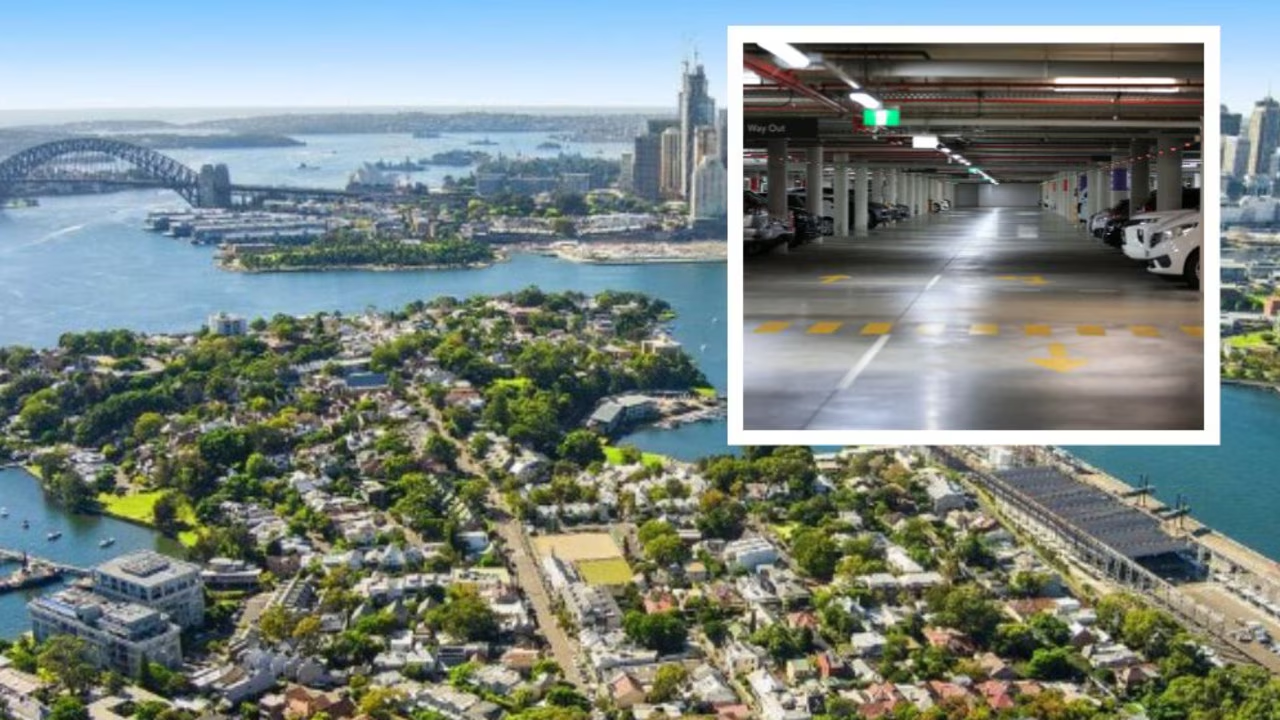
Australia is spending more than $1 billion a year building empty apartment car parks while simultaneously insisting it cannot build enough housing.
That is the central finding of a new Grattan Institute report that argues one of the country’s least glamorous planning rules has quietly become one of the most expensive.
According to the report, mandatory parking requirements attached to apartment developments are adding as much as $137,000 to the cost of some homes while forcing developers to excavate giant underground garages many residents do not even use.
“There are more car spaces in apartments in Sydney and Melbourne than cars,” the report states.
At a time when Australians are being told the country desperately needs more housing supply, Grattan argues governments are still effectively mandating wasted concrete beneath the homes that do get built.
The report estimates up to 40 per cent of apartment parking spaces in Sydney and Melbourne sit empty each night. Yet developers are still routinely required to build them anyway under planning systems largely inherited from the post-war decades when rising car ownership was treated almost as civic religion.
In Sydney, parking requirements add roughly $70,000 to a standard two-bedroom apartment. In Brisbane the figure climbs to $113,000, while Perth reaches $137,000. In some difficult inner-city projects, individual underground spaces can reportedly cost up to $250,000 to construct.

In a lot of cases, apartment buyers do not even own a car.
Grattan found about 40 per cent of households in studio and one-bedroom apartments across Australia’s capitals are car-free, while nearly one in five two-bedroom apartment households also own no vehicle.
“Residents without cars — or those who own fewer cars than they have spaces — are forced to subsidise parking they do not use,” the report said.
The findings land in the middle of a broader and increasingly uncomfortable debate about whether Australia’s housing crisis is now being worsened by layers of regulation, planning controls and infrastructure requirements that have accumulated for decades without serious review.
The country has spent years arguing about negative gearing, migration and interest rates while often ignoring a more mundane reality: housing in Australia has become extraordinarily difficult and expensive to physically build.
Developers across the country regularly point to a number of restrictions, blaming everything from planning delays, overlapping approvals, infrastructure levies, design mandates and zoning restrictions that can stretch projects out for years before a single resident moves in. The Grattan report argues mandatory parking rules have quietly become one of the clearest examples of that phenomenon.
“Parking requirements act as a handbrake on new housing construction,” the institute warned.
The report also estimates Australia could avoid building more than 86,000 unwanted parking spaces over the next five years if minimum parking requirements were abolished nationwide. The savings could instead fund the construction of more than 9,000 additional homes.
In a roundabout way, Australia is figuratively burying part of its housing supply underground.
There is also a generational irony running through the entire debate.
Younger Australians locked out of housing markets are increasingly driving less, delaying car ownership and living closer to public transport simply because they cannot afford the sprawling suburban lifestyles previous generations enjoyed.
The report argues Australia’s planning systems have simply failed to keep up with how people actually live.
“Our analysis shows the costs of providing car-parking spaces for new apartment developments often vastly exceed what new home-buyers are willing to pay for them,” it states.
Victoria has already begun moving away from some minimum parking rules near major transport hubs, with Grattan estimating those changes alone would have removed nearly 29,000 parking spaces from apartment developments built between 2020 and 2025.