
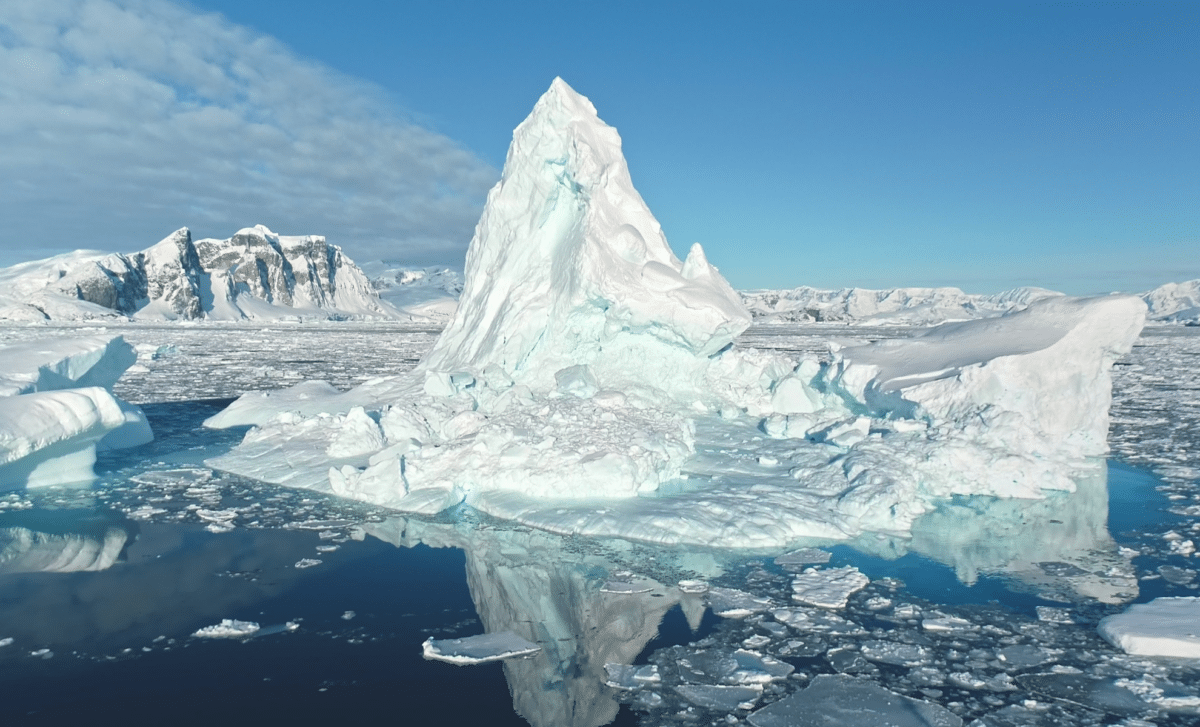
Antarctica’s winter sea ice has plunged to record lows, marking a sudden and alarming shift in the planet’s climate system, according to recent research reported by The Conversation. Scientists describe this decline as a “shock” to the previously resilient Antarctic ice, driven by deep ocean heat now rising to the surface.
A Decade Of Sudden Change
For decades, Antarctic sea ice seemed impervious to global warming, even expanding slightly between 2007 and 2015. Unlike the Arctic, where ice melts rapidly, Antarctica’s frozen waters were considered a stable part of the climate system. But since 2015, the continent has seen a dramatic downturn, with 2023 recording winter sea ice levels far below long-term averages, so rare that the odds of this occurring naturally are roughly one in 3.5 million.
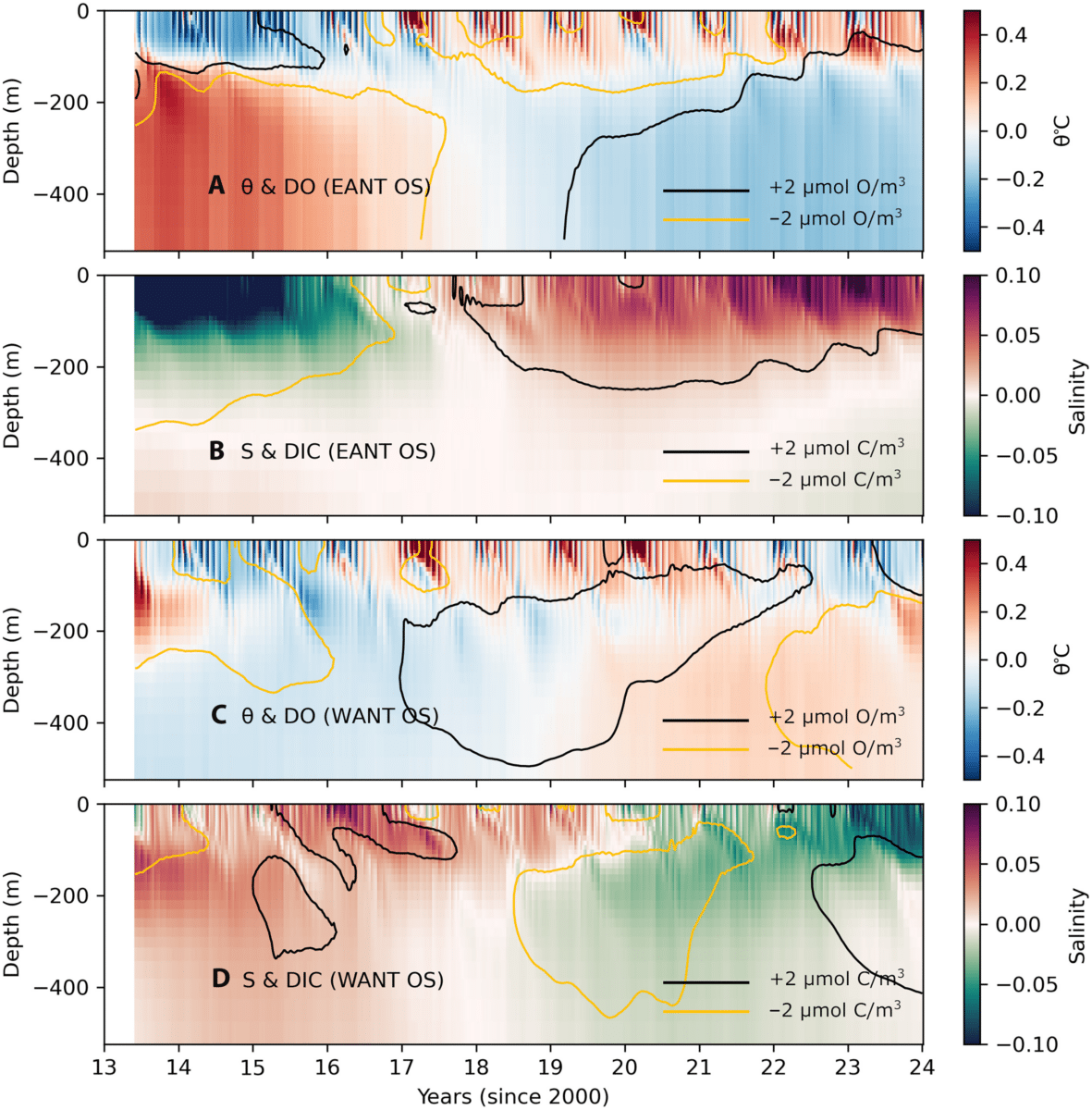 SOSE hydrography.
SOSE potential temperature and salinity anomalies in (A and B) East Antarctica’s off-shelf (EANT OS) and (C and D) West Antarctica’s off-shelf (WANT OS) regions. Contours in the temperature panels represent DO anomalies (±2 μmol O/m3), while contours in the salinity panels represent DIC anomalies (±2 μmol C/m3). Negative anomalies are indicated by yellow contours, and positive anomalies are shown with black contours.
Heat Rising From The Depths
Research shows that heat trapped in deep Antarctic waters is now surfacing, a process accelerated by decades of stronger winds caused by the ozone hole and greenhouse gas emissions. These winds acted like a pump, slowly drawing warm, salty water upward. By 2015, the barrier keeping this deep water submerged weakened, allowing storms and turbulence to churn heat to the surface.
This rising heat melts ice directly and increases surface water density, creating a self-reinforcing cycle that makes it increasingly difficult for new sea ice to form.
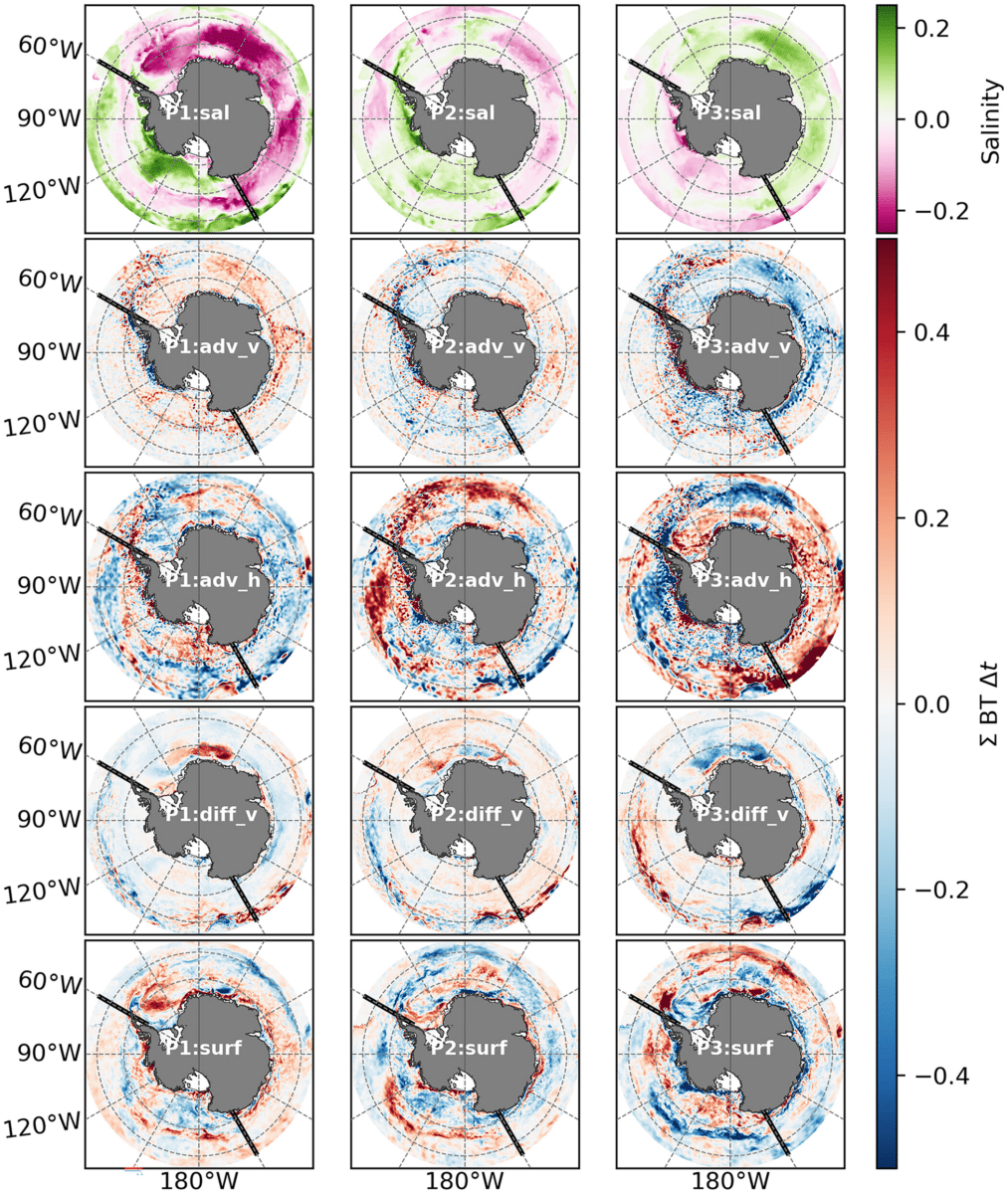 Salinity budget maps.
Time-integrated over periods: P1 (01 June 2013 through 2014), P2 (2015–2017), and P3 (2018–2023). Top row shows salinity anomalies, and subsequent rows show the time-integrated salinity budget terms for vertical advection (adv_v), horizontal advection (adv_h), vertical diffusion (diff_v), and surface fluxes (surf). All terms are on the unit-less practical salinity scale (81). Black thick lines mark the boundaries between E and W Ant at longitudes 150°E and 60°W.
Ecological Domino Effects
The retreat of sea ice is already reshaping ecosystems. Antarctic algae, krill, and iconic species like emperor penguins, seals, and whales depend on ice for survival. Low ice conditions have been linked to mass penguin chick drownings, threatening the species’ future.
As The Conversation notes, these changes are not just local, Antarctic ice acts as a planetary mirror, reflecting sunlight and helping regulate global temperatures. Its loss could amplify global warming rather than buffer it.