
Every GPS satellite carries a correction baked into its software. Einstein’s relativity says clocks tick faster in weaker gravity, and engineers had to account for that before satellites could pinpoint a location. Time dilation isn’t just a classroom abstraction.
But every measurement of it so far has fit a classical picture – time running faster or slower, but never stranger. A new theoretical study lays out exactly how to change that.
Inside an atomic clock

An atomic clock doesn’t have hands. It measures time by counting how often light pulses at the exact frequency that a specific atom naturally absorbs.
Shine a tuned laser at a single ion, and the atom either absorbs the light or doesn’t. The laser locks onto that frequency. The ticks come at hundreds of trillions per second – steady, year after year.
The best of these machines now drift by less than a second over the age of the universe. They underpin GPS, network synchronization, and a growing body of fundamental physics research.
A 2022 experiment at JILA in Colorado detected differences in clock rates across about 0.04 inches (1 millimeter) of vertical separation – roughly the width of a pencil tip.
Where Einstein steps in
That pencil-tip measurement is a relativity story. Einstein’s general relativity says clocks run slower deeper in a gravitational well, an effect called time dilation.
Raise a clock higher, and it ticks a little faster. Move it through space faster, and it ticks a little slower. Both effects have been observed repeatedly, with atomic clocks making the measurements.
Yet the theories used to explain these results treat time itself as a single, smooth parameter in the background. The clock is quantum. What it measures is not.
When time becomes quantum
Quantum mechanics is full of objects that refuse to commit. An electron sits in two energy levels at once; an atom occupies two locations at once. The condition has a name: quantum superposition.
No one has yet observed time itself behaving this way. But if a quantum object can exist in a superposition of motions, relativity says each motion carries its own rate of time.
So the object’s “proper time” – the time read by a clock traveling along with it – should also exist in superposition. In other words, different flows of time could be layered onto the same atom.
Quantum behavior in a clock
Associate Professor Joshua Foo of Kyushu University in Fukuoka, Japan, was one of the lead authors of the paper, which explains how this quantum effect could register in a real clock.
The core prediction is that, in a clock precise enough to detect the effect, the atom’s movement becomes entangled with the energy state the clock is tracking. Motion and energy become linked.
If that happens, the clock’s own quantum interference becomes slightly distorted – a signal that existing measurement tools should be sensitive enough to detect.
“We found that the atomic clock’s motion becomes ‘entangled’ with its internal energy. The signature of this entanglement is that the clock itself loses some of its quantum properties, which can be detected using modern techniques,” said Foo.
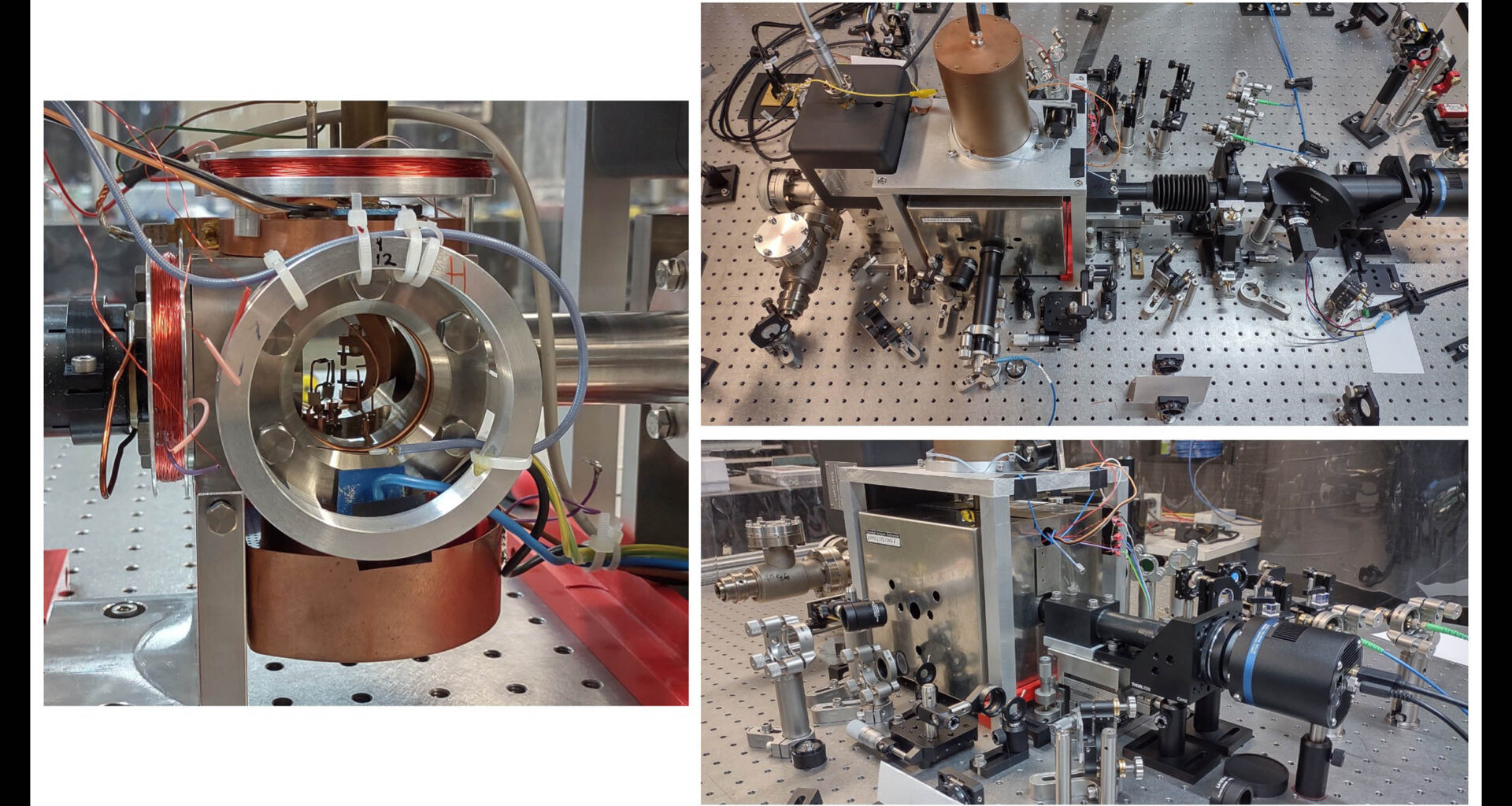
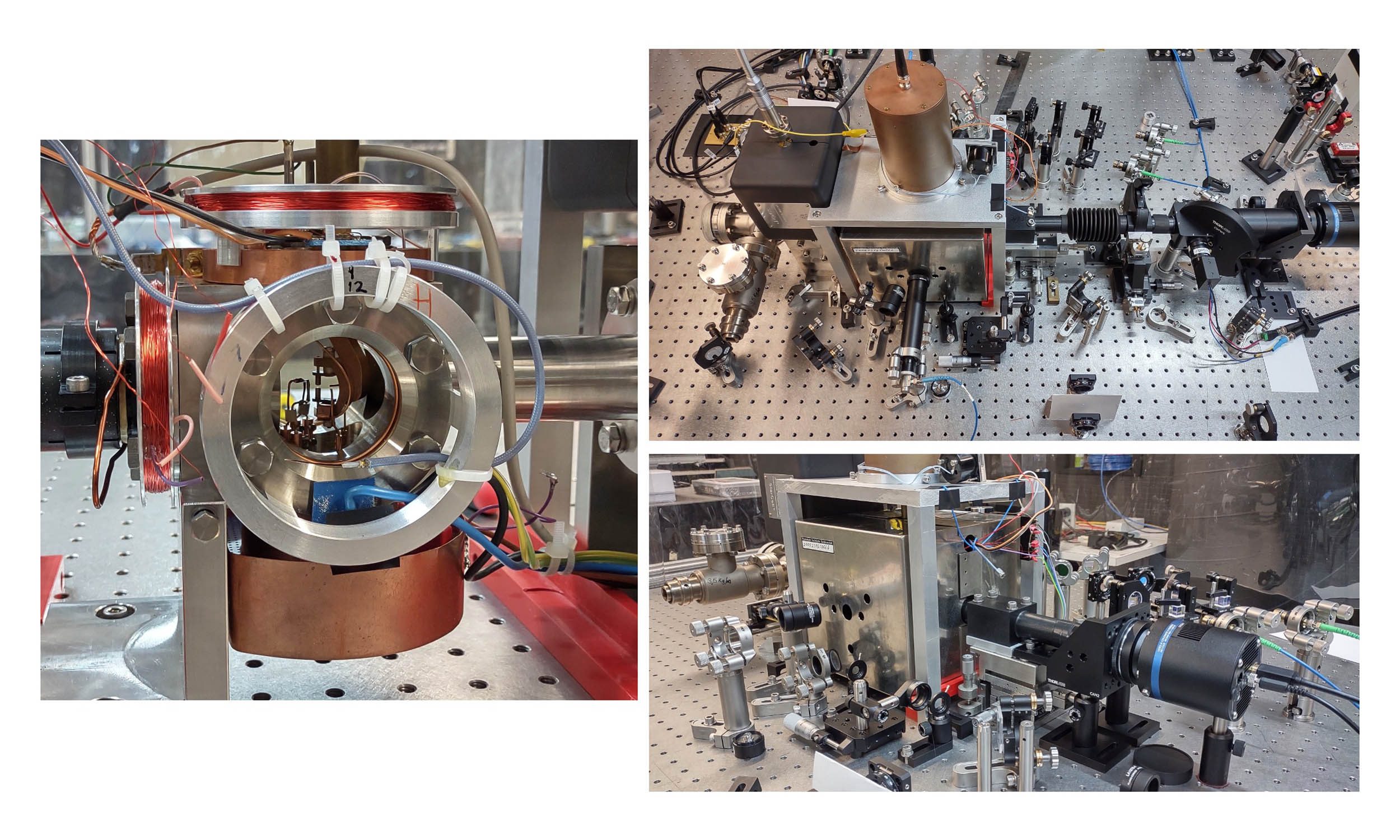 Pictures of the components used in making an atomic clock. The ion trap (left image) holds the clock in place. The optical/laser apparatus (right images) measures the clock’s frequency. Credit: Kyushu University/Colorado State University/Christian Sanner. Click image to enlarge.Boosting the clock signal
The team also worked out how to make the signal louder. Today’s trapped ions sit inside electromagnetic cages and are cooled to within a whisker of absolute zero, where their residual motion must be described in quantum terms.
Preparing the ion in a squeezed state – pinning down its location at the cost of making its speed less predictable – amplifies the predicted effect by a factor of 100 to 1,000.
A leap of that size could open real experimental opportunities. Existing research on next-generation optical clocks has already incorporated squeezed states into the toolkit.
Building the quantum clock
For now, this remains a theoretical proposal. The required hardware already exists in principle – laboratories already build optical ion clocks using single charged atoms.
Aluminum and ytterbium – a dense, silvery metal – are the two most common choices. Both can be cooled to near absolute zero and trapped with lasers precise enough to detect the effect the researchers predict.
What’s still missing is a unified experimental protocol: the right degree of squeezing, the right interrogation method, and conditions clean enough to pull the signature out of the noise.
“Naturally, bringing our theoretical model to reality is the big next step, and developing a detailed experiment that accounts for real-world unpredictability will give us further insight into our model,” said Foo.
The future of quantum time
Physics has spent a century chasing the meeting point between relativity and quantum mechanics. Time has remained one of the deepest sticking points.
Until this study, no one had outlined a near-term experimental path to test whether time itself follows quantum rules. The new framework provides one.
If a clock built along these lines eventually shows the predicted entanglement signature, it would mark the first observation of proper time existing in superposition.
That outcome would open the door to a regime where the smooth flow of time bends under quantum mechanics. The same techniques could then probe an even thornier question: the quantum side of gravity.
The study is published in Physical Review Letters.
—–
Like what you read? Subscribe to our newsletter for engaging articles, exclusive content, and the latest updates.
Check us out on EarthSnap, a free app brought to you by Eric Ralls and Earth.com.
—–