
Some of the more old-fashioned sights in London give the city a period feel. Photo / Imogene Bedford
But the metaphorical distance doesn’t last long. Within hours, the everyday begins to assert itself in less curated ways.
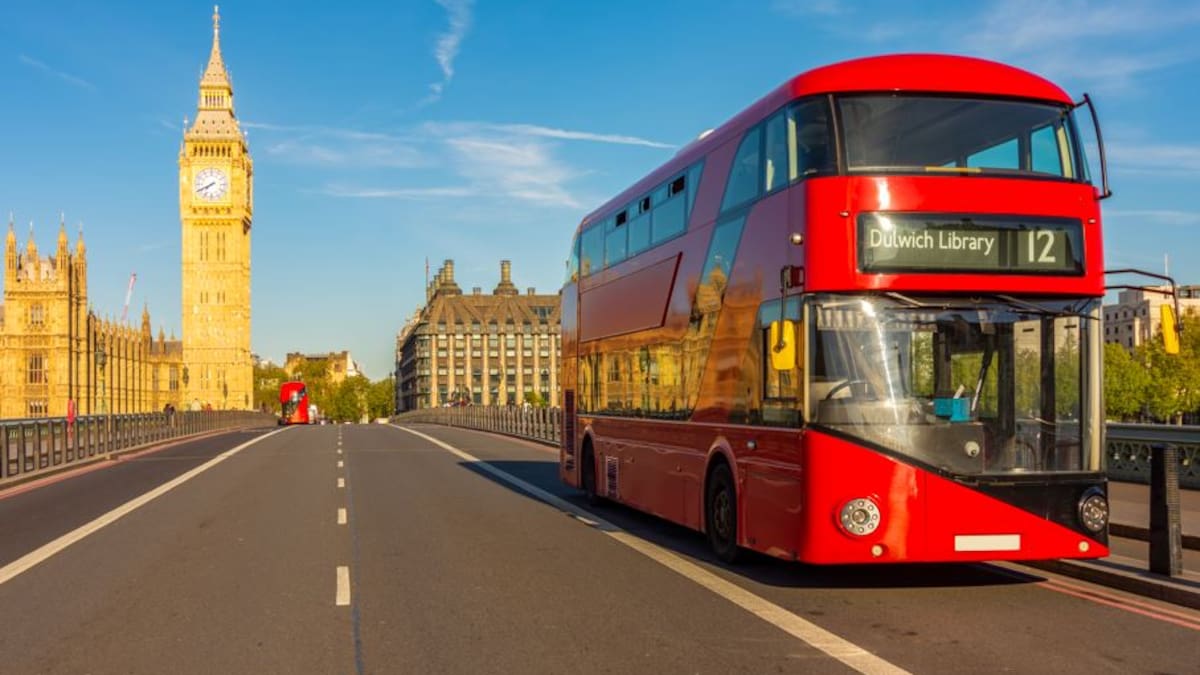
Drivers may be indifferent when you flag them down too early, but London’s red buses are frequent and straightforward to use. Dogs abound on these well-connected services, and journeys cost as little as £1.75 ($4) to ride.
The Underground moves faster still. Every Londoner, it seems, has a station they defend, a line they avoid, and a story attached to both.
The Painted Hall at the Old Royal Naval College in London. Photo / Imogene Bedford
It is the perfect way to explore a city best experienced through movement. Each borough has a distinctive identity from the next, colourful details that are far richer off-screen than on.
Piccadilly Circus is all light and sound, while Westminster carries a stronger sense of institutional weight and history. Soho’s Berwick St – the cover of Oasis’ seminal (What’s The Story) Morning Glory? – is still lined with record stores and men carrying vinyl like a personality trait.
In Camden, I catch Del Water Gap at Roundhouse, a venue that hosted Fleetwood Mac and The Clash during the 1970s. The uniquely circular space is surrounded by eclectic bars and vintage shops that give the area an indie cool.
The most recognisable spaces are no longer confined by aspect ratio. Baroque architecture at the Old Royal Naval College in Greenwich has appeared in Skyfall, Les Miserables, and of course, most recently, Bridgerton.
The Tate Modern boasts a world-class selection of modern art. Photo / Imogene Bedford
My guide Jonathan flips through a book of past productions as he explains how each location was transformed into different historical settings: Regency one moment, wartime the next. Visitors can even get a glimpse of filming as it unfolds.
Almost all of London’s other cultural offerings are just as accessible. Works by Warhol, Monet, and Picasso hang at the Tate Modern, free to the public. Standing before Salvador Dali’s Metamorphosis of Narcissus, the experience is as unexpectedly affecting as it is familiar.
At the National Portrait Gallery, I peruse some of Britain’s most famous faces, while the Design Museum charts the evolution of the everyday. The city feels less like a backdrop than part of the production itself.
The River Avon, famous for it’s influence on Shakespeare, cuts through Stratford-upon-Avon. Photo / Imogene Bedford
Further beyond the capital, fiction and reality seem to be even more intimately intertwined. Stratford-Upon-Avon, best known as the birthplace of William Shakespeare, has a storybook quality. Here, history is not just remembered, it is part of the setting.
It’s easy to travel to this small medieval town: just under two hours out of London Marylebone by train, the city fast gives way to the Midlands countryside.
On the edge of the River Avon, the Royal Shakespeare Theatre puts on productions year-round, drawing audiences as much to revisit the canon as to reinterpret it.
Travellers can visit where Shakespeare was born. Photo / Imogene Bedford
The recent release of Hamnet, Chloe Zhao’s acclaimed film starring Paul Mescal and Jessie Buckley, has the village abuzz and teeming with travellers. Over a crisp chenin blanc at the Arden, the conversation flows easily.
“It’s a lovely place, this,” one diner says to the elderly sisters seated next to him. He has been coming here since the 1980s, while they have visited since the 1950s. There’s a clear sense of continuity in place.
A window at Shakespeare’s Birthplace offers early proof of this. When the house was converted into the Swan and Maidenhead pub, visitors engraved their own names in the glass, inserting themselves very literally into the story. A tradition of low-level vandalism has quietly rebranded as British heritage.
Pubs remain a constant through it all. Often overpriced but always charming, they are informally a national third space. In Stratford, the 15th-century Garrick Inn is more lived in than looked at, worn surfaces and crooked beams evoking centuries of habit – the perfect space to enjoy a local beer and briefly contemplate deleting Instagram.
Shibden Hall was the main filming location for both seasons of Gentleman Jack. Photo / Imogene Bedford
Journeying north, the scenery changes in tone as much as geography. The landscapes of Yorkshire are softly dramatic, winding lanes cutting through rolling hills as the cars barely squeeze past one another in improbably polite mutual trust.
At Shibden Hall near Halifax, West Yorkshire, the manor made famous by the BBC’s Gentleman Jack, Anne Lister’s story onscreen has given the timber frames a new life. My guide explains the property has become a “lesbian mecca” in recent years.
“Basically, it’s a glorified farmhouse”, he says of the striking building, half Tudor and half stone. “It’s Anne that puts it on the map.”
Lister kept scrupulous diaries, often in code to conceal a laundry list of love affairs with upper-class women. The series was filmed in the original interiors, which have been refurnished to preserve the integrity of the space. In the courtyard, visitors can visualise the world she inhabited as they explore the stables, blacksmith, and an apothecary.
The township of Haworth has many charming Old English themed shops. Photo / Imogene Bedford
Further into Brontë country, the relationship between landscape and literature becomes more explicit. Jane Eyre and Wuthering Heights are inseparable from the environment that produced them.
Scattered townships of stone houses, like the small settlement of Low Row, have an atmosphere defined by the ruggedness of the terrain. The moorlands stretch on perilously into the distance, their scale a dominant feature. It’s easy to understand how isolation shaped the writing.
The Brontë homes and their surroundings similarly ground the sisters’ domestic lives, even as they feel lifted from a period drama set. In Haworth, visitors can stop by Mrs Beighton’s Traditional Sweet Shop for a taste of Old England, where the shopfronts are carefully preserved and still in active use.
Emerald Fennell’s adaptation of Wuthering Heights was filmed in North Yorkshire. Photo / Imogene Bedford
An unexpected Midlands interlude has its own surprises. Best known as the setting of Peaky Blinders – to the irritation of some locals – Birmingham is considerably more industrial sprawl than cheese cutter crime drama.
The city is often linked to J.R.R Tolkien, a connection Kiwis might see as a minor custody battle given our own claim over The Lord of the Rings. Amidst the Aston Villa chatter everyone seems only half-aware they’re living in a place others insist on mythologising.
Up close, it’s clear my misgivings about England have been shaped much more by distance than experience. It might look like a film set from afar, but that’s part of its appeal.
In the everyday, the mundane really does hold its own quiet spectacle. A slightly warm pint at a roadside pub doesn’t disrupt the illusion so much as confirm it.
The journalist travelled courtesy of Visit Britain.