
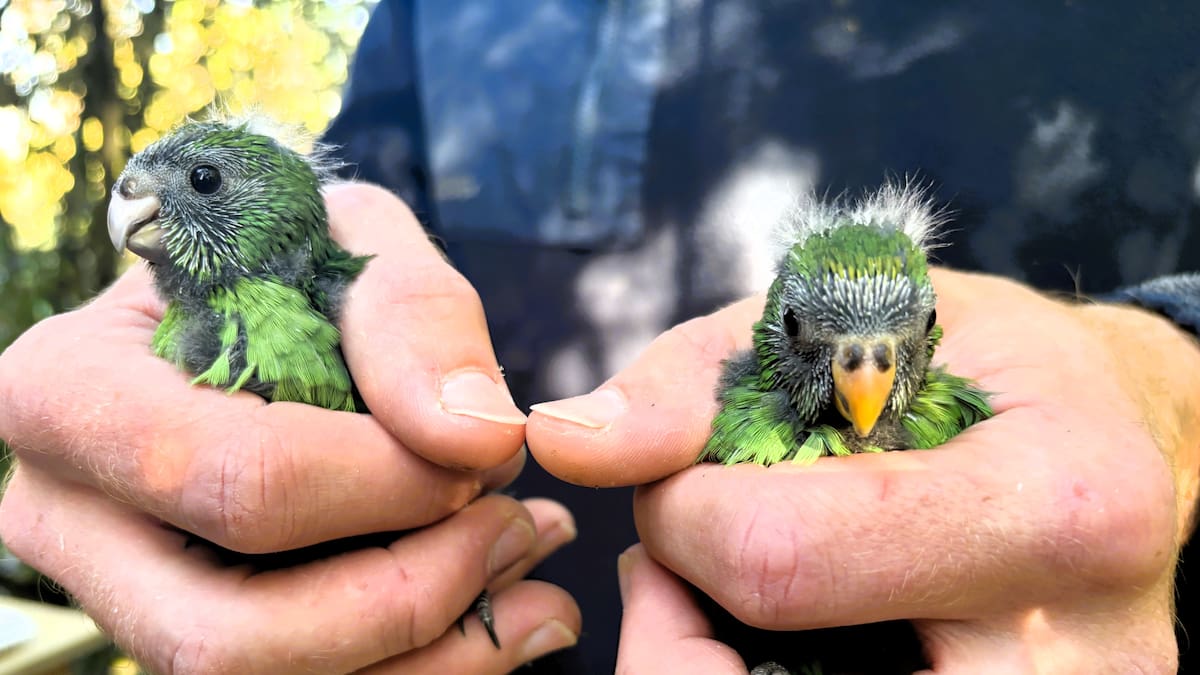
“The breeding season has ended and yet she’s still producing eggs and raising chicks,” Percasky said.
Two of the more than fifty Kākāriki karaka chicks, super parents Nacho and Trixie, have reproduced.
“Ideally, we’d prefer her to stop so she can have a rest, but she shows no signs of that with another seven chicks in her most recent clutch.
“Nacho also deserves credit as he’s responsible for finding food for both Trixie and the chicks, which is incredibly busy. Male kākāriki karaka play a crucial role in chick-raising.
“Trixie herself came from an egg from a pair in the wild, and she’s an incredibly robust, healthy bird who breeds larger-than-normal chicks with Nacho.
“Many of her offspring have been translocated to help boost other populations of kākāriki karaka on offshore islands and into other locations in the wild.”
Nacho is responsible for finding food for both Trixie and the chicks.
Percasky said he’s in awe of Trixie and Nacho and seeing them produce so many chicks is hugely satisfying for everyone involved.
“These two are making a massive contribution to the survival of their species and are such great parents.
“We’re hoping they will decide to have a well-earned break after this clutch. I’m not sure where they get all their energy from.”
The critically endangered bird is New Zealand’s smallest and rarest parakeet, with around 450 left, mainly in predator-free sanctuaries like the Brook Waimārama Sanctuary in Nelson, or on islands like Blumine Island/Ōruawairua in Marlborough and Pukenui/Anchor Island in Fiordland.
Twice declared extinct, then rediscovered, there are two wild populations of kākāriki karaka in Canterbury.
One resides in the Hawdon Valley near Arthurs Pass and the other in the South Branch of the Hurunui River, with current estimates of 50 and 60 birds in each valley.
Trixie has been described as a “super-mum” for her species.
The Department of Conservation (DoC) and Te Rūnanga o Ngāi Tahu lead a recovery programme focused on researching and breeding birds in captivity to release into the wild.
They also protect sites where kākāriki karaka are found, while looking for safe new sites where the species can be introduced.
DoC staff have this week transferred 43 kākāriki karaka, including Trixie and Nacho’s offspring, from The ICWT and Orana Park to Pukenui/Anchor Island, hoping to further grow the population there.
The team are now surveying that population to establish accurate numbers of the birds.
DoC Kākāriki Karaka Recovery Programme lead Wayne Beggs said without the work that the ICWT and Orana Park do by looking after birds like Trixie and Nacho, the special parakeet would have gone extinct.
“We rely on the captive breeding programmes as without them, we couldn’t establish new sites,” Beggs said.
“The wild populations are very vulnerable to predators, so we always need back-up populations.
“The places that help us achieve this are the nurturing heroes. There is so much hands-on work that goes into rearing these chicks.”