
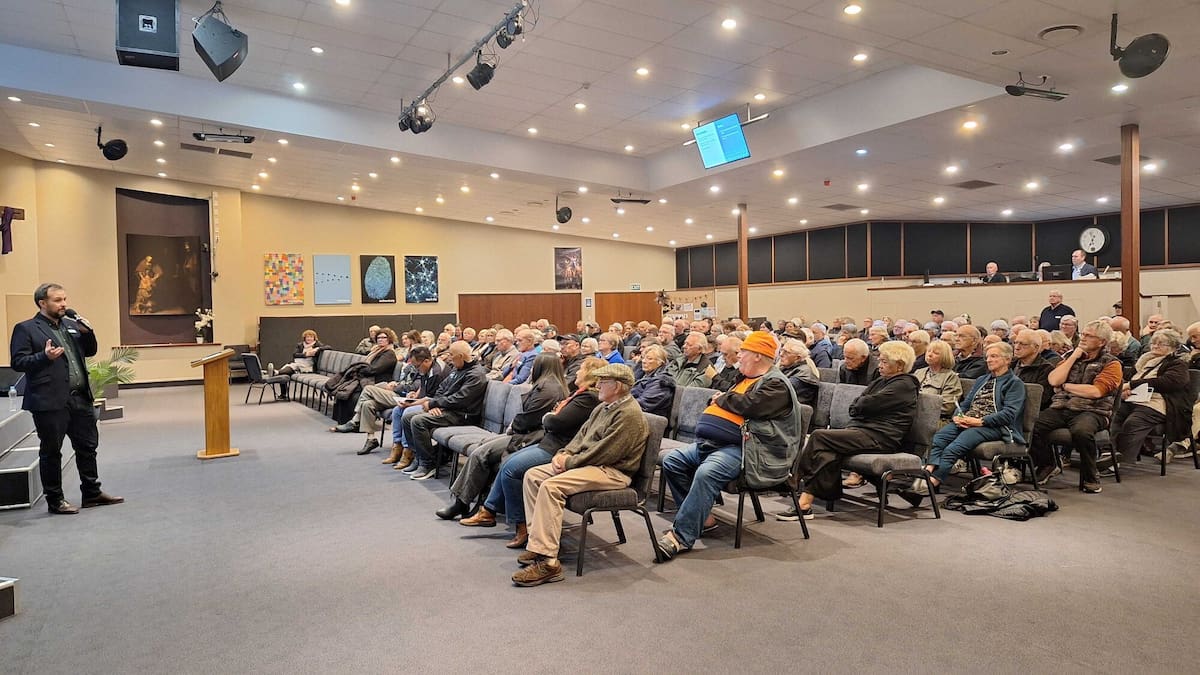
“There certainly has been a clear theme of outrage over a three-month timeline to come up with something so important,” Gilmore said.
Members of the community were able to ask their initial questions and given a chance to pick their preferred option in a survey. Photo / Michaela Gower
Community questions at the meeting centred on rates, loss of voice, fears of being forgotten, the looming general election, the cost of amalgamating and calls for unity.
“What I really liked was that people were really open to hearing other people’s suggestions and thoughts.”
One community member said all he could see with the options was “doom and gloom for Tararua”.
Option 1: Backstop process
This is where the Tararua District chooses not to participate in the Head Start pathway.
The district would continue to work with neighbouring councils and communities, in preparation for the backstop process with large-scale unitary councils.
Gilmore said it could result in a loss of choice in regional reorganisation.
“I’ve heard ministers say that the best way to look at this is it’s a carrot-and-stick approach, Head Start is the carrot, backstop is the stick.”
He said the advantage was more time to make well-informed and sustained decisions on the reform options provided.
Option 2: Go south to Wairarapa
This would likely involve going with Masterton, Carterton and South Wairarapa councils, and give Tararua two to three seats in a new council.
Gilmore said the advantages were that all of them were similar-sized councils, which would maintain a balanced voice.
There are also shared rural and East Coast characteristics, and weather challenges.
“We have existing collaboration already with strong relationships through iwi connections and through Waitī Waters.”
Gilmore said Wairarapa potentially might not be viable to go it alone and might be included in a wider Wellington model.
Tararua District Mayor Scott Gilmore said community input was necessary to come to a solution. Photo / Michaela Gower
“It is likely with economies of scale that this could extend further to Wellington regardless of whether those councils wanted that or not.”
This would leave Tararua with zero seats on a new council, impacting voice, identity and representation.
Option 3: Go north to Hawke’s Bay
This could involve joining with Central Hawke’s Bay, Hastings, Napier and Wairoa councils.
The advantages included some shared rural and East Coast characteristics, existing historical connections, and weather challenges.
Gilmore said some people accessed services northwards, and larger urban centres could provide economies of scale.
“Looking at the risks, Tararua becomes a smaller voice, and rural identity and interest could be deprioritised.”
Option 4: Go west to the Horizons region
This option could involve Palmerston North, Manawatū, Horowhenua, Whanganui, Rangitīkei and Ruapehu councils.
Tararua would likely be represented with one seat on a new council.
Advantages included a mixture of smaller councils and some urban centres, which could provide economies of scale and maintain a balanced voice.
There is also some shared rural identity, and some people already access health and education services.
Existing collaboration already exists through the Mayoral Forum, with limited shared services.
Current regional boundaries and catchment areas align.
He said this option could offer different groupings, with the councils having other choices on how they amalgamated.
“Some of these councils may choose to go into different areas.”
Option 5: Split the district
This option meant different areas would go in different directions and align with areas they already identify closely with geographically.
This option reduces the Tararua collective voice and identity, Gilmore said.
“Some Tararua communities may find themselves unrepresented, depending on the way they go.
“[It] would likely involve significant complexity, transition risks and uncertainty, including around catchment alignment.”
Gilmore said this option would require a “de-amalgamation” to split assets, then a re-amalgamation.
“Maybe people would want to go in different directions,” he said.
“It’s not what I want and it’s not what I stood for the job for.”
Option 6: Fight for a better option
This option seemed to get the most reaction from the crowd.
“[We would need to] convince the Government there is a better way,” Gilmore said.
“We could design something that may actually solve the problem.”
Gilmore said if this way is chosen, the Government may reject a different option and choice could be removed.
Further meetings are planned for Eketāhuna on May 22, Herbertville, Ākitio and Pongaroa on May 23 and Norsewood on May 25.
Michaela Gower joined Hawke’s Bay Today in 2023 and is based out of the Hastings newsroom. She covers Dannevirke and Hawke’s Bay news and loves sharing stories about farming and rural communities.