
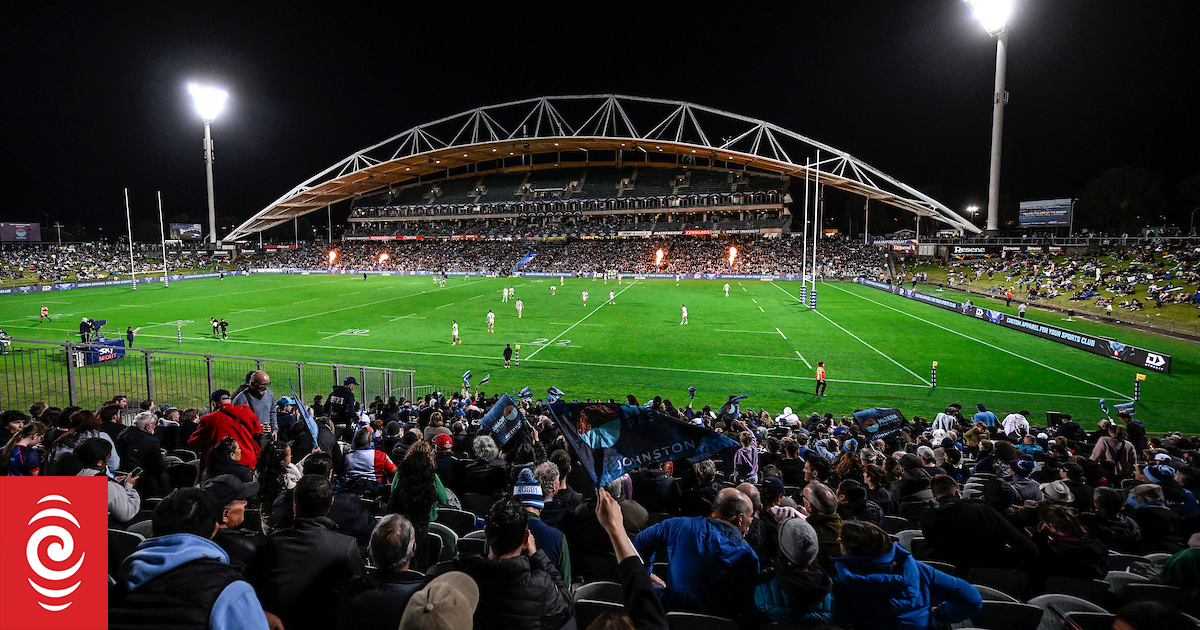
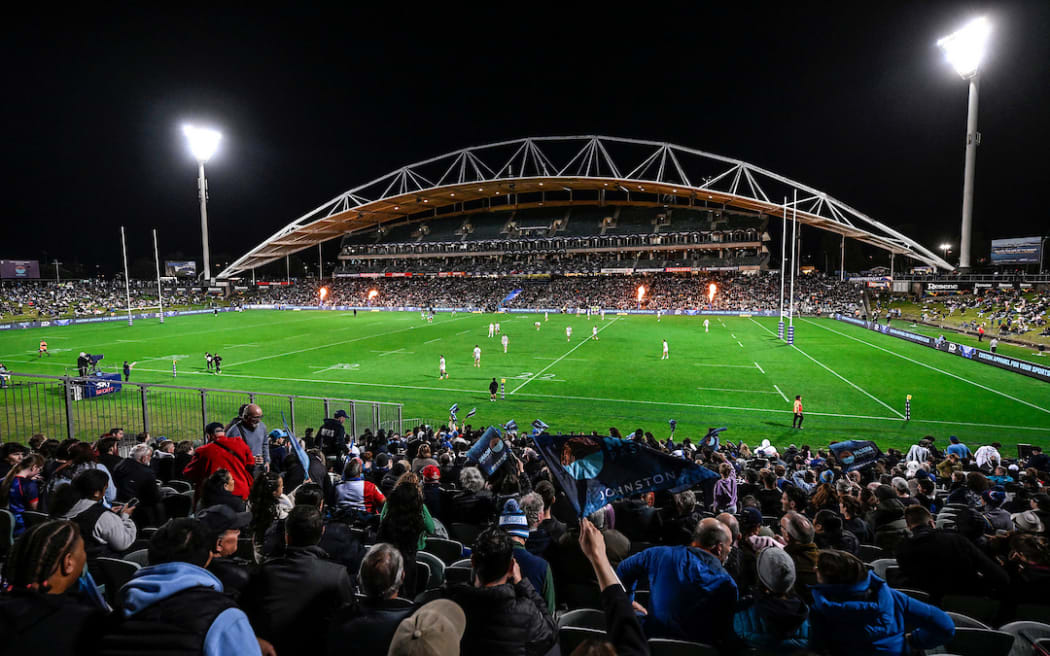
Moana Pasifika will play their last home game this weekend against the Queensland Reds at North Harbour Stadium.
Photo: Andrew Cornaga/www.photosport.nz
On a crisp, clear Thursday morning, a large contingent of media are gathered in the sunshine on the outer oval of North Harbour Stadium for a club very much enjoying its moment in the sun.
Cameras line the edge of the field as Auckland FC players move through drills beneath the watchful eye of coach Steve Corica, the session unfolding to a soundtrack of thudding footballs and animated chatter.
This is the biggest week in Auckland FC’s short history. On Saturday the Auckland side will take on Sydney FC in the A-League grand final in front of a sold out crowd at Mount Smart.
It is the first time a Kiwi team has made the A-League final, and it’s the first time Australian football’s showpiece event will be held on New Zealand soil.
While the cameras are trained on New Zealand’s newest sporting darlings, on the neighbouring field Moana Pasifika head coach Tana Umaga holds an awkward stand-up with three journalists.
None of the major TV networks are there for this one.
For the past two years Auckland FC and Moana Pasifika have trained on neighbouring fields in Albany.
But while they share a training base, the two clubs have increasingly come to inhabit very different realities.
As Auckland FC prepare to host a grand final, Moana Pasifika are preparing for their final chapter. The Super Rugby club will play its home game this weekend against the Queensland Reds, before disbanding at season’s end.
It is a strange co-existence of anticipation and mourning.
One club is walking toward a defining moment in its history, the other toward an ending. They do so through the same doors every day.
The contrasting fortunes of the two sides were not lost on Umaga.
“I was sitting up in the gym earlier contemplating the differences [with Auckland FC] and look, we fully support them. They’ve been awesome flatmates. It’s great to see where they’ve got to and they are fully deserving.
“I guess what it’s demonstrated for us, is that in professional sport when you get success, success follows. When you don’t … yeah.”
Umaga leaves the thought unfinished. But then, he doesn’t really need to explain the situation facing his side – it has played out in the headlines over the last month since the abrupt announcement from the team’s owners, the Pacific Medical Association, that it was cutting the team adrift.
The collapse followed years of financial and structural pressure, with Moana Pasifika struggling to establish a sustainable footing in the competition.
And so, all the team can do is try to turn up for their home fans one last time on Saturday afternoon.
“We’re proud people, and we’re a proud team. We’ve created so much in the short time that we’ve been here yet it’s still difficult at the moment there’s a lot of things going on behind the scenes,” says Umaga.
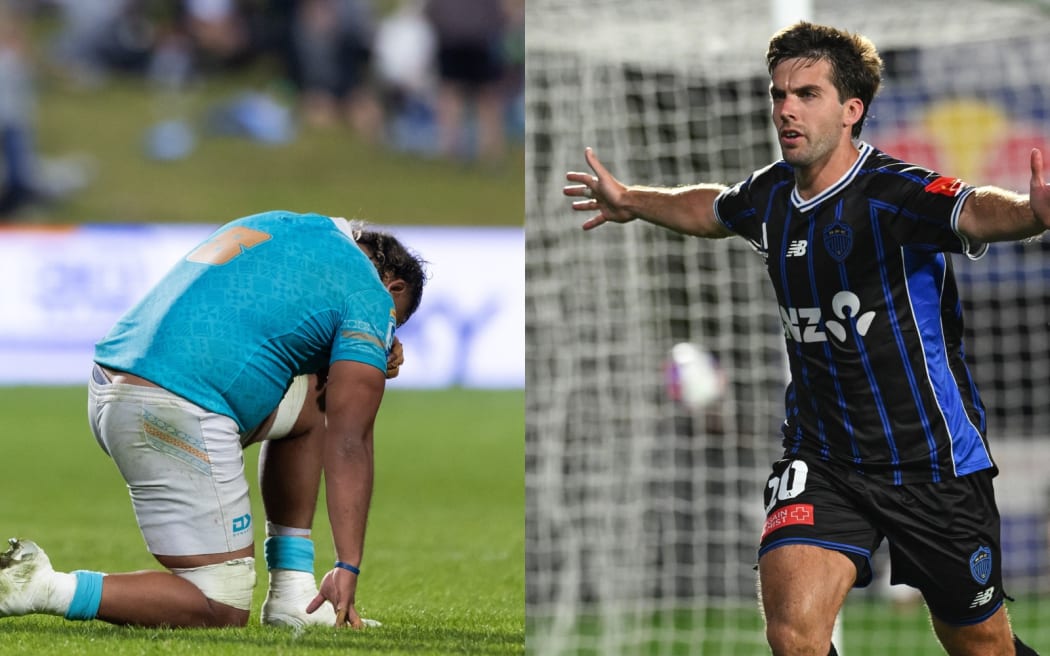
For the past two years Auckland FC and Moana Pasifika have trained on neighbouring fields in Albany.
Photo: Photosport
Flatmates
It has always been an unusual arrangement.
Auckland FC and Moana Pasifika, footballers and rugby players, occupying neighbouring fields at North Harbour Stadium. In a city with a chronic shortage of elite sporting facilities, the pairing was born more out of necessity, than natural synergy.
When Auckland FC arrived on the scene ahead of its debut 2024/25 season, there were few obvious homes for the team.
While the side were able to secure Mount Smart for its home matches, the Warriors’ entrenched presence in Penrose meant there was little room for another professional outfit to establish a permanent training base there.
Instead, Auckland FC set up camp in Albany alongside Moana Pasifika, creating one of the stranger sharehouse arrangements in New Zealand sport.
Moana Pasifika had been based at North Harbour Stadium since its inception in 2022, though the club’s ability to play there remained limited by Super Rugby’s existing territorial arrangements with the Blues.
For all their physical proximity, however, the two expansion clubs were built on radically different foundations.
Auckland FC arrived with heavyweight backing and immediate ambition.
The club forms part of US billionaire Bill Foley’s growing sporting empire, with support from high-profile New Zealand investors including Ana Mowbray, Ali Williams and Steven Adams. Before a ball had even been kicked, Auckland FC had aggressively recruited local football talent and mobilised a strong supporter base.
Momentum came quickly.
Moana Pasifika’s path was far less certain.
The club was hastily assembled following Super Rugby’s post-pandemic reshuffle. The goal was to provide a professional pathway for Pacific players and communities historically underrepresented in Super Rugby.
Funding came largely through government support and grants from World Rugby, with the club never managing to establish the same commercial footing as some of its rivals. Under its licensing agreement, Moana Pasifika were also limited in how many New Zealand Rugby-contracted players they could recruit, restricting their access to top domestic talent.
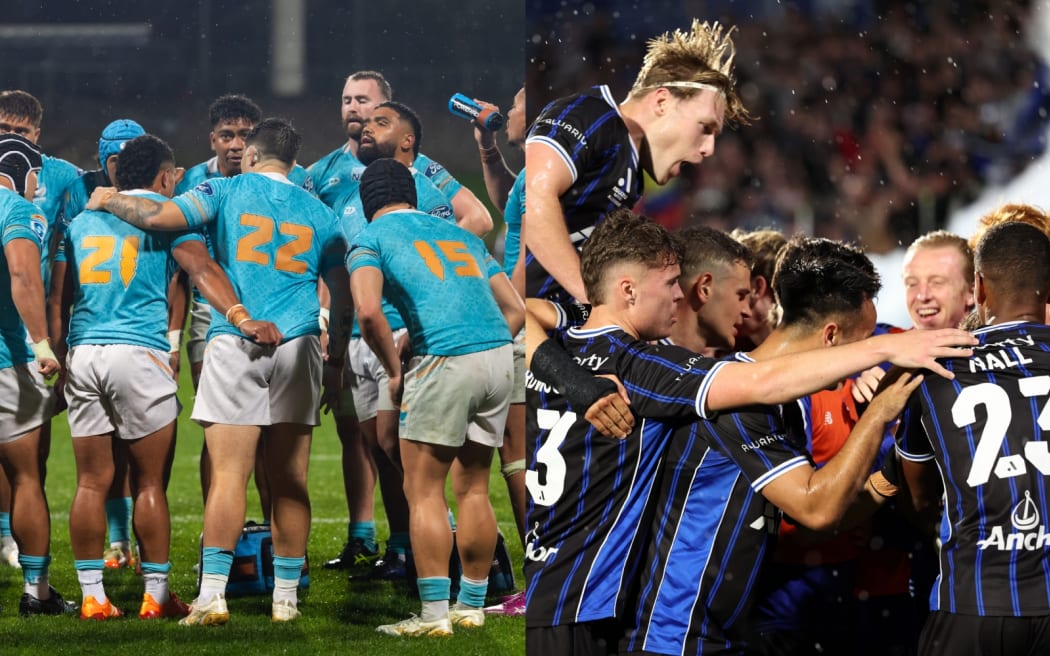
As Auckland FC prepare for a grand final showdown against Sydney FC tomorrow night, on the training field beside them, Moana Pasifika are preparing for their final chapter.
Photo: Photosport
Umaga says resources have shaped the different trajectories of the two teams.
“I think that’s probably the difference – resources. When you have the resources, things can happen for you. When you don’t … well, we’re at that end of the spectrum.
“It would be nice if [Auckland FC] could slip us some, that might help us.”
For two years, the clubs shared fields, training facilities and quips in the hallway.
But they never shared the same margin for error.
The spotlight
Minutes after Moana Pasifika wrapped up their media session – with only Umaga and first five Jackson Garden-Bachop stepping out from the team room before training later in the day – attention shifted to the neighbouring field.
“Wow, I think this is the biggest one we’ve had,” the team’s head of communications, Ian Benet, remarked as he surveyed the bank of cameras and horde of reporters swarming around midfielder Cam Howieson, who was first up to the microphone.
Among the cameras trained on the spectacle is the documentary crew, who have been following the team’s fortunes again this season for the next installment of Forever Auckland FC – latching on to the trend in sport for behind-the-scenes storytelling popularised by Drive to Survive.
The last few weeks have provided the producers with plenty of cinematic storylines.
Earlier this season the club looked on track to repeat last year’s efforts of finishing top of the table. But a late-season injury run took Auckland FC from expected table-toppers to battle-hardened finalists, forcing them into the elimination final, where they survived a penalty shootout against Melbourne City to set up a semi-final showdown with Adelaide.
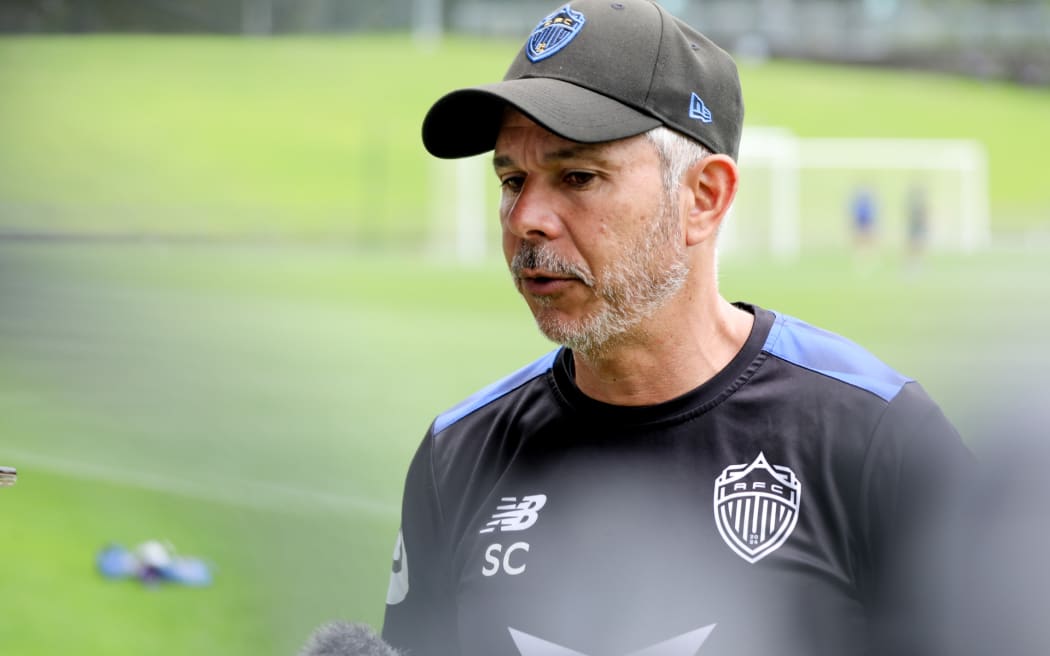
Auckland FC coach Steve Corica
Photo: RNZ / Marika Khabazi
After drawing the first leg at home, Auckland FC were all but written off for the return fixture before delivering one of their best performances to date – a 3-1 rout over Adelaide.
Coach Steve Corica, who, in another neat sub-plot, will be coming up against his old side in Saturday’s title decider, says lifting the trophy this Saturday would be a dream finish.
Corica isn’t just Sydney FC’s former coach. He is a foundation player and former captain, before transitioning to the coaching staff, and has been involved in every A-League title the club has won.
While this weekend will be the biggest of the club’s short history, Corica is confident his side will deliver.
“I know my players and what they can produce,” he says.
“We’ve been going for two years and we’ve won a premiership, a couple of semi-finals, they’ve always performed under pressure.
“There’s probably that added pressure that we didn’t have last week [in the away semifinal in Adelaide], everyone’s going to have their family and friends there watching, but they really have performed well under pressure when we’ve asked them to. It’s just maintaining focus, not getting too carried away in the lead up to the grand final.”
While Corica is attempting to keep his players grounded, Auckland FC chief executive Nick Becker has embraced the sense of occasion entirely.
Part promoter, part hype man, Becker has spent the week helping turn the club’s first grand final into something closer to a major entertainment event.
The VIP guest list for the sell-out match is rumoured to include Taika Waititi, Rita Ora and Jason Momoa.
“It’s going to be such a special occasion, and to be able to make a grand final but also host it for the first time in your own backyard is incredible. I’m so proud of the boys … and we can’t wait to get in front of a full house and win it for them.”
Yet even amid Auckland FC’s week of celebration and spectacle, the shadow hanging over the neighbouring field remains difficult to ignore.
Corica says he was disappointed the timing clash would prevent his side from attending Moana Pasifika’s final home game.
“They’ve been great, we love their energy – they often have the music blaring on the field next to us. We wish them all the best.”
The final shift
Asked if they were expecting a big crowd for what will be an emotional final outing at home, Moana Pasifika’s communications manager Shontelle Matano was not optimistic.
“Not really,” she said.
“The crowds have sort of drifted away.”
When the club first announced it would be wrapping up its operations at the end of the season, there was some hope that Moana Pasifika’s licence could be picked up by a private consortium.
Over the past few weeks, that hope, like the crowds, has faded.
Umaga has been outspoken about what he sees as a lack of transparency and communication from the team’s management about what the collapse of the franchise means for the players.
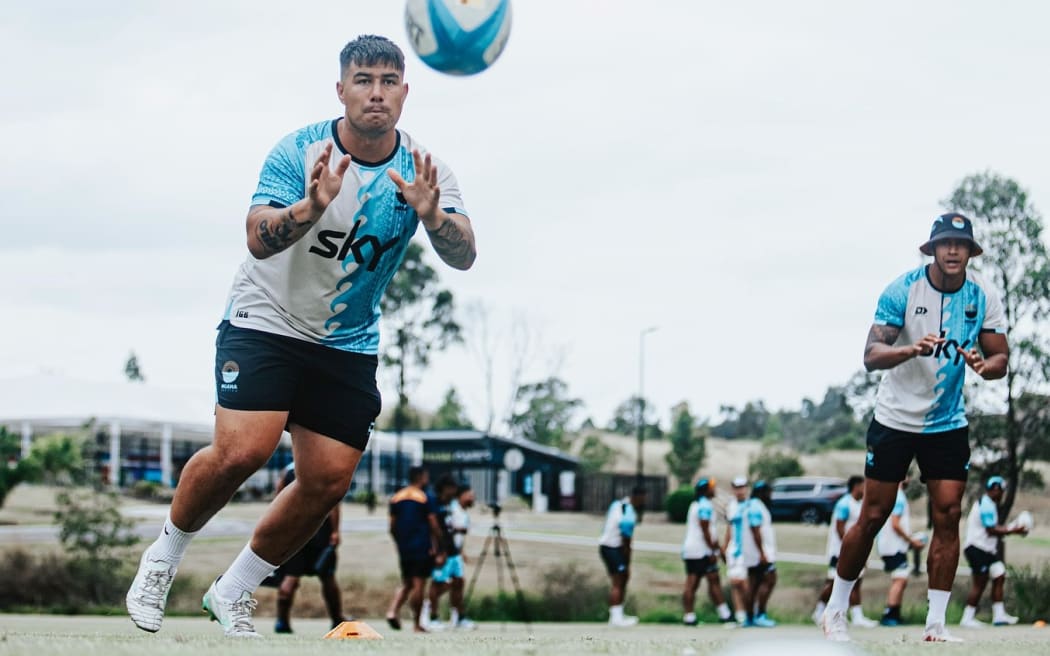
Jackson Garden-Bachop
Photo: Moana Pasifika
First five Jackson Garden-Bachop, who has been with the club the past two seasons, says the uncertainty and lingering questions over whether players will be paid out their contracts has taken a toll on the team.
“On and off the field there is a lot going on at the moment – every one is in different situations contractually, financially and in life as well. We need to lean on each other,” he says.
“We’re just excited to have one more game in front of our home crowd, our people. All our talk has been around putting on a performance that they can be proud of.”
Through it all, Umaga has tried to shield his players from the instability surrounding the club.
He admits, however, the strain has inevitably taken a toll.
“Yeah, 100 per cent. I’d be surprised if it isn’t. Because we’re asking them under that stress to play a professional sport, which is pretty tough on the body and the mind.
“It’s tough coming out to work knowing there’s a lot going on behind the scenes affecting their mindset and wellbeing.”
Professional sport asks the same things of athletes regardless of circumstance: routine, preparation, commitment, resilience.
At North Harbour Stadium this week, one group is seeking to become immortal.
The other is disappearing.
But both still have to get through training.
Sign up for Ngā Pitopito Kōrero, a daily newsletter curated by our editors and delivered straight to your inbox every weekday.