
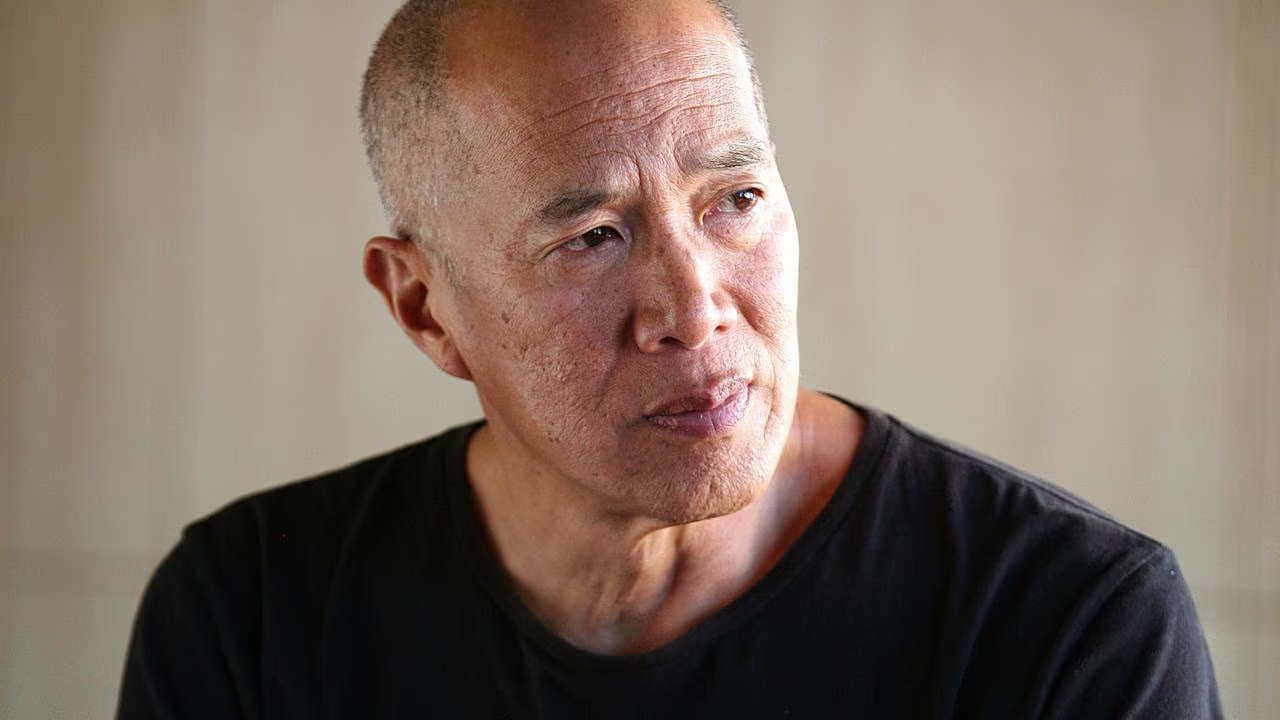
More than 18 years ago, Charlie Teo operated on a rare malignant tumour in my head. I went to him after other doctors sent me home, telling me it was benign, and I had more of a chance of getting hit by a car than dying from the tumour.
They were wrong. Dr Teo was right.
Since then, Dr Teo has become one of the most controversial doctors in modern Australian medical history.
The Health Care Complaints Commission placed conditions on his licence after two horrible deadly outcomes.
Those restrictions require the approval of another surgeon before Dr Teo is allowed to operate on the worst kinds of tumours. The very few surgeons who agreed to sponsor the operations were rejected by the medical council and hospitals now consider him too controversial to have on their books.
Hence, these restrictions have effectively banned him from performing surgery on his home soil.
It took me 10 years before I wrote about my experiences with him, and since then, I have told many stories of other patients and families who have dealt with him.
But there are those in my own profession who feel that, as a former patient, I shouldn’t be telling these stories.
You be the judge.
I first wrote about my own experience with Dr Teo and another brilliant surgeon Dr Tom Kertesz in 2017, when I was asked to be an ambassador for the Cancer Council Relay for Life.
At that time, I hadn’t spoken to Charlie since my last appointment with him back in 2007.
In the years that followed, as he came under intense scrutiny and the focus of public debate, I felt compelled to reach out to him for the first time in more than a decade to request an interview about the controversy.
He was being described in news reports as an egotistical neurosurgeon with a bad bedside manner, a money-hungry cowboy giving vulnerable patients false hope, a last resort, performing procedures no other surgeon would touch.
As a journalist of more than two decades, I was curious. I needed to find out what he thought about the scepticism and the accusations.
To be clear, I hadn’t spoken to Dr Teo in years, so I sent an email to his reception.
We had not been in contact for more than a decade because I did my terrifying annual check-ups with another surgeon because, quite frankly, Dr Teo was blunt. He told it like it was and sometimes I was too scared to hear what my ongoing prognosis might be, especially as a mum of two young sons.
When I reached out, Dr Teo did not recall my case. He looked me up after I declared I was a former patient – and a dreaded journalist.
He agreed to meet with me. I let him talk, a chance to put his side of the story on the table.
I don’t regret it.
He addressed the allegations against him one by one, including the false claims that he operated on the wrong side of the brain.
World-renowned neurosurgeons confirmed his surgical approach was appropriate in the circumstances. Relentless publicity continued and patients came out of the woodwork – former patients and those wanting to contact Dr Teo for consultation after receiving the worst news of their lives.
I was a 48-year-old former patient. I was also a journalist determined to give everyone a chance to share their side of a story, no matter how unpopular it might be.
I made it clear from the outset to Dr Teo there would be further questions.
After I wrote my first stories I waited for an influx of disgruntled patients … they never came.
I waited for the horror stories and was fully prepared to report them … they never came.
I heard a lot from the medical fraternity, many doctors and hospital staff who came out in support of Dr Teo but wanted to remain anonymous for fear of reprisals.
A culture of bullying in the surgical world became evident with many surgeons trying to make a difference but weighed down by detractors, envy and internal politics.
I was learning that the life and death world of neurosurgery was competitive, ruthless even, behind the scenes.
But I was driven to write stories for those families facing indescribable fear and feeling incredibly lost because Dr Teo was one of the few surgeons prepared to take on their cases.
I’ve had messages, as recently as last week, encouraging me to do more, calls to share the plight of more patients wanting to get Dr Teo back operating in Australia.
I don’t have that power, nor do I pretend to be a medical expert or have any kind of expertise to comment on the restrictions imposed on Dr Teo.
It’s not my role as a former patient. As a journalist though, I wanted to tell the stories of the thousands of people whose lives it affects.
I have spoken to countless wives, mums, dad, brothers and sisters, frantically trying to raise the funds to travel to China for last-hope surgery, desperate to buy a few more months.
Mums and dads of children like little Maddy Suy, who will forever cherish every extra cuddle, extra smile, extra song, extra craft session they got, thanks to Dr Teo’s intervention.
Nine-year-old Maddy died in 2024 after an almighty battle against DIPG.
She had surgery with Dr Teo in Australia and then travelled to China when she had a recurrence. She made the most of her short life, writing songs that inspired strangers across Sydney to form their own choir in her honour, drawing pictures that prompted a group of supermarket workers in country NSW to sign up for matching tattoos.
She adored Dr Teo until the very end.
Not even Dr Teo’s fiercest detractors question his ability as a surgeon.
He operates on the most dangerous of brain stem tumours that others won’t touch. Love him or hate him … that is a fact.
His official surgical statistics underscore his success rate and his abilities.
People facing their own mortality all deserve a choice. And they all deserve to be heard.
The restrictions on Dr Teo’s licence effectively mean he is banished to China and other countries that welcome him, wanting to benefit from his skills.
Dr Teo doesn’t shy away from owning his horrific outcomes, and he has never disputed the fact that people have died after surgery. But only the most horrible cases end up in Dr Teo’s surgery in the first place. He is their last hope.
All I have done since this controversy began is to report on the patients and families of patients who came to me wanting to tell their stories and offer support for Dr Teo.
I have also reported on developments in this story that are either newsworthy or in the public interest, or both.
There is no conflict of interest and I have declared my status as a former patient in dozens of articles. This is my third expansive piece outlining my operation and dealings with Dr Teo.
I have also reported on the adverse findings against him and the allegations posed by the patients who made complaints.
If you see a headline with the name “Charlie Teo” and you see that I am the author, then you are free to choose not to “click” or dismiss.
I will say it for the umpteenth time, I am a former patient.
And I am grateful that I’m still here to tell my story, but more importantly relay, without favour, the stories of others. That’s something I will continue to do until they don’t need me to.
STORY BY CYDONEE MARDON PUBLISHED AUGUST 2021
The garden variety CT scan was supposed to prove I was just one of the millions of unlucky Australians to suffer from migraines.
Instead, it uncovered a dark, shadowy, unknown mass in my head.
And so began months of misdiagnoses — from a benign tumour to a brain disease, to a benign tumour again.
This “mass” was in a part of my skull I had never heard of, my right petrous apex. There was no chance of a biopsy because of the complex location so that meant relying on a doctor’s instinct and experience.
The first surgeon I saw, a leader in skull base surgery at a prominent Sydney hospital, told me he’d seen hundreds of patients before me with this benign tumour and they’d lived long lives with no medical intervention.
The professor’s parting words were “go live your life, come back for a check up in 12 months”.
One month went by — two at the most — and I called the surgeon’s practice asking for a follow-up appointment. My call was met with exasperation. I felt like a pest wasting people’s precious time.
I had no symptoms, other than the wretched migraines, just a gut feeling. I told the doctor I was getting a second opinion and asked his thoughts on Charlie Teo.
“No, he’s a cowboy,” the professor fired back.
I did it anyway.
Sitting in his waiting room was surreal. Dr Teo had agreed to see me late one night after surgery. Leaning back in his chair, feet on the desk and dressed in his scrubs, he got straight to the point.
After reviewing my scans he said I had rare malignant tumour called chondrosarcoma.
It could be removed, not in his words, by cutting open my skull, taking out the tumour, and screwing it back together.
The risks were blindness, deafness and my face could collapse. The results might not be pretty, he said.
Worse case I could have a stroke and die on the operating table.
If I didn’t do it, the risk was I would die anyway.
Oddly, his blunt appraisal gave me comfort.
His next words convinced me I was in the right hands: “If you were my daughter I would say ‘do it’ ”.
Four days later I underwent a craniotomy at Prince of Wales Hospital. Testing on my tumour confirmed the diagnosis.
The surgery left me deaf in one ear and I cannot shed tears in one eye but 90 per cent of the cancer tumour is gone.
I’m eternally grateful.
On the morning of the surgery I thought it proper to call the original surgeon who told me I was more likely to die from getting hit by a car than be affected by the benign tumour that was too risky to remove anyway.
I thanked him for his time and expertise and said Dr Teo was removing the tumour.
The silence was deafening.
After what felt like five minutes, he said: “Well, good luck then. He’s a cowboy. Your life is in your hands.”
I am thankful for that cowboy — the man who has supreme confidence in his own skill and ability, who takes risks no one else will.
That was 15 years ago.
I cannot comment on the outcomes for other patients of Dr Teo. I don’t know them. I wasn’t there.
But what Dr Teo gave me was the opportunity to say yes.
Or no.
It was up to me to take the risk.
I’m forever grateful for being given that choice and others facing the prospect of an early death deserve the same.