
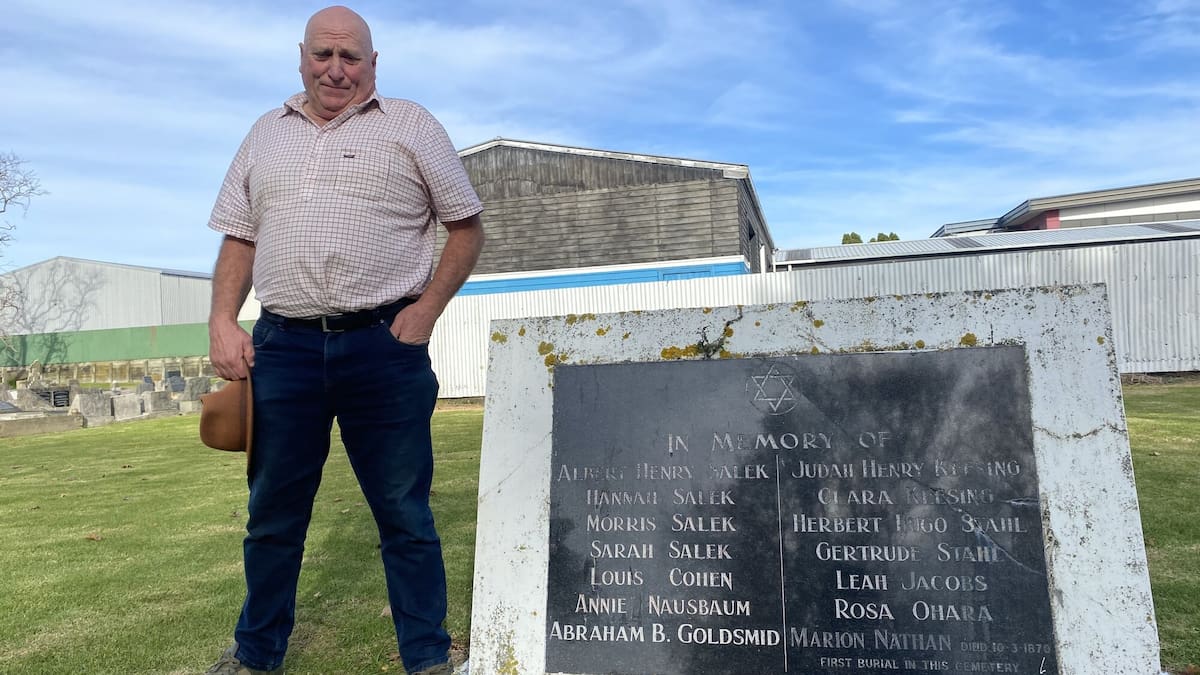
The Jewish Cemetery section at Heads Rd Cemetery dates to the 1860s, with the first burial in 1870 being Marion Nathan.
According to council archives, ownership and administration by the Wellington Provincial Government since 1862 moved to the Crown in 1875.
The largest section of Heads Rd Cemetery was transferred to the Borough Council in 1878 but the Jewish, Catholic and English cemeteries were not.
Over time, Whanganui’s Jewish population dispersed to places such as Wellington, where there was a larger Jewish community.
The council said this partly led to the cemetery’s deterioration as responsibility for the Jewish Cemetery “became unclear” with “no consistent management for many years”.
In 1950, on behalf of descendants of those buried there, the Wellington Hebrew Congregation reported concern about the state of the cemetery and maintenance responsibility moved between the City Council and Wellington Hebrew Congregation over the next few years.
The council took formal responsibility after its closure in 1968, when it became a closed burial ground under council care.
Sole told the Chronicle the council had opportunities in 1902, 1956 and the early 1960s to take responsibility for the Jewish Cemetery but declined each time.
The Jewish memorial at Heads Rd Cemetery in Whanganui. Photo / Fin Ocheduszko Brown
What happened to the headstones?
In Sole’s 2009 book Angels among us, former sexton Richard Grieve recalled that “some, if not all of the headstones from this cemetery, were stored initially in the Catholic Cemetery, then ended up in Virginia Lake, possibly to hold the banks together”.
Sole told the Chronicle: “I don’t think he would have said that if he didn’t know”.
“To have the Jewish headstones dumped in the lake I believe is culturally very insensitive and would be distressing to their families of today – if they even know.”
Tate said the headstones were initially stored at Heads Rd Cemetery, with their inscriptions recorded and used for the memorial, but their current whereabouts were unclear.
“In recent decades, the council has put considerable effort into searching for records about what happened to the old headstones, but no documentation has been found,” Tate said.
The council was not aware of any verified information that the headstones were used in Rotokawau Virginia Lake, he said.
Could the headstones have been used to hold up the banks at Rotokawau Virginia Lake?
Memorial attacked
In 2004, the memorial was vandalised in one of the worst cases of grave desecration the city had seen, according to a council officer at the time, Keith Hindson.
Hindson said it “looked as if it had been attacked with a sledgehammer” and had a swastika painted on it.
Two months later, the memorial was repaired and reconsecrated.
Sole believed at least two names were missing from the memorial, Leon Simon and Charles Phillips.
Simon, owner of the Ridgway Brewery, died by suicide in 1899, and Phillips died in 1909.
Sole said the council had an obligation to add the names and find out who else might be buried there.
“Who else was not on that? I really want those two names added on to it. I don’t think they did their research very well at all; they probably just asked around and got whatever – god knows who is buried there.”
Tate said the memorial reflected the information available when it was developed in 1968, to the best of the council’s knowledge.
“However, we cannot definitively confirm that it includes every person buried at the cemetery,” he said.
Whanganui District Council chief executive Doug Tate. Photo / Mike Tweed
Call to reinstate headstones
Charteris discovered his Jewish heritage in his 30s.
He learned about the Jewish memorial and the cemetery’s brief history while researching and was shocked to learn the headstones had been removed.
“How were they allowed to do that?” he said.
Charteris said it was “annoying” that a country like New Zealand would marginalise the Jewish community in such a way.
“I look at it like ‘why do we have to bring that here to New Zealand?’”
He wanted the headstones reinstated so descendants can retrace them.
John Charteris discovered his Jewish heritage about 30 years ago. Photo / Fin Ocheduszko Brown
Sole said removing the headstones seemed a way of “dismissing” Jewish history in Whanganui.
“It seems to me that it was extremely unfair that part of our community was marginalised in that way,” she said.
“They were leading forces to the community, they gave a lot to Whanganui.
“It was our moral right to preserve this bit of history. There is that old saying that ‘you can always tell a nation by the way they treat their children and bury the dead’.
“Anything viewed from the lens of history can look okay, but it doesn’t mean to say that it is okay.”
Sole said standing at a grave “brings closure in a way that nothing else can”.
“We are all connected somewhere down the line, I don’t think they would ever have decided that ‘those Catholic stones are looking a bit grotty, we are just going to pull them out and stick up a communal plaque’,” Sole said.
“Eventually, someone is going to come along and are going to want and find you, no matter who you are … that is something that is denied to the descendants of those Jewish people.”
Whanganui Mayor Andrew Tripe said the council would welcome discussion about the memorial and cemetery’s future.
“We understand that this is a matter of importance for descendants and for members of the wider community, and we respect the strength of feeling around it,” Tripe said.
“If people want to have a thoughtful discussion about the site’s history and how it is recognised, we would be willing to listen and engage in that conversation respectfully.”
Fin Ocheduszko Brown is a multimedia journalist based in Whanganui.