
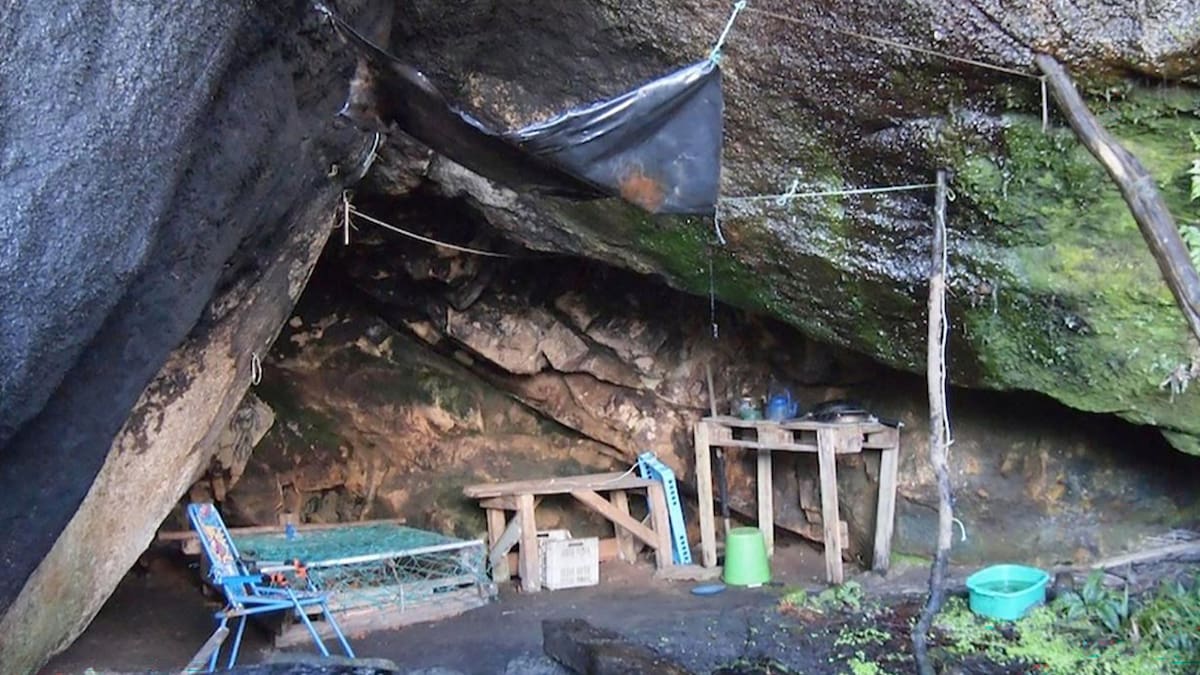
Home: The cave in Doughboy Bay where Keiko Agatsuma lived. It is still used by trampers today. Photo / Supplied
She appeared like an apparition, staggering out of the bush and on to the road. A young Japanese woman, shouldering a pack that was as large as it was empty, blinking in the bright summer daylight. Unlike all the other people who appeared from the bush on Stewart Island/Rakiura
in 1978, there was no Swanndri, tramping boots, or rifle casually slung over her shoulder. Instead of a hat, she wore a silk scarf with a strange symbol printed on it and a jacket a few sizes too big for her. Instead of tramping boots and gaiters, she wore heeled shoes and a long, mud-covered dress.
I was 8 years old, and my sister and I were on a family holiday to Stewart Island/Rakiura with the Chapple family. As kids did in those days, we roamed in packs, and it was on one of our roams along the road to Oban that we came across our apparition. She was the first Japanese person I had met. Until then, my only exposure to the Japanese had been the crazed banzai warriors caricatured in bad war movies. She was the opposite of all that. She had a serene, peaceful presence that was immediately recognisable to my child self.
Her eyes flicked around the faces in our group, and she let out a little whimper of joy. She began to reach out with both her hands, then retreated as if some inner discipline had kicked in. As a group, we all just stared, some of us with our mouths open. The woman composed herself, thinking hard about the words to come, and said in clipped English, “Which way Halfmoon Bay?” She looked left and right along the road she had come out onto.
Keiko Agatsuma arrived in New Zealand on a tourist visa. Photo / Supplied
There was a pause, and then, with the synchronicity of reef fish, we all pointed to the east, down the road that led to Oban. She smiled and, placing her hands together, bowed to us several times. I was the youngest of the mob of kids and found myself involuntarily bowing back, my hands palm to palm in front of me. I quickly snapped upright when I noticed I was the only one doing it. She smiled at me and then at the others and shuffled off down the road to Oban. Five pairs of eyes followed her until she was out of sight around the corner. Only then was the silence broken. Amid all the nervous chatter and speculation about whether she was a witch or a ghost, we began to mimic the only words she had spoken to us. “Which way Halfmoon Bay?” It began to stick like a catchphrase in a 1970s sitcom.
A tourist no longer
The Japanese woman we had met was Keiko Agatsuma, and she became briefly famous for being a cave-dwelling hermit in Doughboy Bay on Rakiura’s rugged west coast. In 1978, she arrived in New Zealand on a tourist visa. She travelled the South Island, but when she crossed to Rakiura, she began to depart from the typical Japanese tourist behaviour. With a backpack full of food, she took a water taxi to Freshwater Landing at the head of Paterson Inlet. After two days of slogging through mud, she arrived at the Forest Service hut in Mason Bay. She stayed at the hut and foraged for food to supplement her grocery supply, occasionally returning to Oban to resupply. She befriended Tim and Ngaire Te Aika, who farmed a small block in Mason Bay, and, like many who met her, they warmed to her tenacity and quiet kindness. She would occasionally share a meal with them at their farmhouse and insisted on doing farmwork to repay them.
On one of her forays away from Mason Bay, Agatsuma walked over to the more southerly Doughboy Bay and, like most people who visited the area, stayed in a cave down by the beach. It had a high ceiling and an overhanging rātā tree, which protected it from the worst of the rain. She constructed a bed from driftwood and hung colourful fishing buoys in the tree. She was there for a week when some hunters who were flying out from the beach landing strip found her doubled over with stomach cramps outside her cave. They convinced her to come with them and flew to Invercargill, where she was admitted to the hospital.
Immigration authorities were notified, and it was found she had overstayed her tourist visa. At the time, New Zealand was cracking down on overstayers with dawn raids continuing in urban areas. Agatsuma became yet another case and was deported back to Japan after several hearings in the Invercargill District Court. Despite trying to achieve a quiet escape, Agatsuma’s story took off. Even before she had returned to Invercargill, reporters had heard of her through the grapevine and even chartered a plane to land on the beach at Doughboy Bay in an attempt to interview her. The international media tapped into the sensation of the “Japanese cave-dwelling hermit” headline. Not since 1974, when the Imperial Japanese Army second lieutenant Hiroo Onoda was found in the jungles of Lubang Island in the Philippines, believing World War II was still going on, had there been a media scrum like this.
Wild is the wind: Doughboy Bay, on Rakiura’s rugged west coast. Photo / Supplied
When Agatsuma returned to Japan in early 1979, she quickly disappeared into the obscurity of middle-class life and a career as a post-production assistant on animated films. Echoes of her story bounced around in local Rakiura myth and eventually found form in Peter Wells’ short story Of Memory and Desire. This was refracted into the Niki Caro film Memory & Desire and found its shore in Ashleigh Young’s excellent essay Sea of Trees.
Into the vernacular
The memories of our holiday on Rakiura are still strong. There were crayfish and blue cod with every meal, a dilapidated dinghy to explore the bay, and a terrific southwest gale with waves the size of mountains for our voyage back to Bluff on the old Wairua. Perhaps my strongest memory was our meeting with Agatsuma and her enduring question.
My dad had not joined us on the holiday to the island. He had been at a bowls championship, and his team had reached the finals. It grated on him that he could not be there, as he had spent his life devoted to putting his family first. When we returned, he listened to our stories with delight.
He marvelled at descriptions of the seafood dinners and the creek explorations by dinghy, but the story of our meeting with Agatsuma captured his attention. We watched the television news as she was deported from New Zealand, escorted by her brother, who had come from Japan to support her. Her catchphrase quickly became part of our family vernacular, used when we were confused about which way to go. The minute we approached any kind of “T” junction in a country road, “Which way Halfmoon Bay?” would be shouted from the back seats of our old Holden HD.
Like people, sayings have a lifespan. During the years, its use in our family has diminished. Initially, everyone knew its meaning, but as the family dispersed and was replaced by new generations, this was lost. Eventually, it was used only rarely by my dad and me.
Near the end of his life, the morphine would occasionally give him vivid hallucinations. At their onset, he would ring me from the hospice and start the conversation with, “Matt, I think I am having a hallucination.”
A couple of days before he died, he called to tell me my grandmother and my mother – both long dead – were in the room with him, tending to his needs. I reassured him it was a hallucination and said, “Say hello from me”. He chuckled in disbelief at the tricks of his own mind and let out his exasperated summary of being at the junction of two worlds. “Which way Halfmoon Bay?”
SaveShare this article
Reminder, this is a Premium article and requires a subscription to read.
Copy LinkEmailFacebookTwitter/XLinkedInReddit
Tags:
- 1978
- apparition
- appeared
- bay
- blinking
- Boots
- bright
- bush
- case
- casually
- cave
- Curious
- daylight
- dress
- empty
- from
- gaiters
- halfmoon
- hat
- heeled
- her
- instead
- islandrakiura
- Islands
- jacket
- Japanese
- large
- like
- long
- mudcovered
- New Zealand
- News
- NewZealand
- NZ
- of
- other
- over
- pack
- people
- printed
- rifle
- road
- scarf
- Shoes
- shoulder
- shouldering
- silk
- sizes
- slung
- staggering
- stewart
- strange
- summer
- swanndri
- symbol
- that
- the
- there
- tramping
- unlike
- way
- which
- with
- woman
- wore
- young