
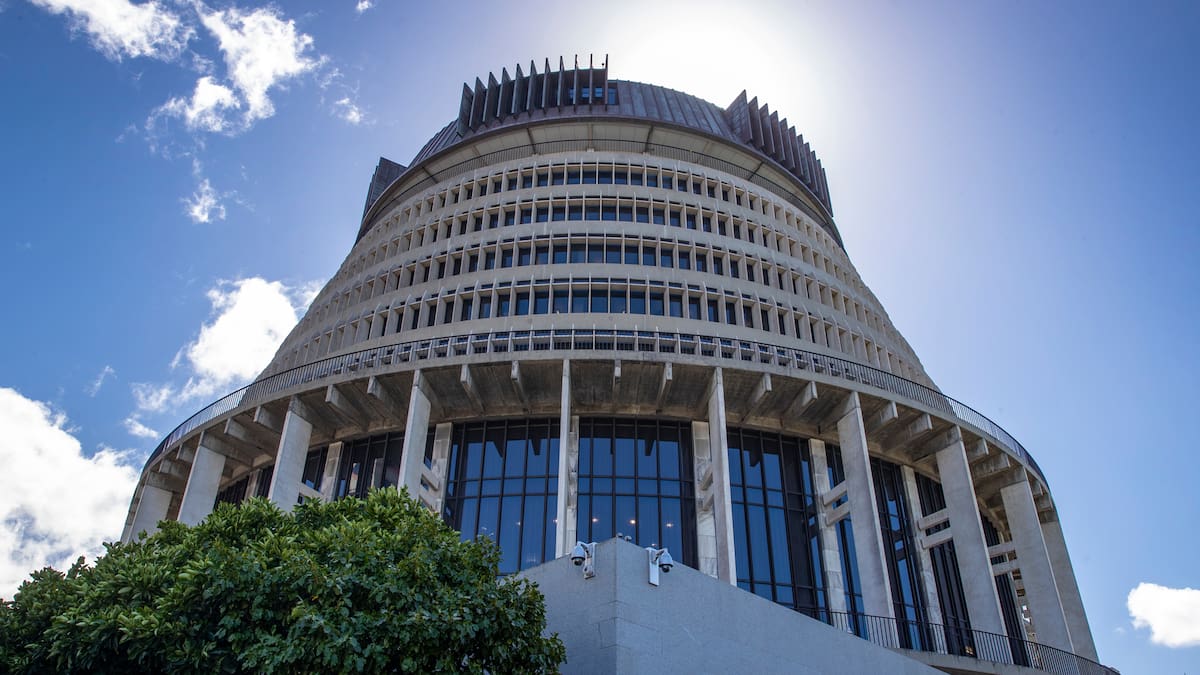
We’re speaking in Costello’s office on the third floor of the Beehive, formerly the site of Parliament’s bar. Newly renovated, the offices are among the nicest in the building, replete with beautiful timber and wool-lined walls.
Costello’s rise in politics has been far from gradual. While not a stranger to political life, the former Hobson’s Pledge spokeswoman was fast-tracked to No 3 on New Zealand First’s list before the 2023 election, almost guaranteeing her a seat in Parliament.
After coalition negotiations, she became one of her party’s three MPs in Cabinet, taking the ministerial portfolios of Customs and seniors alongside associate ministerial roles in police, health and immigration.
The Herald spent two days shadowing Costello, sitting in on meetings with various officials and sector stakeholders, observing discussions with staff and witnessing preparation for engagements such as Question Time.
Casey Costello has risen in prominence since entering politics with New Zealand First. Photo / Anna Heath
The Herald agreed not to report the specific details and conversations of Costello’s meetings to preserve the free and frank advice officials provide.
Costello’s staff numbers about a dozen, including a person on the front desk, private secretaries who are the bridge between a minister and their agencies, political advisers, a press secretary and a senior private secretary, whose role is vital to the functioning of the minister’s office.
Costello is known as a thorough reader and prolific with a red pen, to the point where drafted correspondence being sent out publicly under her name often comes with plenty of suggested amendments.
“In this office, we’ve always come back to the fact that, well, I’m the one that [could] be unemployed next year when it comes down to it,” she says.
While some may see a minister’s work primarily in the House or through the media, a significant amount of time is devoted to responding to letters from the public.
Dozens are received daily. Upon receipt, they’re referred to the relevant private secretary depending on the policy area the inquiry pertains to, then forwarded to their agency to prepare a response. This is then sent back to the private secretary to be analysed by a minister’s political staff. At that point, it’s either elevated to the minister or sent back to the agency if there are concerns with the response before finally being sent out.
“Although it does seem like an administrative nightmare, it’s actually quite useful … I’ve had answers to public letters written that haven’t been part of the briefing I’ve ever received … which shows the value,” Costello says.
Cabinet minister Casey Costello in her Beehive office. Photo / Mark Mitchell
Central to Costello’s duties are her responsibilities as a member of the Cabinet, a group of 20 ministers who meet weekly to determine the Government’s policies.
While Costello’s reports and proposals to Cabinet are the final product, there is a significant amount of legwork done beforehand through one-on-one meetings and in Cabinet committees, which allow more detailed discussion of an issue before it’s taken to Cabinet. An informed staff appears integral to this; using relationships with their counterparts to be able to assess the positions of Cabinet colleagues.
Costello’s relative inexperience initially made her a target in Cabinet for more experienced members. However, having a party leader in Winston Peters and an experienced staff helped to shield her from pressure tactics. The coalition agreements also meant there were clear policies to advance without the need for prolonged debate.
Coalition agreement items weren’t always simple to fulfil. As Associate Health Minister, Costello was charged with carrying out the promised repeal of the former Labour Government’s smokefree generation legislation; a move that saw Costello and NZ First facing immense scrutiny and accusations they were motivated by the interests of the tobacco industry.
For Costello, that was an early lesson in navigating pushback from officials as she pursued promoting vaping and other products as cessation tools.
“That was a classic case in point where every single official said, ‘You’re going to kill 1800 New Zealanders a year or something …’, it was massive and all of that narrative that came out with it.
“And now we fast forward two years on and we’ve now got Australia going, ‘Oh, s***, we should have looked at what you were doing because we’re in big trouble over here’.
“It was [the officials’] job to say, ‘this is the position, these are all the reasons that we’re in this position’. It was my job to say, ‘This is the coalition agreement commitment that says we’re going to change this tack, and we’ve got to work in a different way of doing it’.”
Casey Costello with her staff preparing for Question Time in the House. Photo / Mark Mitchell
Costello doesn’t shy away from giving an honest appraisal of briefings she receives, referring to one as “pretty s***”, albeit not in front of officials.
The relationship between officials and ministers can be complicated to manage and private secretaries, who are representatives of the agencies the minister has responsibilities for and are based in the minister’s office, are central to that relationship functioning.
They are effectively the bridge between a minister and the agency, managing expectations and communicating with both sides.
It is sometimes an unenviable position. A minister might use a private secretary as a sacrificial lamb in front of officials if an error is made. They might need to calm an agitated agency that disagrees with a minister’s decision or navigate a minister’s frustration at officials unwilling to progress their ideas.
Costello points to the Government’s gang patch ban legislation as a lesson in how to view advice from officials.
“Even when the bill went through, all of the Opposition challengers were quoting advice that was given to the minister to say, ‘This is a really bad idea’, and now all of the agencies have come out and said, ‘Oh, actually it works’, so there is that balance in that conversation of sometimes [officials] don’t know everything.
“That’s their job to present the advice and that’s the minister’s job to say, ‘Well this is what we’ve signed up to do’, or ‘This is what the public have told us they want’.”
Casey Costello says she doesn’t shy away from giving an honest appraisal of briefings from officials at the Beehive. Photo / Mark Mitchell
Part of the struggle originates from the question Costello poses: “What is good government and what is good politics?
“Sometimes they intersect,” Costello says.
“[I’m] here because I’ve been elected to represent or deliver on what my party [stands for], which is why the coalition agreement becomes quite an easy mechanism because it’s there in black and white, that’s what we’re going to deliver, but there’s stuff you do because it’s good government.”
In a meeting with Ministry of Health officials, Costello’s desire to reinforce the Government trajectory regarding smoking cessation was clear, requesting a sharper direction of travel that could be communicated to Cabinet while officials indicated they had taken on Costello’s feedback to communicate the harms of smoking alongside other products like vapes.
Those meetings also provide an opportunity for ministers to discuss with officials observations from recent engagements or visits.
In meetings with immigration and police officials, Costello raised her recent travel to Hawaii to attend a Pacific-focused United States summit in her capacity as Customs Minister.
Amid a fluctuating US presence in the Pacific as the nation balances a more inward-looking focus while wary of China’s partnerships in the region, Costello highlighted instances where law enforcement resources in Pacific nations were found lacking.
To police officials, Costello indicated her interest in utilising the Government’s renewed interest in the region, particularly so under Peters as Foreign Minister, to secure funding for a greater and more effective New Zealand Customs and police presence throughout the Pacific.
The Herald sat in on several of Minister Costello’s meetings across two days. Photo / Mark Mitchell
For initiatives not contained within the coalition agreement, Costello says it comes down to the quality of the argument for already constrained funding to be approved.
“That’s where that kind of negotiation part comes in as to how much we can get over the line within the fiscal restraints that we’re operating in and everything comes back to fiscal restraints.
“This year’s Budget will be tough because there’s still a lot of stuff that everybody wants to deliver in a very tight envelope.”
Despite the challenges, Costello maintains acting as a Cabinet minister is an “incredibly privileged position”.
“When you come from an environment where you try to make things work and you’ve got no resource and you’ve got no technical skill and you’ve got no back-up … I’ve got people running my calendar and people answering my correspondence, so the fact that I’ve got to show up and spend some time in the office … I don’t think it’s hard work.”
Adam Pearse is the Deputy Political Editor and part of the NZ Herald’s Press Gallery team based at Parliament in Wellington. He has worked for NZME since 2018, reporting for the Northern Advocate in Whangārei and the Herald in Auckland.