
By Rachel Lin and Jake Chung / Staff reporter, with staff writer
The cold, relatively low-salinity water near Antarctica might have played a greater role in the modulation of carbon dioxide before and after a climate shift said to have occurred about 430,000 years ago, a paper led by National Taiwan University (NTU) researchers said.
The paper, “Shifts in Antarctic Intermediate Water properties coincide with atmospheric CO2 rise across the Mid-Brunhes Event,” was published in the Science Advances journal on April 29.
Raul Tapia and Ho Sze-ling (賀詩琳) of NTU’s Institute of Oceanography were among the authors.
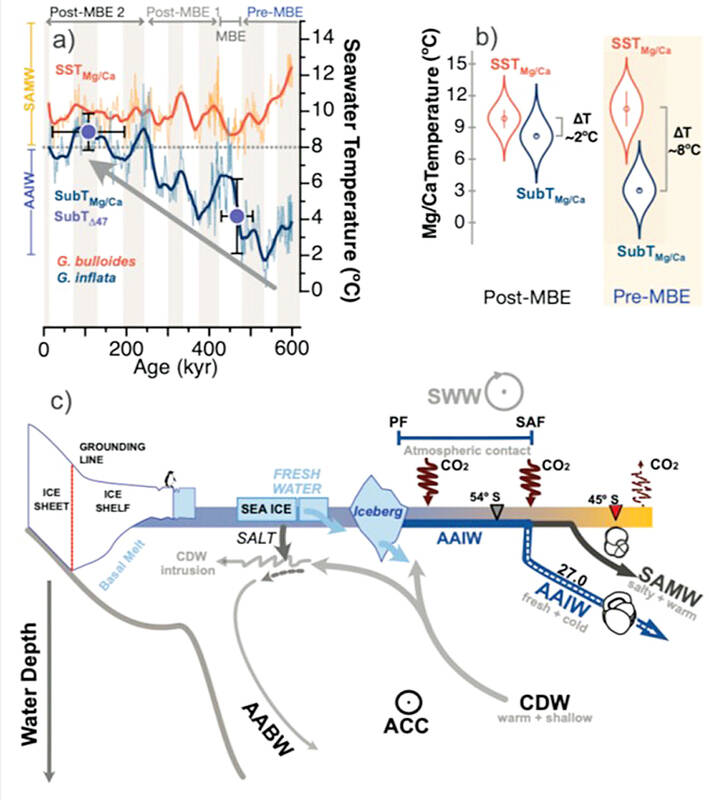
Photo: Screen grab from National Taiwan University’s Web site
They examined sediment core samples from the south Pacific, a source region of interglacial Antarctic Intermediate Water, to assess its variability and hydrographic properties in the upper subantarctic Pacific over the period of the Mid-Brunhes Event.
The Mid-Brunhes Event corresponds to an increase in the amplitude of the cycle between glacial and interglacial periods.
“Changes in bottom-water formation and properties have been extensively studied” in relation to atmospheric carbon dioxide concentration fluctuations at glacial-interglacial levels, but Antarctic Intermediate Water has received comparatively little attention, the authors wrote.
The Mid-Brunhes Event describes a sudden increase in carbon dioxide density of 35 parts per million compared with previously, a change said to have introduced great changes to the climate.
Previous studies typically attributed the change to bottom-water processes, but were unable to explain why.
The April study said that the Antarctic Intermediate Water prior to the Mid-Brunhes Event was colder and had lower salinity, increasing its ability to absorb carbon dioxide, making the deep sea an effective carbon sink.
Following the climate shift, the water warmed and its salinity increased, resulting in carbon dioxide absorbed into the ocean being more easily released, it said.
The salinity and temperature changes to the ocean water were due to increased freshwater input from icebergs transported from the Ross Sea by the Antarctic Circumpolar Current prior to the Mid-Brunhes Event, the authors said.
Following the event, the southward shift of the Southern Westerly Winds led to enhanced upwelling of carbon-rich deep water during interglacials, they said.
The Antarctic Intermediate Water might play a more central role in climate regulation than previously believed, they said, adding that with Antarctic ice caps melting at a greater pace, the sea’s ability to serve as a carbon sink might be increasingly reduced.