
“Wilding pines are quite simply an environmental disaster, either way you look at it,” Luxon said.
Southland MP Joseph Mooney, Act leader and Deputy PM David Seymour, Biosecurity Minister Andrew Hoggard, and Prime Minister Christopher Luxon above Lake Wakatipu, announcing extra funding for getting rid of wilding pines. Photo / Derek Cheng
“They’re self-seeding, they’re fast growing, they’re threatening a lot of productive farmland and are also a massive risk to our sensitive water supplies and our different catchments across the country, [they] limit native biodiversity and – I’ve seen this in the South Island, more in North Canterbury – a huge fire risk as well.“
“There’s almost $3.6 billion worth of economic loss that happens as a result of them over the next 50 years, potentially.”
The extra funding will take the total for stopping the spread of wilding pines to $109m over the next three years.
About $30m of it is coming from the International Visitor Levy (IVL), which by law has to be spent on conservation or tourism.
While levy money is ring-fenced, the coalition Government has been banking most of it while still technically using it tourism or conservation projects.
It has achieved this by a funding switch: moving money out of, for example, the Department of Conservation’s budget into the Crown account, and then replacing it with levy money.
Budget documents last year revealed that the Government is banking at least $100m a year – and up to $139m a year in IVL revenue – from an estimated annual levy pot of $229m, though this may have been revised down to $190m a year due to fewer-than-expected numbers.
Act MP and Biosecurity Minister Andrew Hoggard. Photo / Alex Burton
Hoggard, who used a chainsaw to fell a pine during the announcement, said that clearing wilding pines will boost rural communities as well as biodiversity, farming and tourism.
“Tourism is a key part of our plan to grow the economy and create jobs, lift wages, and help Kiwis get ahead. This funding will help protect our unique natural environment from the spread of wilding pines.”
The National Wilding Conifer Control Programme is led by Biosecurity New Zealand and delivered in partnership with councils, landowners, iwi, industry, community groups, and other government agencies.
The money will be allocated to infestation sites in nine priority areas including:
Queenstown and the Whakatipu Basin (tourism, high country farming);The Mackenzie Basin – (tourism, high country farming, hydro-generation);Molesworth in South Marlborough (New Zealand’s largest farm);The Central Plateau (tourism).
The Ministry for Primary Industries will also develop a National Pest Management Plan for on-going control of wilding conifers.
Hoggard said independent economic analysis estimated a $30 benefit for every dollar invested in continuing the National Wilding Conifer Control Programme.
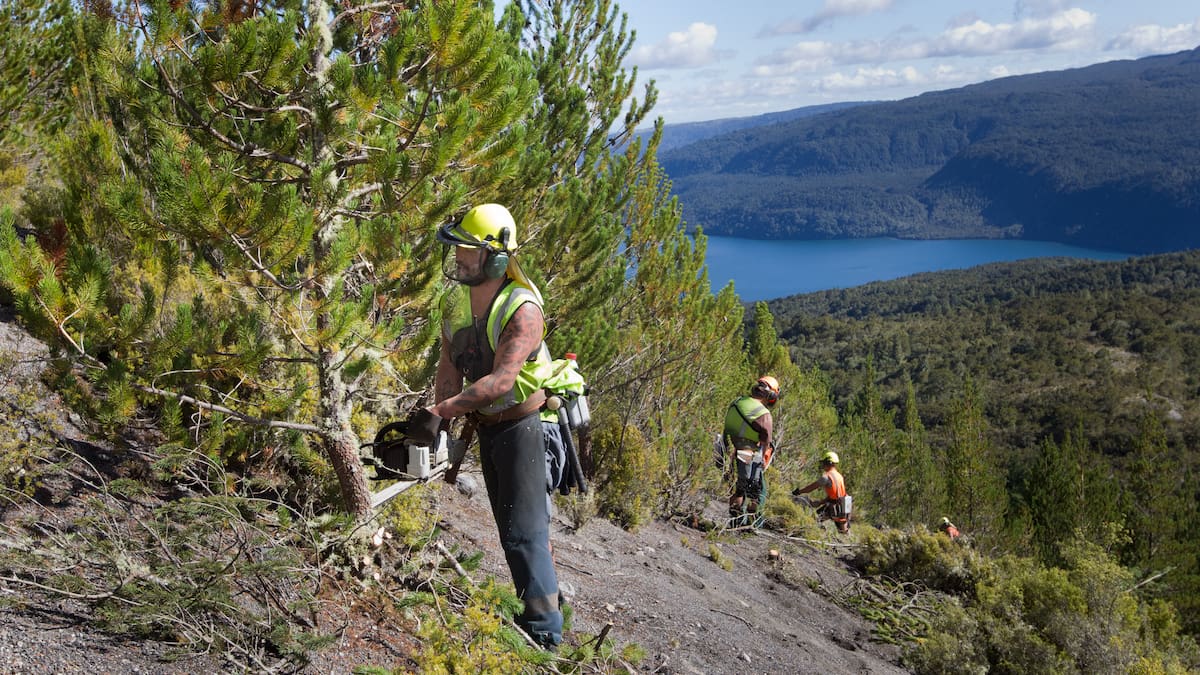
Sparse, scattered infestations are controlled by ground crews, either felling with chainsaws or loppers, or when spread over large areas are individually spot sprayed from helicopters or drones.
Dense infestations are either sprayed by helicopter or cleared mechanically. Drones are also sometimes used.
Derek Cheng is a senior journalist who started at the Herald in 2004. He has worked several stints in the press gallery team and is a former deputy political editor.