
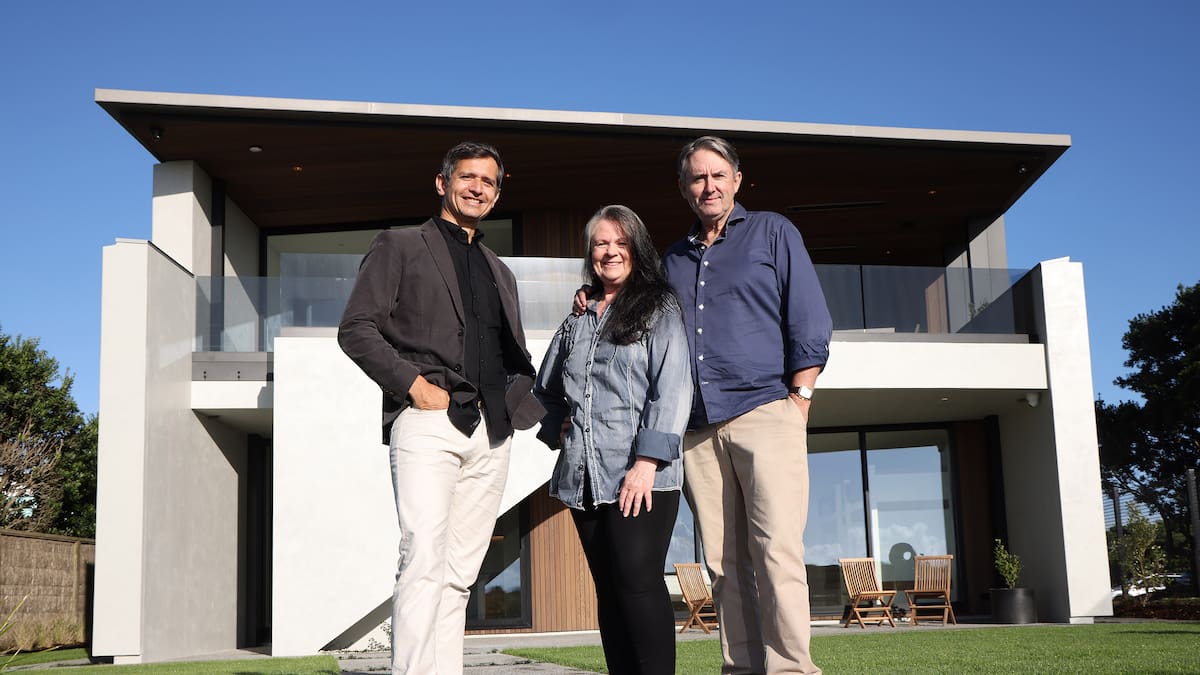
The penultimate episode of this season of Grand Designs NZ is about the building of a $10 million house on Ōmaha Beach, the rich suburban end of the glorious Tāwharanui Peninsula, north of Auckland.
That’s a lot of money and a lot of house but it’s being built
by someone with a lot of experience when it comes to managing budgets. In fact, one of the couple involved has just taken on a role where he’s at the top of a $30 billion-plus public organisation. More on that – and a post-show interview with presenter Tom Webster – later.
The place turns out to be not just another interchangeable Ōmaha Beach house sitting on the curved bland streets laid out in its subdivision days. It’s a massive chunk of high-end architecture that does some interesting things.
Like using prefabricated, sculptured, glass-reinforced concrete (GRC), a material you don’t often see in residential building, to block out some of the neighbourhood with a great wall.
Like use a New York loft influence on its two-storey interior.
Like future-proof the downstairs accommodation for an influx of grandchildren, only one of whom has been born yet.
It also does some rich-dude things, like a three-car garage, a wine cellar that looks more like a wine shop and a big-screen viewing room.
In his intro, Webster falls back on that default Grand Designs jeopardy possibility: What will the neighbours say?
Well, as we soon find out, the immediate neighbours are mainly the back of the local shops, the main beach-access carpark for the beach and the surf life-saving club. That carpark is the reason for the big wall, and inside there is clever window positioning that takes your eye above it.
As well as “unlocking the magic of the site”, mother and son local architects Lindy and Luke Leuschke must deal with a building that can’t encroach on an archaeological midden with heritage protection on the section. The construction begins with a blessing from local iwi.
The interiors of the Omaha Beach house in Grand Designs NZ 2006.
But there’s a different tribe living at Ōmaha Beach now. It was made famous as a rich-lister haven area by the likes of Sir John Key. He sold his place there for a mere $3.1 million in 2018 (current QV market value of $7,230,000).
On recent visits to the place, it occured to me that Ōmaha Beach has the feel of a gated community waiting for the gates to arrive.
Yes, the name does evoke the famous D-Day landing spot. This Ōmaha and the WWII one also has something else in common: They were both transformed by an influx of men driving big German tanks …
Yes, to build a house there you have to have some money, especially as there’s not much of Omaha left to build on. That doesn’t appear to a problem for this week’s participants, who paid $4 million for the site.
Describing what the breadwinner of couple Mark and Lisa Darrow building this week’s house does, Webster understates: “Mark now sits on the board of eight large organisations.”
That’s not quite right, anymore. According to his LinkedIn profile, Mark Darrow has reduced his boardroom portfolio. And that’s not because he wants to spend more time at the beach or in his wine cellar. While he remains the chairman of the Civil Aviation Authority, Armstrong Motor Group, and the Taranaki Savings Bank, Darrow is also the newly appointed chairman of the board of Health NZ. That’s the one with the $30 billion-plus budget.
In the programme they say it’s the fifth house that he and Lisa have built since they first met while working together at a Palmerston North accountants nearly 40 years ago. They now have adult children and are looking forward to the next generation – no pressure kids! – with their first grandchild arriving during the build.
There are some delays along the way, to do with the GRC panels with a test panel not being the right size, then the rest not arriving in good time due to a change of ownership in the suppliers.
Otherwise, this is a show where there is virtually no discussion about budget over-runs. The Darrows are unflappable. The builders are undaunted. The weather is generally okay. Even the apprentice is stoked about working on something with curved walls because of the experience it will give him. The Darrows’ furniture designer son, Troy, chips in with a very cute bunkroom for those future kids, of which his is the first.
Must say, it’s heartening to see the chairman of Health NZ thinks that providing beds for generations yet to be born and that no expense should be spared is a good thing. Long may it continue.
The exteriors of the Omaha Beach house in Grand Designs NZ 2006.
What Tom Webster, still an architect when he’s not working on the show, has to say about the project.
So, $10 million, that is not quite the record for this series after the $11 restoration in episode one, but it’s up there and on-budget. Given Mark Darrrow’s roles as board chairman of many major entities, did you get a sense there was pressure on him not to go over-budget because it really wouldn’t be a good look?
That may be true, but I also got the sense that managing a “meagre” $10m budget for a man of Mark’s vast experience and professional responsibilities was child’s play.
The Darrows have built five houses before. He’s clearly a high net-worth individual and financially more than capable. So, this was a show low in building and budget challenges and more about the architectural one – whether they could build a high-end house up the drive from the superette and next to the carpark, leaving the midden undisturbed and still have the feeling of a beachfront all to themselves. Fair summary?
Good summary. The main construction challenge was the GRC wall system. Elements that are relatively unorthodox or used in a novel application often require a disproportionate amount of attention (and cost) to design, procure and deliver to the right quality. But, as we saw, these elements can have great architectural impact.
The show is a very good advert for glass reinforced concrete: Are you a fan?
In the right context, yes, it adds to the architect’s toolkit of material choices. GRC plays particularly well as a lightweight option, for creating large-scale and sculptural elements, which works with New Zealand’s seismic challenges.
So, you weren’t tempted to say at some point during the build: “Today it’s D-Day on Ōmaha Beach….
I’m not afraid of a good pun or a well-conceived Dad joke (oxymoron?) but I missed that one, sadly.
You can catch up on this and earlier episodes of GDNZ here.
SaveShare this article
Reminder, this is a Premium article and requires a subscription to read.
Copy LinkEmailFacebookTwitter/XLinkedInReddit