
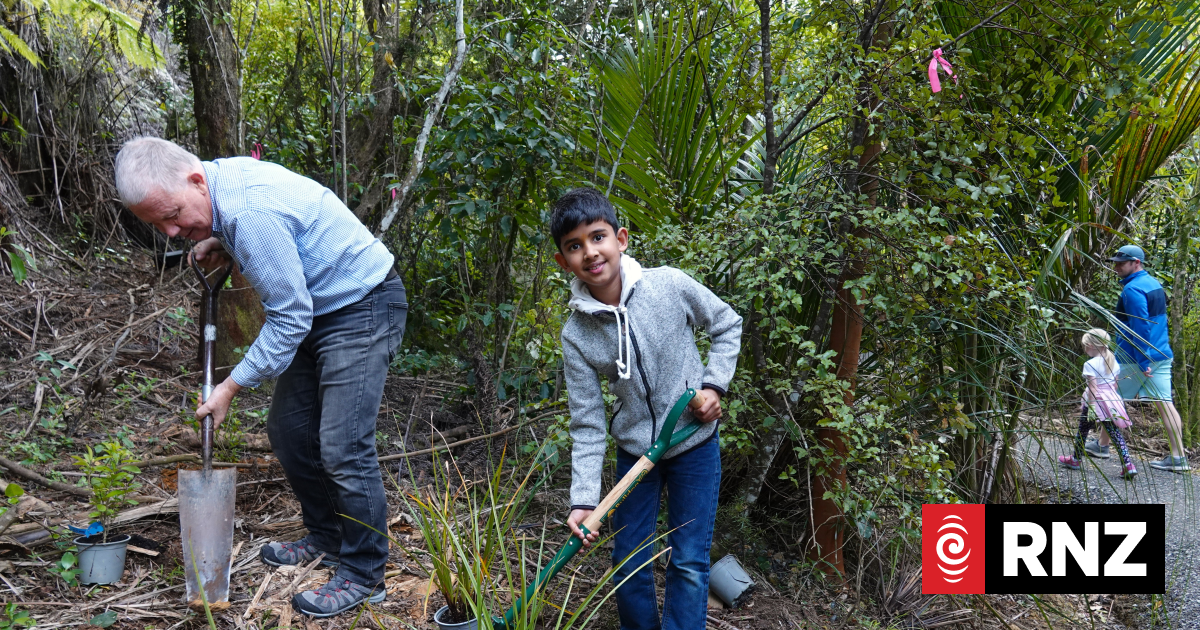
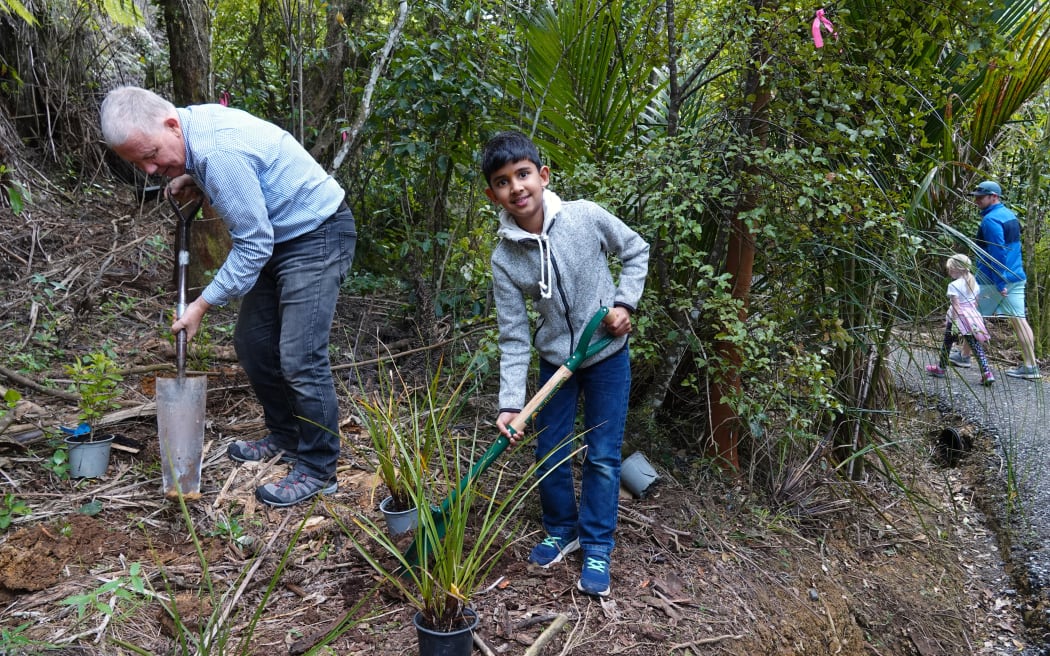
Eight-year-old Ayaan Jalan aids the replanting effort.
Photo: RNZ / Peter de Graaf
Residents of the Auckland suburb of Hillsborough are celebrating the reopening of an “incredibly special” bush reserve, seven years after severe storm damage forced its closure.
Belfast Reserve – one of the few surviving pockets of native bush on Auckland’s central isthmus – first closed in 2019 when heavy rain washed out a footbridge.
Some residents continued to use the reserve, despite further damage from falling pine trees, but five large slips triggered by the 2023 Anniversary Weekend storm made the bush impassable to even the most determined walkers.
The damage was so severe some locals feared they would never be able to use the tracks again.
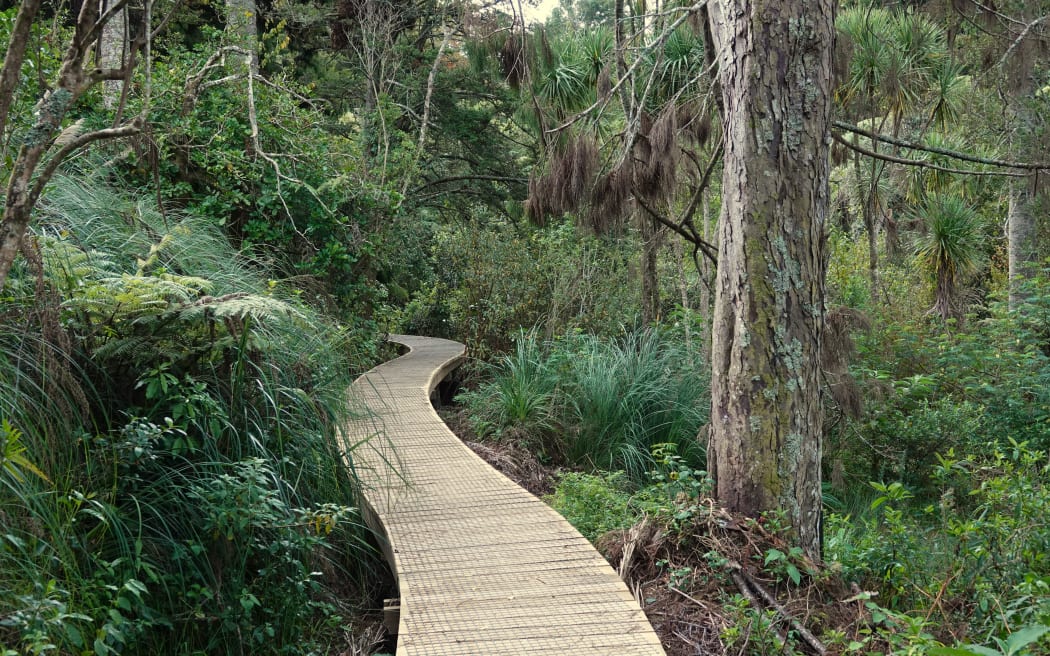
A new boardwalk in Belfast Reserve.
Photo: RNZ / Peter de Graaf
But on Sunday, about 60 residents gathered to celebrate the reserve’s reopening, after a Auckland Council reconstruction project costing more than $700,000.
The event – organised by the Friends of Belfast Reserve and environmental group Urban Ark – included a pest trapping demonstration, a tree hunt for the kids, and planting along disused sections of the old track.
Hillsborough residents Dean Sutcliffe and Geoff Williams organised the tree planting.
Sutcliffe said the 7ha reserve was a mix of mature and regenerating bush, and highly unusual for Auckland.
“There’s a lot of tree fuchsias, king ferns and mangeao. There’s no reserve quite like it in Auckland, with a lot of things you don’t usually find in the city,” he said.
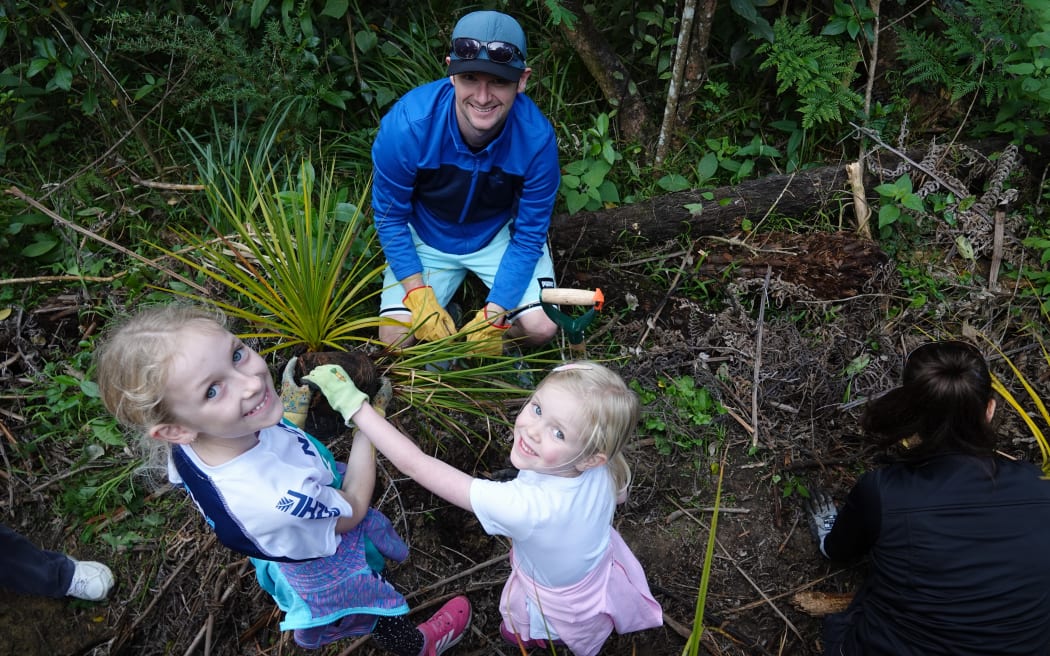
Hillsborough sisters Emily, 9, and Juliette Darlington, 6, show their dad how planting is done.
Photo: RNZ / Peter de Graaf
Williams said it was an “incredibly special” patch of bush.
“There’s a lot of regeneration, so a lot of natural healing is going on,” he said.
“We’ve already met a lot of dog walkers, runners and family groups, and everyone’s absolutely thrilled and delighted it’s open again.”
Janet Vaughan of the Friends of Belfast Reserve said she founded the group in 2018 to support the re-establishment of native species, and later lobbied for the reopening of the tracks.
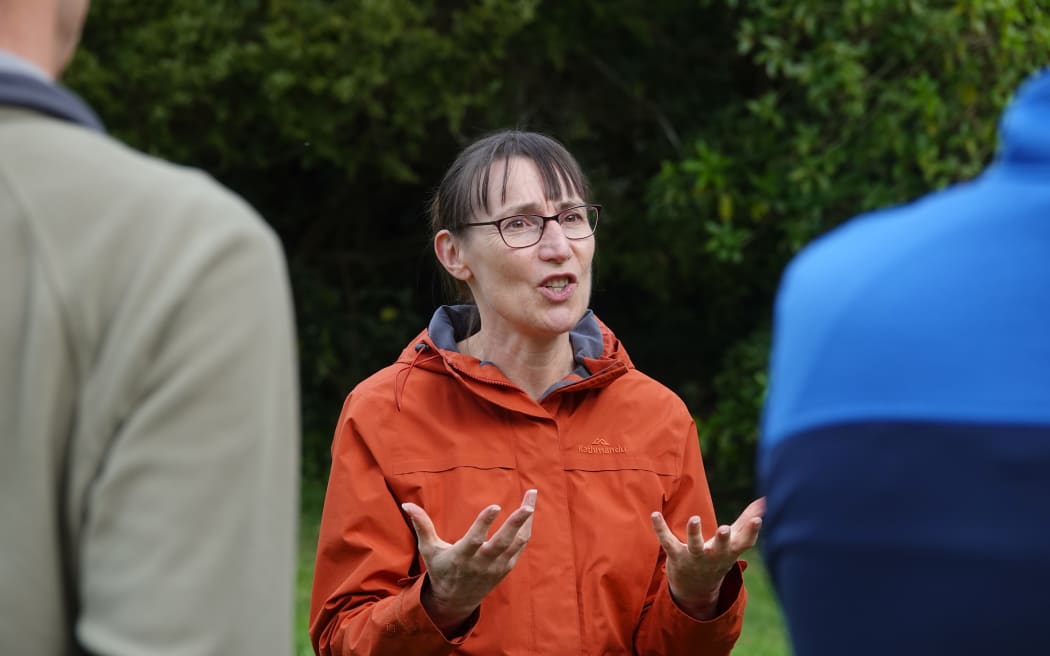
Friends of Belfast Reserve founder Janet Vaughan explains the group’s long-term hopes for the return of native species.
Photo: RNZ / Peter de Graaf
Now the group hoped to encourage residents to take up backyard pest control and create a ring of traps around the reserve.
The long-term aim was to encourage the return of native species such as the kākā.
Birds already present, as reported in the iNaturalist app, include the tūī, kererū (native pigeon), kotare (kingfisher), pīpīwharauroa (shining cuckoo), eastern rosella, riroriro (grey warbler), silvereye and pīwakawaka (fantail).
Vaughan said tree species in the reserve included kauri, tōtara, puriri, rimu and kahikatea, along with “magic” plants such as the rare king fern.
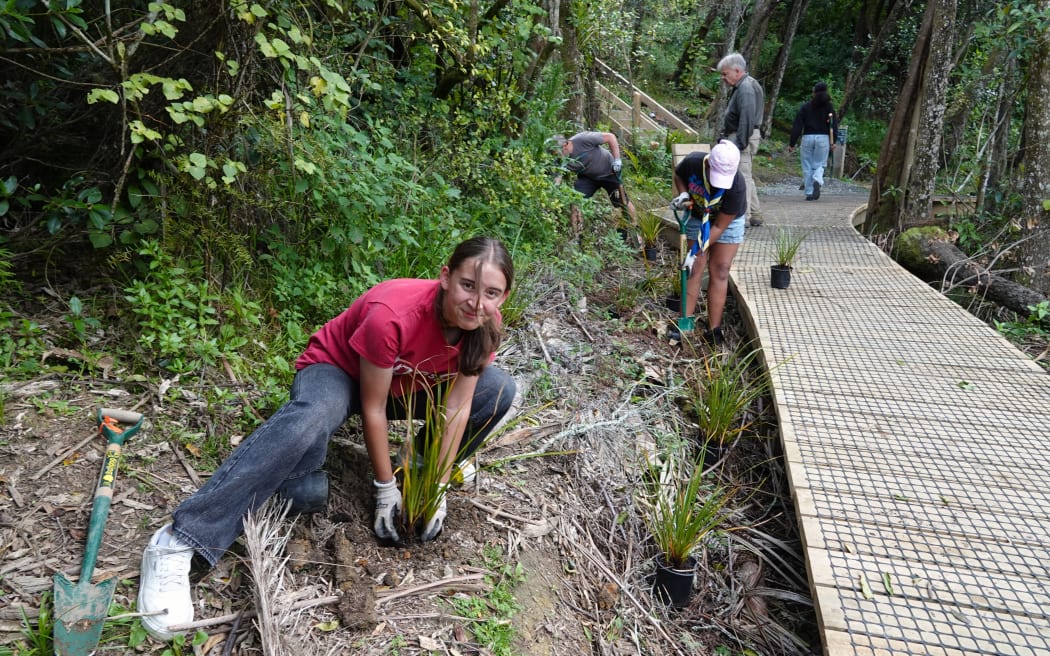
Fourteen-year-old Maddy Drummond gets to work replanting a bank along the rebuilt track.
Photo: RNZ / Peter de Graaf
Auckland Council Puketāpapa area operations manager Jody Morley said repairs to the 2019 damage had been delayed first by the Covid pandemic and then the 2023 storms.
The reconstruction was finally carried out over a three-month period in 2026, with a helicopter used to fly in significant amounts of timber and gravel.
The project involved re-routing the tracks around one landslide, clearing a slip, and building across three others.
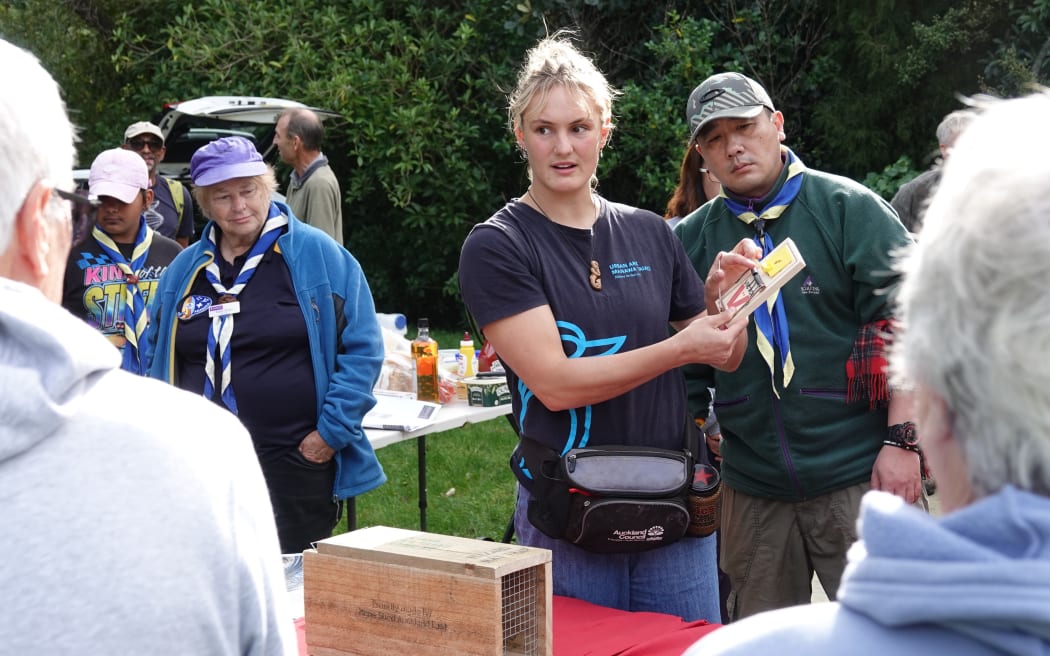
Nikita Jones of environmental group Urban Ark demonstrates a rat trap.
Photo: RNZ / Peter de Graaf
A bridge spanning the main gully had been washed away, so was replaced by a 12-metre laminated timber structure, and four other bridges considered to be at risk were rebuilt.
Three large, downed pine trees were also removed.
Morley said the total project cost was $725,000, paid for by Auckland Council’s Fix and Finish Fund.
When the tracks first opened in 2000, Edward Lawry, a long-time local resident and chairman of Hillsborough Conservation Society, said the land was sold to “a couple of larrikins” in the 1970s.
They immediately set about bulldozing the bush.
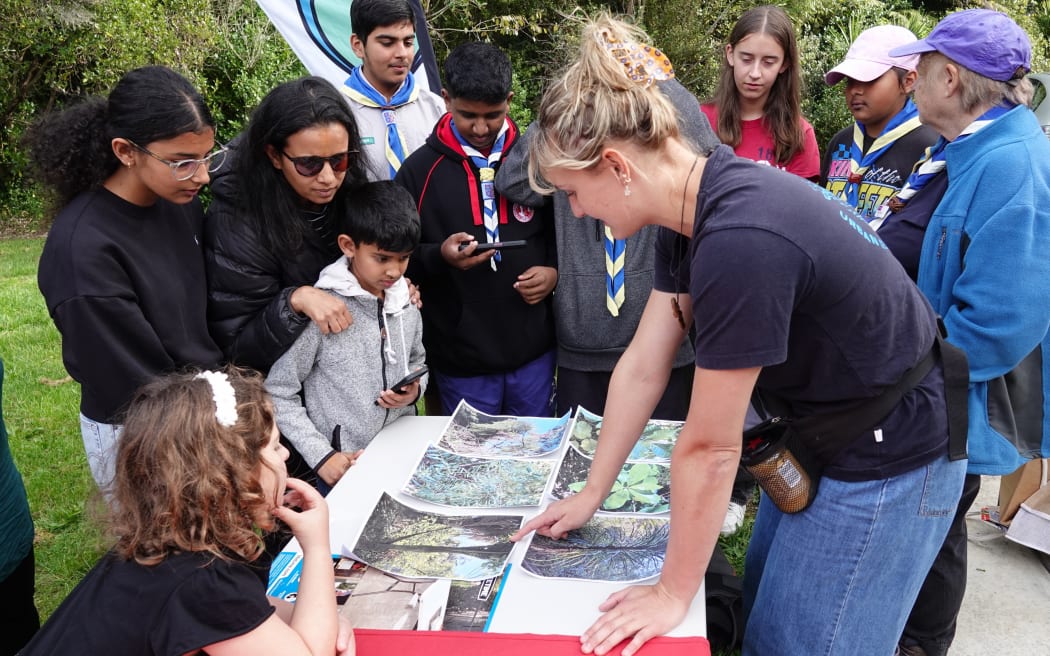
Nikita Jones of environmental group Urban Ark explains the rules for the tree hunt.
Photo: RNZ / Peter de Graaf
Lawry said when the would-be developers defaulted on their payments and sold some sections twice, the society saw an opportunity to persuade the council to buy the land.
The council “bought it for a song”, he said.
The cost of building the original tracks in 2000 was $120,000.
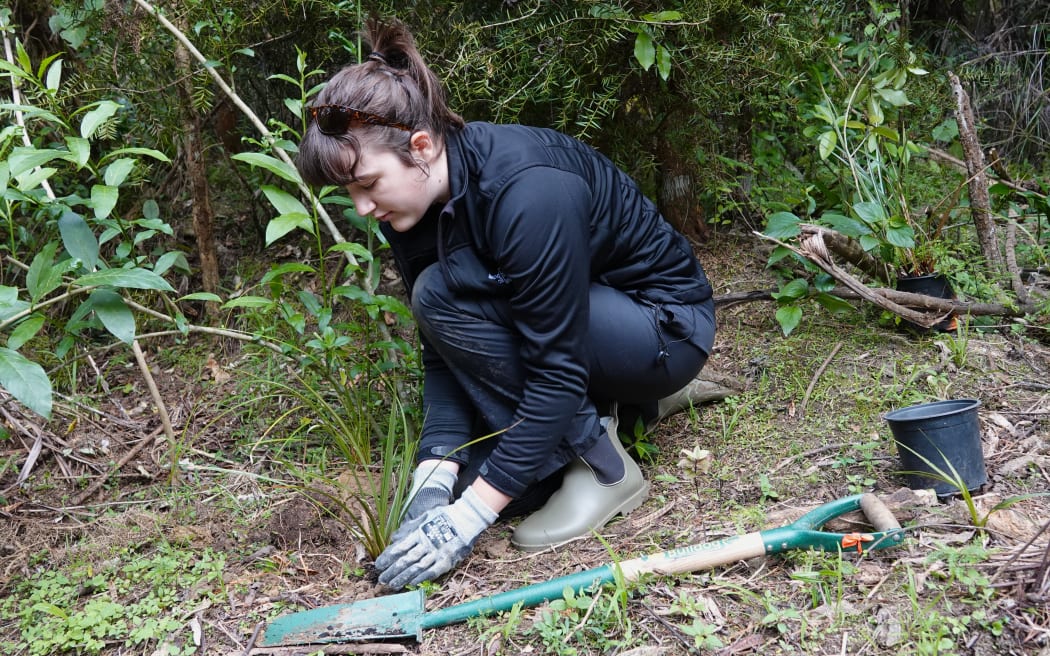
Hillsborough resident Alexis Moore helps with replanting along the track.
Photo: RNZ / Peter de Graaf
Belfast Reserve is bordered by Hillsborough Road, Belfast Street, Goodall Street, Frederick Street and Taylor’s Bay on the Manukau Harbour.
The bush tracks are accessed from Goodall Street, Belfast Street and Frederick Reserve.
Sign up for Ngā Pitopito Kōrero, a daily newsletter curated by our editors and delivered straight to your inbox every weekday.