
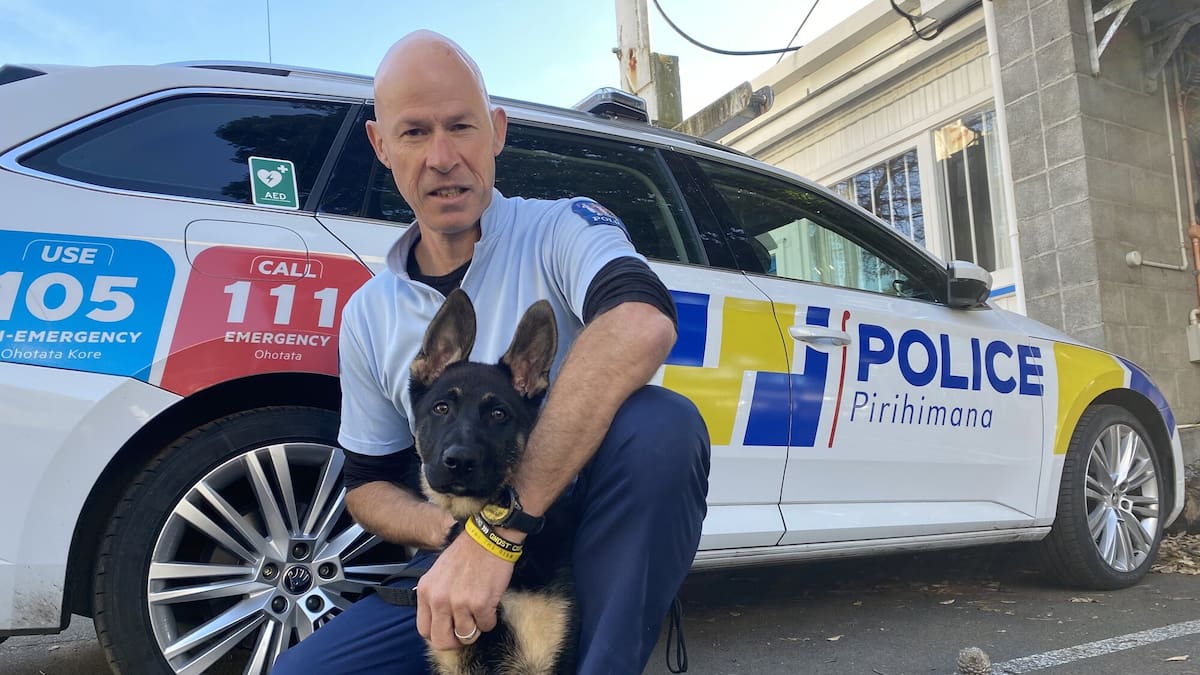
Despite suggesting Peyton in honour of NFL quarterback Peyton Manning, Jason received no definitive response.
About three days later, he got a notification from a group chat.
“[It] said ‘hey, we’ve sat around over the weekend, had a chat and we want it to be called Page’,” Jason said.
“I messaged back saying ‘haha’ but didn’t hear anything for a few days so I rang and said ‘are you guys serious?’ and they were like ‘yeah’.”
He was “taken aback” by the news and initially felt “weird” about it before coming to terms with it.
“I was quite chuffed actually, I thought it was pretty cool. I’d never even contemplated it,” he said.
Jason was a dog handler and analyst for 18 years before becoming a youth aid officer more than three years ago.
It was uncommon for police to name a dog in honour of a former handler, he said.
“It would be nice, eventually, if we had some other litters that match up with other previous handlers; that would be quite a cool thing to do, I reckon.”
Whanganui Senior Constable Jason Page’s retired police dog Hitch (left) with Page.
Now about 5 months old, Page, a male German shepherd, is in Whanganui and gearing up for police dog training.
Deciding when dogs were ready for formal training at Trentham varied, Jason said.
“Generally, if we see really good qualities in a puppy at 10 months to a year [old] then they will start full-on training to be a police dog,” he said.
The first few months were important for instilling good patterns.
“By investing in pups when they are young, we get a better package.
“The biggest thing is socialising; a big thing that will let a potential police dog down is nerves.
“If you have a nervy dog that freaks out when it hears a noise or when cars are driving past, that is all nerves and we don’t want that. We want confident dogs.
“Our dogs are about experiencing everything.”
After confidently socialising with other dogs and humans, the imprinting and scent boxing phase begins.
Imprinting teaches a dog to recognise a specific target odour. Scent boxing is a precise foundational exercise used to teach tracking.
Control and obedience were important for potential police dogs, Jason said.
“For us, the dog is a tool, not a pet. It’s like farmers’ working dogs and you have to treat it like that,” he said.
“You can’t just leave it lying around at home all the time – it is either at work doing its job or in the back of the van or kennel at home.
Jason said although it was early in the process, Page was excelling in training.
“He’s looking awesome actually. He’s literally, excuse the pun, dog to a bone with the scent boxing, he loves it.
“He’s got really good drive and his nerves are awesome … he looks like he’s got the goods.”
The puppy has been performing well in his pre-training training. Photo / Fin Ocheduszko Brown
The experience has taken Jason back to his days as a dog handler.
He said he missed the bond with his dog and the feeling of making a catch.
“You’re getting a win as a team and you’re getting something for the victim.
“For 17 years [after a year of training with another handler], it was just working on your own, you were a team – you and your dog.”
When Page is deemed ready for formal training at Trentham, he will complete three courses over several months.
Jason said it was not guaranteed the dog would return to Whanganui if he graduated training but it could be on the cards.
The dogs’ destinations were usually pre-planned, with other stations needing a replacement dog in the future.
“It’s good because you might not have a need for it now but you might have a need down the track so you can put the word out and someone from another district might offer one up,” Jason said.
One of Whanganui’s five police dogs is nearing retirement age which could make Page the perfect replacement.
Fin Ocheduszko Brown is a multimedia journalist based in Whanganui.