
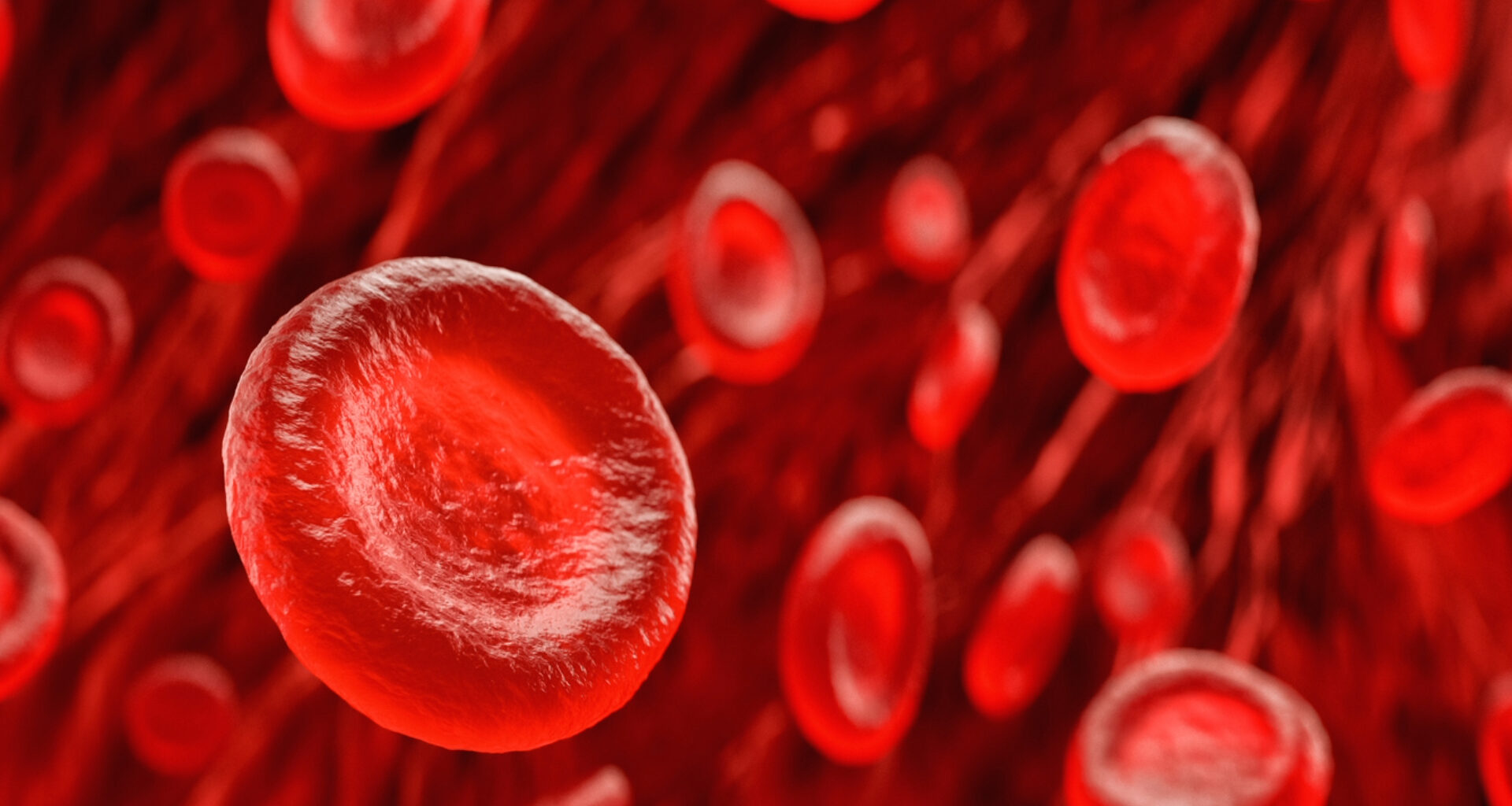
A new study from Kyoto University in Japan has revealed that the blood pumping through our bodies is actually an ancient inheritance.
Scientists have reconstructed a massive, 700-million-year-old family tree for blood cells by tracking genetic blueprints across species. The stunning takeaway? The way cells mature in our marrow today mirrors exactly how they evolved from single-celled ancestors millions of years ago.
To uncover this, a new analytical method was designed to compare gene expression profiles across diverse animal lineages and unicellular organisms. They wanted to know when blood cells first originated, and how they branched into the specialized defenders we rely on today.
The answers were written in our DNA.
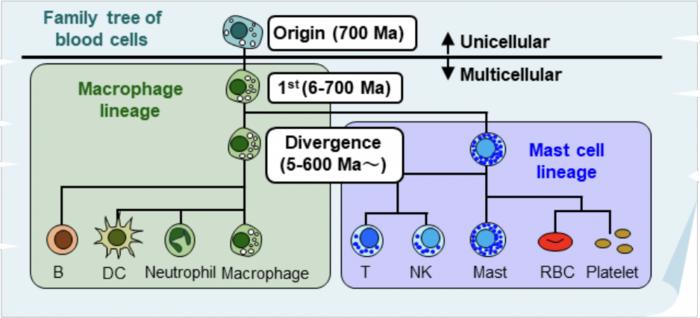 The 700-million-year history of our blood cells. Credit: KyotoU / Yosuke Nagahata
Ancient genetic inheritance
The team tracked a specific gene called FOS — which is common to modern blood cells — all the way back to a single-celled organism that lived 700 million years ago.
This timeline coincides perfectly with the dawn of multicellular animals. When those ancient, single-celled organisms began banding together to form the very first animals, they didn’t start from scratch. But repurposed their old genetic material to invent the first blood cells.
Among all human blood cells, macrophages most closely resemble those ancient, single-celled ancestors. Macrophages are the heavy lifters that engulf debris and pathogens. This strongly suggests that the planet’s first blood cells were essentially macrophage-like scouts.
From there, evolution got creative.
Using their new mapping technique, the scientists watched the family tree branch out over deep time. First, mast cells branched away from the early macrophages. Later, those mast cells split again, giving rise to red blood cells and prototypic T cells. Meanwhile, prototypic B cells made their own separate exit from the macrophage line.
Every time our body creates new blood cells, it rewinds the clock and repeats this epic, 700-million-year journey.
“I feel deeply moved by these findings, which represent the culmination of our work and illustrate that the differentiation pathways of vertebrate blood cells reflect the 700-million-year evolutionary history of these cells,” said Hiroshi Kawamoto, team leader.
First author Yosuke Nagahata, now based at the Institute of Evolutionary Biology in Spain, agreed. “When I let it sink in that this legacy from so long ago is circulating within my body as blood cells, I feel closer to our distant ancestors.”
Genetic blueprint to fight disease
The study reveals that the circulating blood and immune cells in our bodies are essentially a successful, living continuation of the genetic legacy passed down by our ancient single-celled ancestors.
Interestingly, the newly developed method holds promise for medical research in tracing the evolutionary origins of complex diseases such as cancer.
Researchers hope to gain a much deeper understanding of their underlying cellular mechanisms by uncovering how these diseases develop through an evolutionary lens.
These insights are expected to pave the way for innovative, more effective treatments and therapeutic strategies.
The study findings were published in the journal Proceedings of the National Academy of Sciences on May 25.