
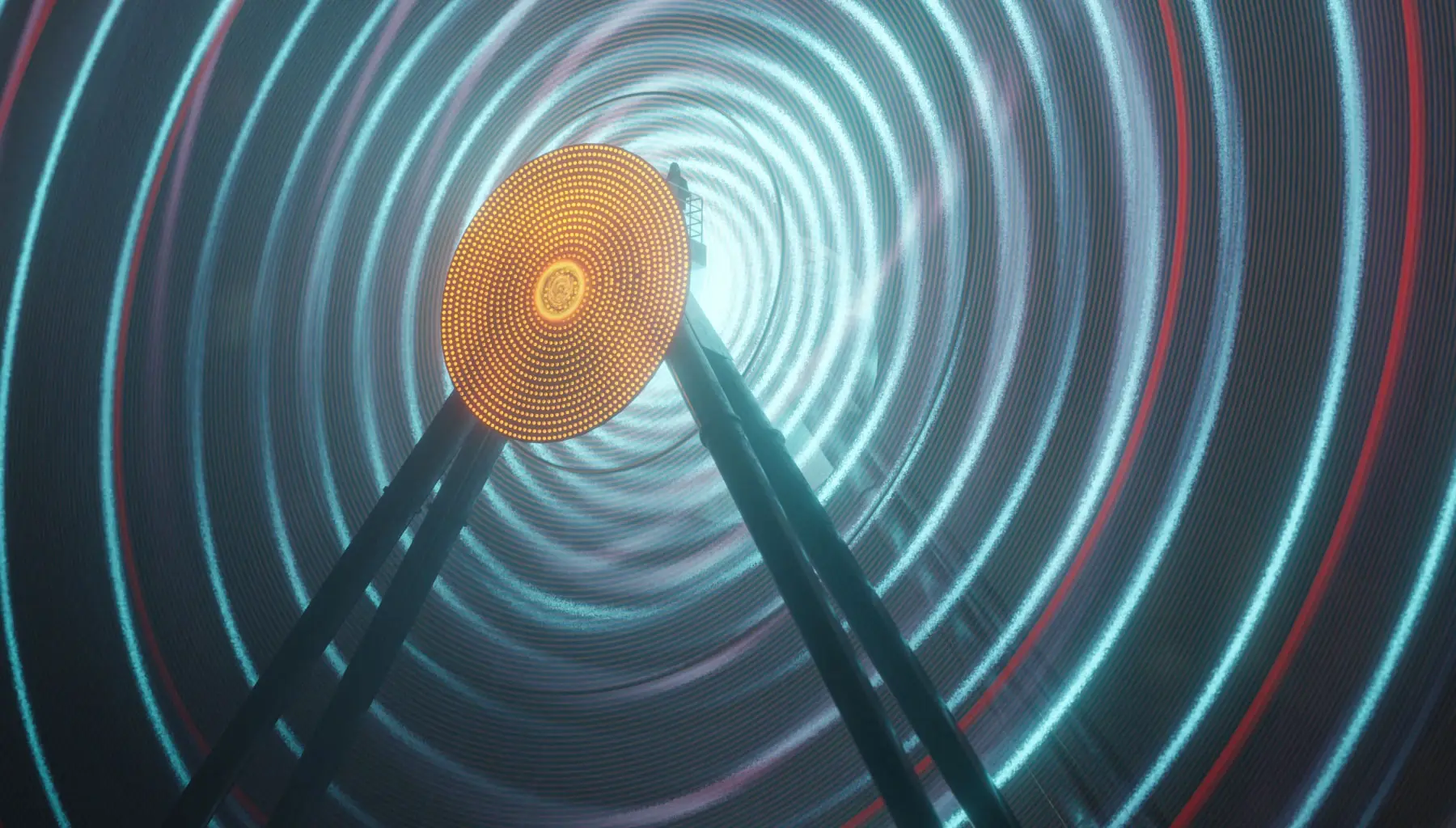
The vibrations of atoms in a crystal generate one type of rotation, an intrinsic spin-like trait called angular momentum. For the first time, researchers have directly observed this rotational motion transferring from one vibration mode to another in an actual material over real time.
In a new study published in Nature Physics, a team led by physicists at the Fritz Haber Institute of the Max Planck Society in Berlin reported the direct observation and control of angular momentum transfer between two distinct lattice vibrations in a crystal. This result not only meets a 100-year-old prediction from theory that had yet to be verified, but also addresses an important hole in physics that has persisted since Albert Einstein and Wander Johannes de Haas conducted their landmark rotational experiments more than a century ago.
In crystals, the atoms can vibrate like tiny bells. These vibrations are called phonons. Sometimes two phonons scatter off each other, switching energy and momentum (the straight-line push they carry). This exchange occurs through a process called anharmonic coupling.
Still, how phonons could exchange rotational or angular momentum has not been elucidated.
As the authors note, “tracing the consecutive flow of angular momentum from the initially excited phonon to other lattice modes has remained elusive and represents a huge gap in our understanding of the ultrafast demagnetization sequence and other spin-lattice-coupled phenomena since the pioneering experiments by Einstein, de Haas and Barnett.”
To directly observe this process, the team chose a topological insulator, bismuth selenide (Bi₂Se₃). This insulator has an optimal crystal symmetry, making it an ideal test material. The sample was a single-crystal film only 15 nanometers thick (about 5,000 times thinner than a human hair) on a sapphire substrate.
A novel way to use light to give electrons a spinning kick
They struck terahertz pulses at the crystal to perturb it into a vibrational mode controlled by infrared-active phonons, which rotates almost 360∘ degrees in a circular path with a frequency of 2 terahertz. This intrinsic anharmonicity of the crystal then connected that spinning phonon to another mode vibrating at a perfectly harmonized frequency: twice the frequency, so 4 terahertz.
The observation was stunning: The second phonon mode derives angular momentum that is equal but opposite to the first mode’s rotation. This change in helicity is not forbidden by any laws of physics but rather arises precisely from the crystal’s symmetric threefold rotational structure. They call this process rotational phonon, phonon Umklapp scattering, the angular momentum counterpart of the already well-known linear momentum Umklapp scattering.
As computational simulations subsequently confirmed, this transfer of angular momentum from phonon to phonon is over 1000× more efficient than any direct light excitation of the same states. In fact, only 3 percent of the angular momentum from the first vibration was transferred to the second mode; what happened to the rest likely dissipated as lower-energy acoustic phonons within the lattice.
“The observed coherent process inverts the usual equilibration flow of angular momentum and provides the first direct observation of anharmonic phonon-phonon angular momentum transfer,” the authors write.
The effects of this finding extend beyond the experiment. A longstanding question in magnetism is the transfer of angular momentum when a material is demagnetized by an ultrafast laser pulse, from the ensemble spins of electrons to the physical rotation of the lattice. This sequence represents the Einstein-de Haas effect, and it relies on phonons to transport and transfer spin angular momentum; however, the intermediate mechanisms have not yet been clarified.
Scientists observe a single quantum vibration under ordinary conditions
The new results shed light on one of those gaps. As the team states, the findings “confirm the long-standing hypothesis: phonon-phonon angular momentum transfer is permitted via lattice anharmonicity and conserves crystal angular momentum,” with “far-reaching implications for spin relaxation phenomena, such as ultrafast demagnetization.”
In future studies, the team hopes that the ability to dexterously control the axial momentum of phonon modes will mark the commencement of a new field, which they call axial nonlinear phononics.
They write, “In the future, the axial nonlinear phononics established here will provide a precise handle for ultrafast control over spins, topologies, and chiral quasiparticles, pointing toward potential applications in ultrafast magnetic switching and topological materials.”
Journal Reference
Minakova, O., Paiva, C., Frenzel, M., Spencer, M. S., Urban, J. M., Ringkamp, C., Wolf, M., Mussler, G., Juraschek, D. M., & Maehrlein, S. F. (2026). Observation of angular momentum transfer among crystal lattice modes. Nature Physics, 1-7. DOI: 10.1038/s41567-026-03274-8