
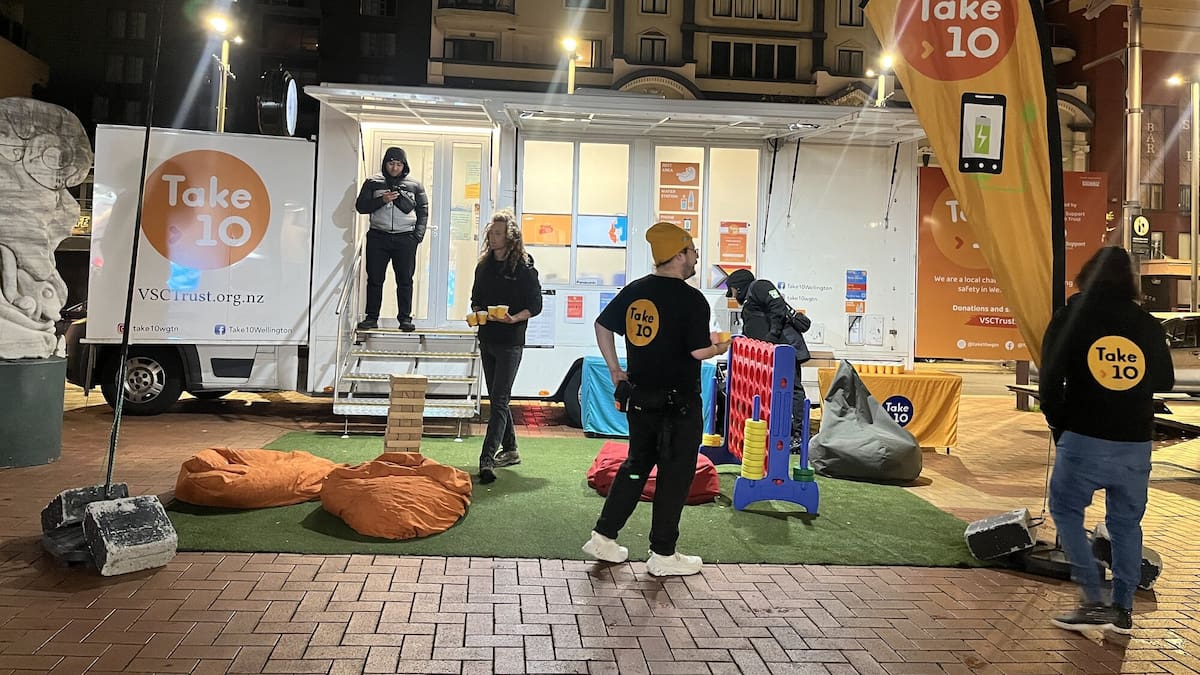
Parking in the middle of Wellington’s nightlife strip is what made Take 10 effective at helping people, but the truck required a significant amount of upkeep.
Take 10 is now seeking a Wellington landlord who could grant it a permanent home in a building on Courtenay Place.
A stable location would help Take 10 direct funding towards core services, rather than spending money on parking, insurance and maintenance for its truck.
Take 10’s truck has a phone charging station to help make sure people can communicate with their friends, pay for things and order a ride home at the end of the night.
When the Herald visited Take 10 on a Saturday night, a drunk girl was seen shepherding her friends through town at 12.11am before she spotted a large Connect Four game set up outside the truck.
She yelled out “five-minute break, everyone” and sat cross-legged on the artificial lawn to play, while her mates chugged cups of water handed to them by volunteers.
Another girl stood by the charging station and watched her phone battery go from 9% to 32% while she waited for her friends to come find her.
She described Take 10 as “a f***ing godsend” and said she had introduced many people to the truck, which had become a safe meeting point for them.
Take 10’s truck houses a sick bay for people who are feeling unwell.
Staff member Marcail Parkinson recalled once spending two hours sitting on bean bags while supporting a young person who had found out their mother had died.
They received the news while they were out clubbing and ran away from their friends to process their grief, eventually wandering towards the truck.
If Take 10 did not exist, Parkinson said the person might have ended up “in an alley” instead of somewhere safe.
She said she joined the team because she had been taken care of by Take 10 before and “wanted to give back to the nightlife community”.
Staff member Marcail Parkinson was motivated to join the Take 10 team after being on the receiving end of their help.
Team leader Mas Quaid said he had been there for people whose relationships had broken up at large events, such as music festivals, and they had been left stranded.
He had also supported people who were experiencing suicidal ideation or had been a victim of sexual harm while in town.
Quaid said his favourite thing was meeting parents who told him they wished Take 10 had been around when they were younger.
“The main goal is to be that constant presence,” he said.
“People might not need us that night … but three or four nights down the line when they are in trouble, they know that they can come to us.”
Mas Quaid (left) has been volunteering at Take 10 since 2022. Photo / Janhavi Gosavi
Vulnerable Support Charitable Trust’s operations manager Leigh Keown expected Take 10 to be $100,000 short of funding this year, which was a third of its annual operating costs.
While it received partial funding from Wellington City Council, the bulk of its money came from donations and small grants, which were becoming increasingly difficult to secure.
In December, Health New Zealand declined Take 10’s funding application for $50,000 from the Alcohol Harm Prevention Community Action Fund, Keown said.
To reduce costs, it needed to swap its truck for a building.
“We’re looking for a space, potentially with another community-focused business, such as a cafe or ice cream shop, that allows Take 10 to remain as a safe haven for those who need it.”
Janhavi Gosavi is a Wellington-based journalist for the New Zealand Herald who covers news in the capital.