
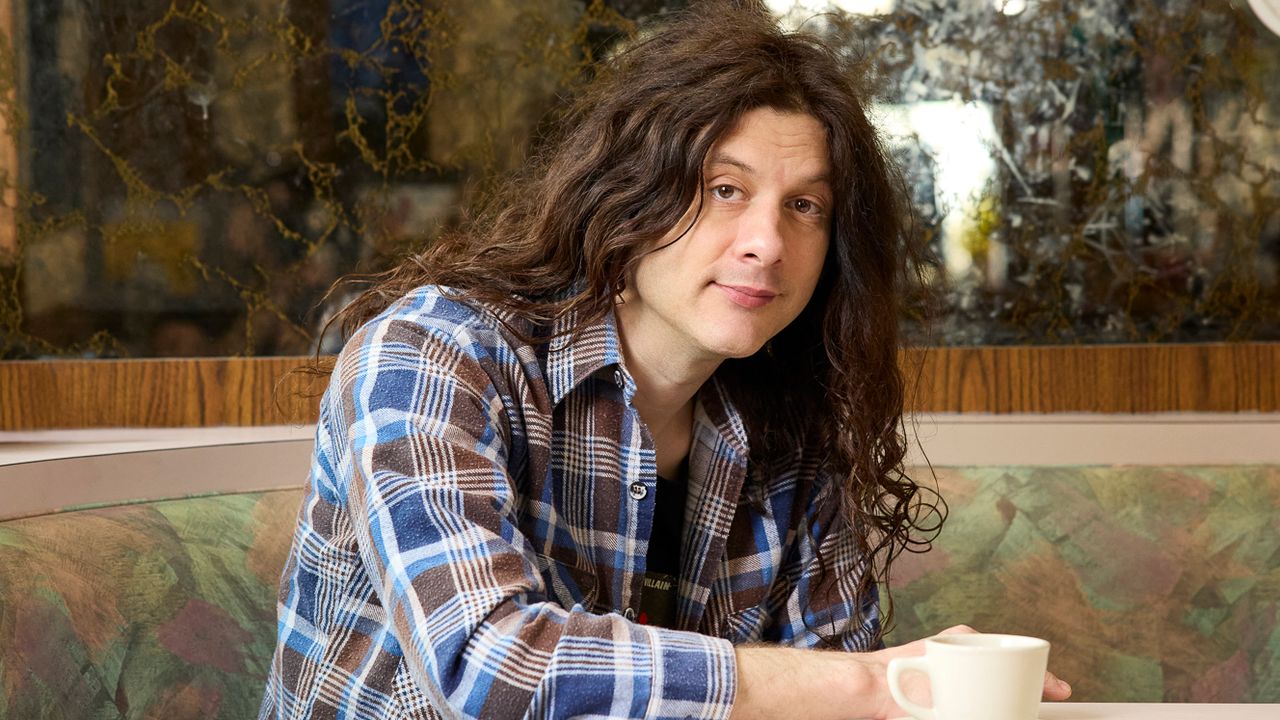
What do Bruce Springsteen and Neil Young have in common? Long-running legends, co-employers of guitarist Nils Lofgren, writers of songs called “Born to Run,” “Long Walk Home,” and “Wrecking Ball.” But on Kurt Vile’s latest album, the only thing the 46-year-old songwriter cares about is that Bruce and Neil have both written music about his hometown.
“I’m from Philadelphia,” Vile sings in “You don’t know cuz it’s my life.” “A couple heroes wrote songs but that ain’t where they’re from… So, hey, you don’t know!” Since the undercurrent to Vile’s sunny, hypnotic music has long been a sense of universal benevolence, he quickly ensures us he’s not trying to start any regional beef: “But I still love ya,” he affirms before a heartfelt incantation he repeats in the place of a chorus: “Neil and the Boss.”
In a phone call with Vile just before he and his family head out for vacation, Neil and the Boss come up a lot. Vile paraphrases Neil’s frank dismissal of farewell tours and lets out a hearty laugh (“When I retire, you’ll know… because I’ll be dead”), then discusses his relationship with the goldmines of Bruce recordings that have been steadily receiving official releases in recent years. While Vile is stoked about the new material, lately he finds himself returning to the tried and true. “I’m more emotional,” he says. “I like when music takes me back.”
It’s a quality he’s been able to achieve in his own songwriting. Philadelphia’s Been Good to Me is Vile’s most emotionally candid record. As a married father of two daughters, he lets the ideas of stability and devotion inform his perspective on his bustling hometown, which, he assures me, does not provide a hard concept for the record, despite its title. Still, a sense of place informs even just the sound of his guitar solos at this point. Largely self-produced and entirely home-recorded, Philadelphia’s Been Good to Me is a record that could come from no other artist, at no other point in their career, and, of course, from no other city.
Amid all his usual lyrical ticks—the cinéma-verité musings on his own creative process, the proud dismissal of actual drugs on his still-pretty-druggy music—Vile offers moving odes to his wife and kids like “Every time I look at you” and, in “99 BPM,” reflections on his late collaborator, Rob Laakso, who died from cancer in 2023. In typical Kurt form, this elegiac subject was not a conscious decision; the way he tells it, Laakso was one of many spirits summoned deep inside Vile’s basement studio in the leafy neighborhood of Mount Airy, a space he refers to as OKV Central (or “Overnight Kurt Vile,” named for his preferred working hours).
“I had this acoustic guitar that was like a beater I hadn’t played in a while,” Vile says. “It was a piece of crap, almost. But when I picked it up, I played that riff you hear. I turned it into a loop. I slowed it down. And then it made me think, first of all, this sounds awesome; it’s got me in the zone. It also got me thinking up lyrics. And then I looked down at the guitar, and was just thinking about a session with Rob.”
In this anecdote lies an elemental Kurtness that can be hard to describe. For all his reverence for the classic-rock era, Vile is a lot less interested in linear pathways through emotion or traditional storytelling. Where the Bruce of “Bobby Jean” bid adieu to an old friend with an archetypical earnestness that made us all imagine the tenderness and precarity of our own friendships, and the Neil of Tonight’s the Night mourned his fallen comrades in a ragged roll call of rock’n’roll ghosts, Vile tells a looser story, using a cosmic shorthand better suited for mumbling to oneself. In baring his soul, what other songwriter could land on a line like “It was 2012 but it felt like 2014”?