


Photo: Unsplash / Anu Priya
School leavers in some of the country’s poorest and smallest districts face a near impossible battle to find work or training places, with unemployment among 15- to 24-year-olds jumping dramatically in those regions in the last year.
Youth unemployment is soaring and at nearly 15 percent, it is roughly three times that of the wider working age population – which is at a near nine-year high.
But fresh analysis of quarterly statistics by data analytics consultancy Dot Loves Data found that, in the 12 months to March 2026, many regions saw the number of 15- to 24-year-olds who are Not in Employment, Education, or Training – known as NEETs – jump by more than a third. In some areas the NEET rate almost doubled.
Ōpōtiki District has the highest youth NEET rate in New Zealand at 42.8 percent, (up 42 percent from March 2025), followed by Kawerau District at 39.5 percent (up 28 percent). Westland saw its NEET rates increase by a staggering 134 percent (to 20.1 percent) while Grey District sits at 19 percent up from nine percent (a 109 percent rise).
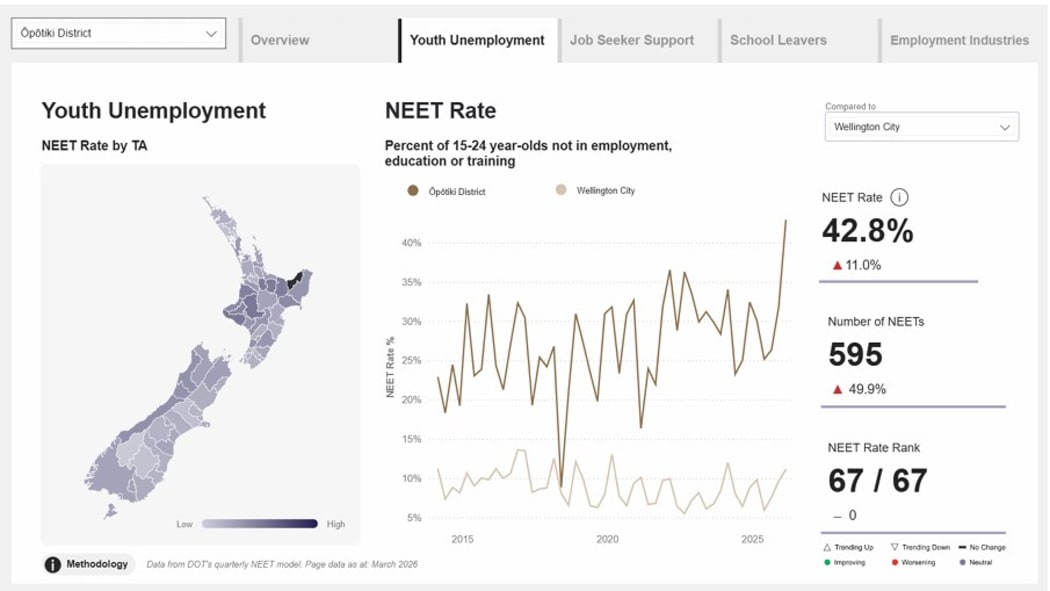
Ōpōtiki District youth unemployment graph.
Photo: Supplied / Dot Loves Data
Queenstown has a comparatively low NEET rate at 6.9 percent, it marks a 130 percent change (up from 3 percent in the March 2025 quarter).
In comparison, New Zealand’s unemployment rate was reported by Stats NZ in March 2026 to be 5.3 percent.
Dot Loves Data director Justin Lester said those areas already face population decline, skills shortages and economic pressure, and the “absolutely shocking” figures pointed to a dangerous cycle for regional New Zealand.
The sharp rise in youth unemployment was “a tragedy” for young New Zealanders trying to get a foothold in the job market, which threatened the future of many communities, he said.
“When young people cannot find opportunities locally, they are forced to leave their communities in search of work. That means fewer skilled workers, fewer young families putting down roots, and shrinking local economies struggling to sustain essential services, businesses, and long-term growth.”
Lester said he was a child living in Invercargill in 1991 when the Ocean Beach freezing works closed.
“It took 30 years for the Invercargill population to get back to where it was in the late 1980s… it’s all well and good to say, look, we’re working hard to get jobs back, but, unless you’re creating local employment, sometimes these small rural locations just never get back there or it can take decades.”
He said regional youth unemployment needed to become a national economic priority.
“We need to be investing in local employment. We need New Zealand-based jobs. We need New Zealand-owned businesses.
“It’s really concerning to see how badly these rural communities are being impacted and it must be incredibly dispiriting for young people across New Zealand.”
Sign up for Ngā Pitopito Kōrero, a daily newsletter curated by our editors and delivered straight to your inbox every weekday.