

Find winning stocks in any market cycle. Join 7 million investors using Simply Wall St’s investing ideas for FREE.
Roundhill Memory ETF (ticker: DRAM), the first ETF focused solely on memory chips, has launched with Sandisk (NasdaqGS:SNDK) as a top holding.
DRAM has quickly become the fastest growing ETF in history, signaling a sharp pickup in dedicated capital flowing into the memory sector.
The ETF launch comes during a global memory chip shortage linked to rising AI demand and tight supply conditions.
Sandisk, traded as NasdaqGS:SNDK, is a pure-play memory company that sits directly in the path of this renewed focus on memory capacity for AI and data intensive workloads. The rapid rise of DRAM concentrates both institutional and retail attention on companies that provide NAND, DRAM and related memory solutions. For investors, this means Sandisk is now tied not only to fundamentals but also to a new source of capital flows via an ETF that is expressly built around the memory theme.
Looking ahead, the presence of a large, dedicated memory ETF can influence how steadily capital moves into and out of NasdaqGS:SNDK, especially during periods when AI infrastructure spending is front of mind for the market. While the ETF does not change Sandisk’s operations, its growing assets and trading volumes may help support liquidity and keep the stock closely linked to broader sentiment on memory supply, pricing and AI related demand.
Stay updated on the most important news stories for Sandisk by adding it to your watchlist or portfolio. Alternatively, explore our Community to discover new perspectives on Sandisk.
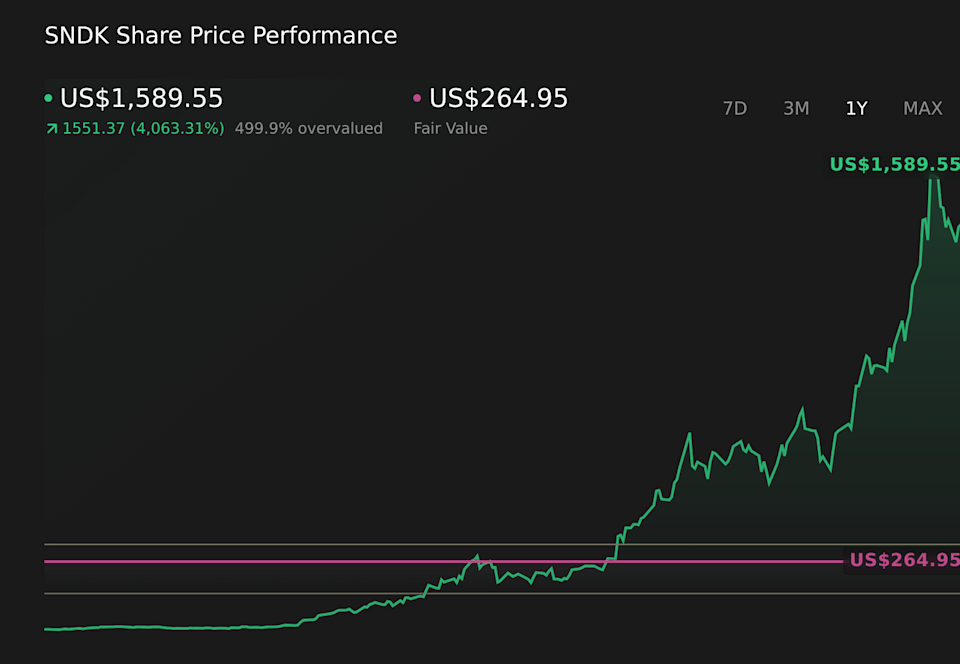 NasdaqGS:SNDK 1-Year Stock Price Chart
See which insiders are buying and buying and selling Sandisk following this latest news.
For Sandisk, the launch and rapid growth of the Roundhill Memory ETF signals that investor interest is shifting toward more targeted exposure to memory chips, not just broad semiconductor funds. DRAM pulls in capital that automatically allocates to Sandisk alongside peers like Micron and SK Hynix whenever money flows into the ETF. This can reinforce existing momentum and keep Sandisk closely linked to AI related headlines about memory shortages and pricing power. Coupled with recent index inclusions and higher institutional attention, that points to a stock where flows from ETFs, quant funds and active managers can interact, sometimes amplifying moves in either direction when sentiment on AI infrastructure or memory supply tightness changes.
How This Fits Into The Sandisk Narrative
The ETF’s focus on memory directly supports the narrative that tight NAND supply and AI driven demand are central to Sandisk’s story, by channeling more dedicated capital toward the sector.
If ETF inflows slow or reverse when investors reassess memory pricing or AI capex, that could challenge the assumption of sustained pricing power that underpins some of the more optimistic expectations for Sandisk.
The existing narrative highlights customer contracts and technology ramps, but does not fully account for how ETF driven flows and index inclusion can affect liquidity, volatility and short term price swings.
Knowing what a company is worth starts with understanding its story. Check out one of the top narratives in the Simply Wall St Community for Sandisk to help decide what it’s worth to you.
The Risks and Rewards Investors Should Consider
⚠️ Heavier exposure to ETF and index flows can increase Sandisk’s share price volatility, especially if sector sentiment on AI infrastructure or memory shortages cools quickly.
⚠️ Concentrated positioning in a hot theme can attract short term traders, which may lead to sharp pullbacks if expectations around AI data center spending or memory supply loosen.
🎁 Dedicated capital flowing into a pure memory ETF supports liquidity for Sandisk and can help sustain investor attention on its role in AI and data intensive workloads.
🎁 The ETF’s structure puts Sandisk alongside large peers such as Micron and Samsung Electronics in many portfolios, which can make it a default way for institutions to access NAND focused growth.
What To Watch Going Forward
From here, watch how assets and trading volumes in DRAM evolve relative to Sandisk’s own liquidity and news flow on AI related demand and memory supply. Keep an eye on any shifts in ETF holdings or index memberships that could alter Sandisk’s weight in passive products, as well as commentary from memory peers like Micron and SK Hynix on contract lengths, pricing and supply conditions. Those signals can help you judge whether current capital flows into the memory theme are building or starting to cool.
To ensure you’re always in the loop on how the latest news impacts the investment narrative for Sandisk, head to the community page for Sandisk to never miss an update on the top community narratives.
This article by Simply Wall St is general in nature. We provide commentary based on historical data and analyst forecasts only using an unbiased methodology and our articles are not intended to be financial advice. It does not constitute a recommendation to buy or sell any stock, and does not take account of your objectives, or your financial situation. We aim to bring you long-term focused analysis driven by fundamental data. Note that our analysis may not factor in the latest price-sensitive company announcements or qualitative material. Simply Wall St has no position in any stocks mentioned.
Companies discussed in this article include SNDK.
Have feedback on this article? Concerned about the content? Get in touch with us directly. Alternatively, email editorial-team@simplywallst.com