
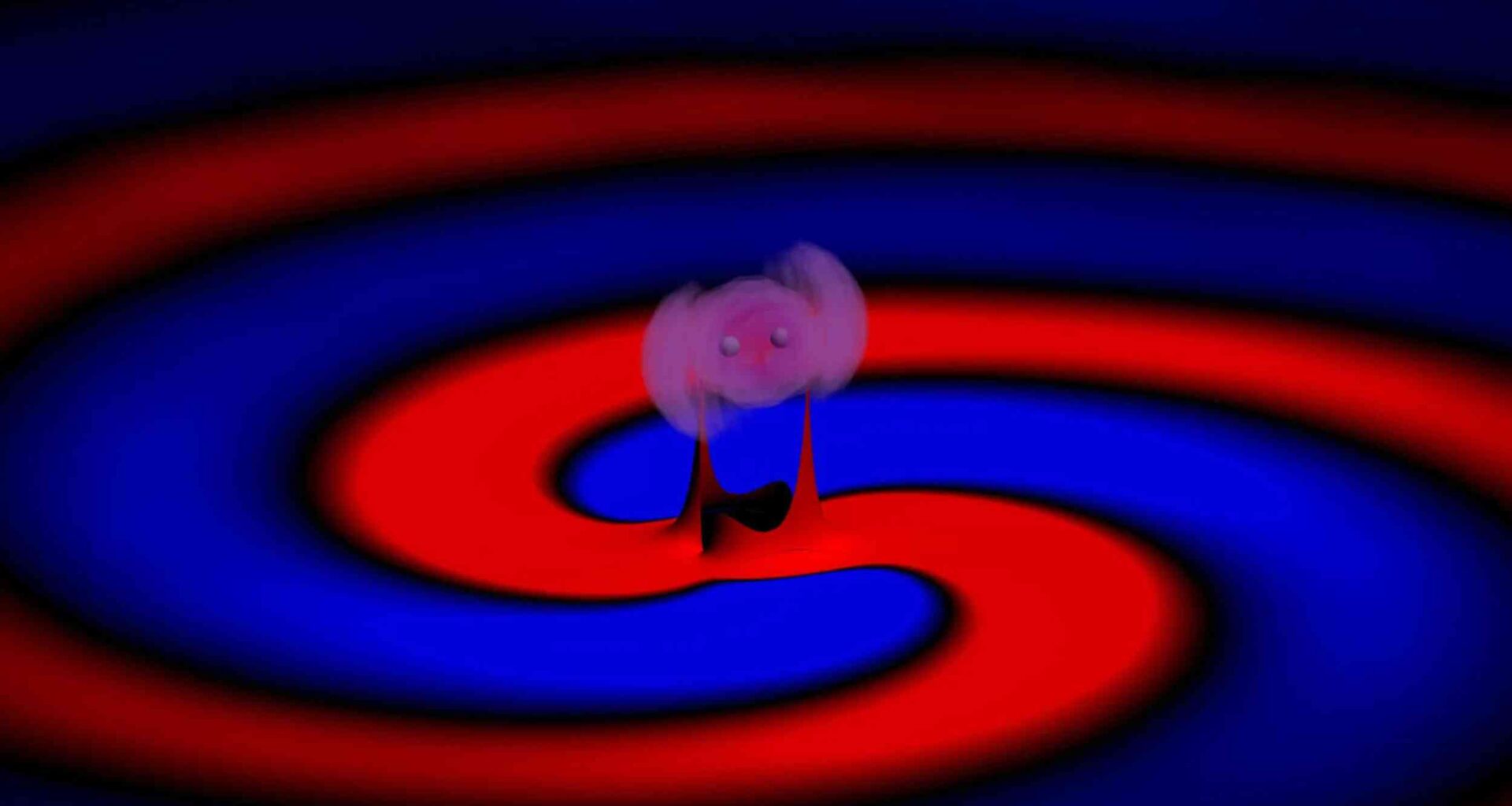
For a decade, physicists have caught the ripples from black holes crashing together. Each time, they assumed the same setup: two black holes spiraling in through empty space. The math fit, so nobody tested the assumption closely.
One team finally did. They built a tool to check whether each merger happened inside an invisible cloud and ran it on the 28 clearest signals on record. One came back looking different. It might carry a trace of dark matter.
An odd ripple appears

The work comes from Josu C. Aurrekoetxea, a postdoc at the Massachusetts Institute of Technology (MIT), who worked with collaborators across Europe.
Their question was whether any recorded gravitational waves looked like they passed through something other than empty space.
All the signals came from LIGO-Virgo-KAGRA – a worldwide network of gravitational wave detectors spread across the United States, Italy, and Japan – recorded during its first three observation campaigns.
Together they represent the clearest black hole merger signals the network had captured.
The signal that stood out was cataloged as GW190728. It was recorded on July 28, 2019, and carried a pattern that fits better with a merger inside a dense cloud of invisible material than with two black holes colliding through empty space.
The unseen majority
Dark matter is a placeholder name for stuff that has to be there but cannot be seen. Galaxies spin too fast for their visible matter to hold them. Starlight bends near them as if extra mass is pulling.
Current estimates put it at more than 85% of all matter in the cosmos. Yet nobody has caught a particle of the stuff in a detector – it refuses to interact with light or magnets like ordinary matter.
Gravity is the only handle anyone has on dark matter. Physicists keep inventing new places to look, including the way light bends around galaxies – a focus of a long-running review of the field.
Building a new model
The team focused on one popular candidate – a hypothetical particle so light it behaves more like a coordinated wave than a tiny ball. At high enough densities, it would slosh around a black hole like a continuous fluid.
Earlier simulations showed that a dense cloud of such a field would change how black holes spiral together and leave a fingerprint on the outgoing wave. What was missing was a fast model to check that against real detector data.
That is what the new paper provides. The team produced a faster waveform model, checked it against full simulations, and ran it on the catalog to ask whether each event happened in a vacuum or inside a dark matter cloud.
Spinning up dark matter
Black holes are useful here because of superradiance. A spinning black hole holds a huge reservoir of rotational energy, and a cloud of ultralight particles can siphon it off. In theory, the cloud grows denser as the hole slows.
Until this study, the case for hunting superradiance clouds in real wave data was largely theoretical.
An earlier paper on how these ultralight particle clouds evolve around spinning black holes laid the groundwork but stopped short of a direct test against detector data.
The new analysis closes that gap. By running the model on the catalog and letting the data decide between vacuum and environment, the team gave the field its first head-to-head comparison.
Testing on LIGO
For 27 of the 28 events, the answer was boring. Vacuum mergers fit the data as well as anything, and the team’s upper limit on dark matter density around those pairs is now a real, published number.
For two events, GW190728 and another called GW190814, the pure-vacuum picture couldn’t account for what the detectors recorded. In plain English, the data look uneasy with the idea that nothing was there.
GW190728 went further. Factoring in how dark matter clouds build up around spinning black holes, the data favored the dark matter scenario over empty space at roughly 30 to 1.
Those are good odds in everyday life. In physics, a discovery requires odds of millions to one.
An outlier from 2019
GW190728 looks ordinary on paper. The two black holes had a combined mass about 20 times that of the Sun, small as detected mergers go. Smaller pairs spend longer in the detectors, leaving more of the lead-up to merger visible.
If the team’s reading holds up, the implied particle has a mass near one trillionth of an electronvolt – a standard measure of how heavy a subatomic particle is.
That puts it far below what any accelerator can reach or underground detector has mapped.
Aurrekoetxea keeps expectations grounded. The evidence isn’t strong enough to declare a discovery, he says, and independent teams should run their own checks before anyone goes further. A clue, not a verdict.
Where this leads
Every event in the catalog was treated as a clean vacuum merger by default. The new model changes that. It lets analysts spot when a merger looks like it happened in a crowded place.
This analysis opens two doors. Astronomers gain a way to test where dense pockets of dark matter sit, marked by black hole pairs that drift through. Particle physicists gain a candidate target mass to chase.
The detectors keep running. Coming observing runs should roughly double the catalog.
A real population of mergers in dark matter environments would show up as more outliers, and a handful with the same fingerprint would be harder to dismiss.
The study is published in Physical Review Letters.
—–
Like what you read? Subscribe to our newsletter for engaging articles, exclusive content, and the latest updates.
Check us out on EarthSnap , a free app brought to you by Eric Ralls and Earth.com.
—–