
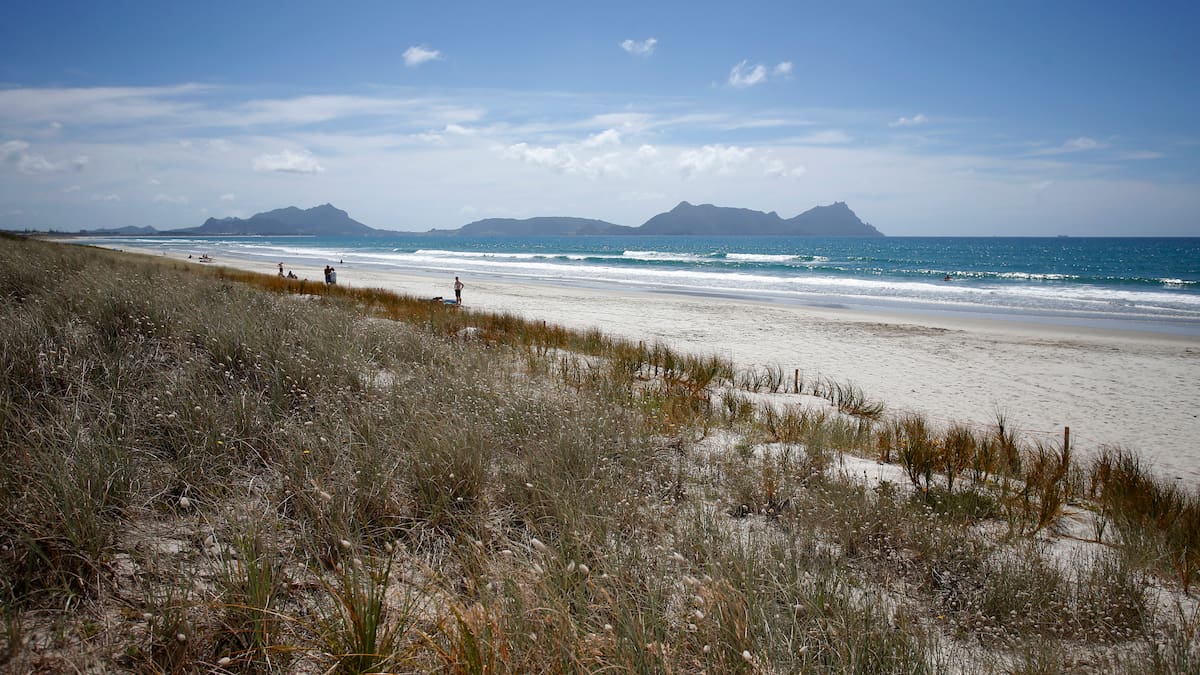
The Bream Bay pipeline would start from the new wastewater treatment plant, stretching 3km out to sea. It would discharge into about 8m of water.
It would be Northland’s first large council offshore outfall for treated municipal wastewater.
In comparison, Whangārei’s Kioreroa Rd plant discharges 12m litres or the equivalent of 4.8 Olympic swimming pools of treated wastewater a day, but into Whangārei Harbour, an estuary. It services 68,500 people.
Charles led a Ruakākā wastewater management update at a Whangārei District Council briefing on May 12.
Updates on Ruakākā’s new wastewater treatment plant plans featured at a WDC briefing meeting at Te Iwitahi in Whangārei. Photo / Susan Botting
He said the council needed an urgent solution because Ruakākā’s 1980s wastewater treatment plant was nearing capacity and constraining development.
The 2022 closure of the Marsden Point oil refinery added pressure.
Industrial volumes of the Ruakākā plant’s treated wastewater had previously been used by the refinery but now needed another destination.
In the meeting agenda paper Charles acknowledged that discharging into the sea was not preferred by some in the community, including tangata whenua, because of cultural concerns such as potential impacts on kaimoana gathering areas.
Others with potential concerns when consent was granted included shellfish business operators and Niwa, which today runs land-based Northland aquaculture centre kingfish farm at Ruakākā and is consented to take about one Olympic swimming pool of seawater via its Bream Bay intake pipeline every 10 minutes.
Thousands of people visit Ruakākā Beach over summer to swim, surf and relax. Bream Bay is a popular recreational fishing ground.
Patuharakeke Te Iwi Trust Board Te Pou Taiao unit pou hautu (co-convenor) Juliane Chetham said the board had strongly opposed the ocean outfall’s 2012 consent and had not changed that position.
The trust board is the Ruakākā treatment plant upgrade project’s mana whenua partner.
It has a Mana Whakahono a Rohe agreement with the council formalising how the two collaborate on Resource Management Act planning and decision making.
“We have always been opposed to the ocean outfall – which is significant in size – and haven’t changed our position,” Chetham said.
The project upgrade steering group member said the board’s preferred options were land‑based discharge or reuse in suitable local industry.
Chetham said the board wanted any discharge option to include a land contact bed where wastewater went through whenua (land) including rocks and vegetation after it was treated, to restore the mauri (life force) of the water which had been lost during the treatment process before final discharge.
She said the board acknowledged a new treatment plant was needed.
But it strongly opposed the likely more expensive ocean outfall as part of that, saying disposing of human waste into the sea or any waterway was anathema to the board and to Māori — even if treated.
Chetham said the board and council were working well together and hoped that would continue when the new inter‑council company Northland Waters – Ngā Wai o Te Tai Tokerau took over WDC’s water assets.
This is scheduled for July next year.
The council has budgeted $94.3m for the project.
Charles’ meeting agenda item said the region’s new Northland Waters CCO – shaping up to take over councils’ wastewater assets in July next year – had $87m in its delivery plan to build and commission the new infrastructure.
WDC acting general manager waters Simon Charles (left) led an update on Ruakākā’s new wastewater treatment plant plans. Photo / Susan Botting
He said the population of Ruakākā and One Tree Point was expected to reach about 100,000 and the Waipu area by about 7000 by 2084.
Ruakākā’s wastewater treatment plant is off Marsden Point Rd near Ruakākā village. It discharges 1.2 million litres of treated wastewater a day to land and serves 7300 people.
The new plant will serve Ruakākā Beach, Ruakākā south, the township, One Tree Point, Takahiwai and Marsden Point, with processing for Waipu, Waipu Cove, Langs Beach and Langs Cove to be added on.
Work on the pipeline so far includes marine and land investigations, offshore geotechnical studies, oceanographic modelling, land testing, topographical surveys, and assessments of installation methods and design philosophy.
WDC must prove the ocean pipeline is the best wastewater discharge option before proceeding, under its 2012 Northland Regional Council consent conditions.
Meeting agenda papers said other options investigated included discharge to Ruakākā River via McCathie Rd, council-owned land near Bream Bay College, Whangārei Harbour through Marsden Point’s Channel Infrastructure stormwater detention pond, land at the new Rama Rd plant site, recycling and reusing or a combination of these.
The new wastewater treatment plant is illustrated at a WDC briefing meeting at Te Iwitahi in Whangārei. Photo / Susan Botting
Charles said one option could involve splitting discharge, with part of the treated wastewater sent to land and the rest offshore.
Projected growth in One Tree Point, Ruakākā and Waipu required more than 300ha if treated effluent were discharged solely to land.
Meanwhile, Charles said an interim solution for urgently needed extra treated wastewater discharge was developed.
WDC had applied for a Department of Conservation concession on nearby Poupouwhenua scenic reserve for this purpose. Its lease had been approved, and draft NRC and WDC consent conditions were being negotiated.
*Auckland Council Watercare’s 2025 Warkworth–Snells Beach wastewater scheme is consented to discharge up to four million litres of treated wastewater into the Hauraki Gulf. It is much closer to land and is an upgrade to an existing rather than a completely new facility.
■ LDR is local body journalism co-funded by RNZ and NZ On Air.