
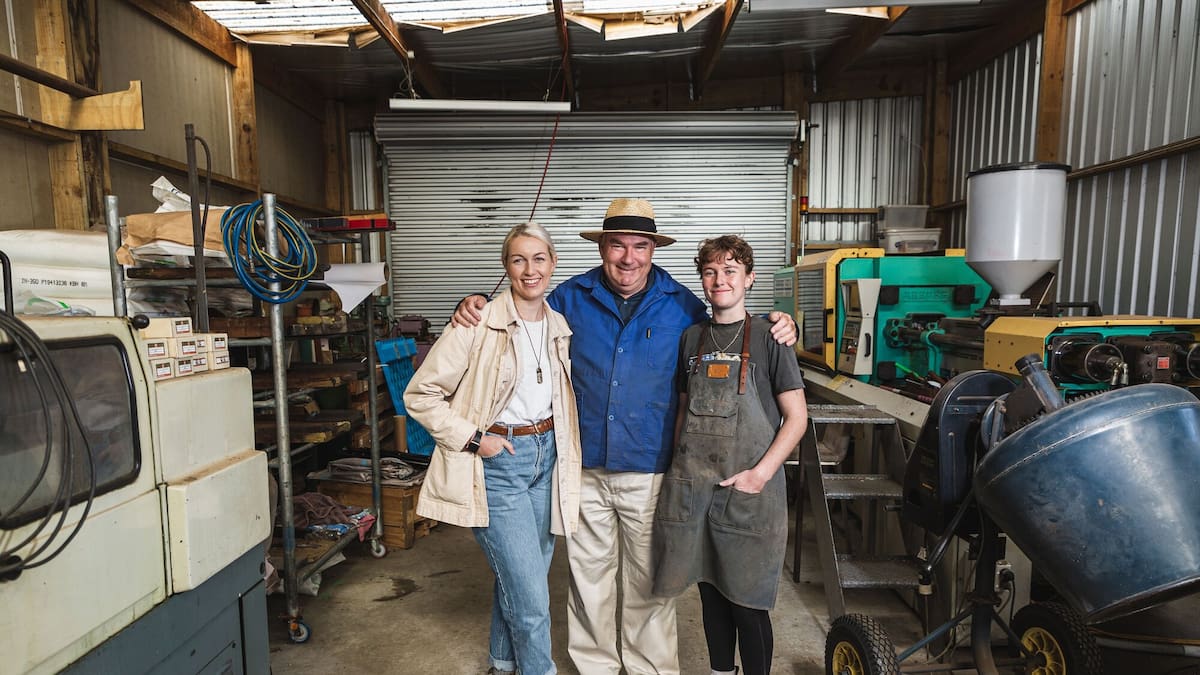
Why New Zealand-made knives are finding success on a global stage.
A rack of 20 or so dangling pieces of knife-shaped steel emerges from the forge, quite literally red hot.
It’s quickly dunked into the vat of adjacent quenching oil, immediately sparking a fire of dancing orange flames.
The air audibly singes with the heat of it all.
These pieces of stainless steel are in the first stages of becoming a Victory Knife. After some time in the oil, they’ll be transferred to a freezer at -80 degrees overnight for a ‘second quench’.
“It’s all about changing the microstructure of the steel,” Gareth Hughes, owner of Victory Knives, says.
“You want it to be soft enough to take an edge, but hard enough to hold an edge.”
Knives coming out of the furnace at Victory Knives’ factory. Photo / Chris Cameron
In this case, taking an edge means the next stage of the process – after polishing to return it to its expected sheen, the metal is then expertly ground to produce a sharp, reliable blade edge for cutting.
The sweet spot is a piece of metal that is pliable enough to be shaved to the brand’s exacting standards, but one that is also tough enough to withstand heavy, regular use.
Victory Knives produces about 3000 knives a day in its Auckland factory. Of that number, about 70% are used by food production facilities across New Zealand and around the world (approximately 50% of what they make is exported as far afield as Norway).
Victory Knives produce about 3000 knives a day in its Auckland factory.
When the average consumer thinks of knives, they likely think of the tools used to cook dinner – to chop our carrots, slice our cucumbers and tuck into our meal.
By contrast, though, the majority of knives produced by Victory won’t be seen by the average consumer.
Instead, they’ll be used eight hours a day by the butchers who produce the meat we buy from our supermarkets, by the farms that harvest the broccoli we steam on our stoves, and, interestingly, deep sea divers working across the world on projects at the bottom of the ocean.
Edward Goddard moved from the English town of Sheffield to New Zealand and set up Victory Knives in 1927, bringing a slice of Steel City down under with him.
At that time, Sheffield was the home of bladesmithing in the United Kingdom, famed for its high-quality steel items.
Goddard, when he emigrated, brought that craft here to New Zealand, opening what would eventually become Victory Knives – the oldest running bladesmith in New Zealand.
The Victory Knives and Just Another Fisherman’s Bare Bones collaboration.
Eight years ago, the company entered a new era when it was bought by Hughes, who brought the brand into the modern era, while still honouring its past.
He has helped tell the story of its long history, and really championed this small but mighty homegrown manufacturing industry.
This year, Victory finally saw the culmination of years of friendship with local apparel brand Just Another Fisherman with the release of the Bare Bones collection.
A set of two knives – a fish filleting knife and a sashimi knife – it’s designed to best serve hardy Kiwi fishermen, but also encourage them to get the most they possibly can out of their catch.
Victory Knives and Just Another Fisherman’s Bare Bones collection is designed to best serve hardy Kiwi fishermen, but also encourage them to get the most they possibly can out of their catch.
“This collaboration was really about trying to educate our customers about utilising all parts of the fish, both from a sustainability perspective but also keeping in mind the cost of living,” Aaron Styles, founder of Just Another Fisherman, says.
Discussions around working together had been happening for a while, but Styles didn’t feel that whacking the JAF logo onto an already existing Victory Knives product (of which there were already many) was the right move.
So, when Hughes began prototyping a new sashimi knife, the two knew there was something special.
And they were right – the collaboration promptly sold out.
The demand speaks not only to the enthusiasm of the JAF customer, but also to this lesser-known industry that is quietly promoting homegrown knife production on our shores.
Victory Knives may be the biggest and oldest, but bladesmithing in New Zealand extends far beyond this storied company.
One name that comes up regularly, both with Hughes and Styles, as well as in conversation with chefs like Peter Gordon, is Hayden Scott of Champion Knives.
Formerly a sous chef at Al Brown’s Depot, his knives are steeped in kitchen experience.
The Svord workshop in Waiuku, Auckland.
The other, of course, is Svord, based in Auckland’s Waiuku.
New Zealand’s second-largest producer after Victory, Svord was born from owner Bryan Baker’s search for purpose after being laid off at the age of 18.
Initially not much more than a monetised hobby, Svord’s entire direction changed when Baker met a trained cutler from Czechoslovakia.
“He had recently shut his knifemaking business down in Hamilton, and came to see me and basically told me I was wasting my time and unless I changed my ways, I’d probably end up closing down,” Baker says.
“So he taught me how to run the business. I got a lot of machinery off him, and he really taught me the trade of making knives.”
Svord started life making sport knives.
Initially, Baker met some resistance from stores who were used to stocking knives made in the United States or Germany, but soon enough the quality of the pieces spoke for themselves.
Plus, Baker says, the Svord knives are designed in New Zealand and purpose-built for use in the New Zealand environment. About 40% of the 25,000 knives they make each year are exported overseas.
Bryan Baker, founder of Svord, with daughter Kelsey who has founded Nuz with her sister Madison.
These days, the Svord collection has expanded beyond just sport knives, but also into a new generation.
Baker’s daughters, Madison and Kelsey, have launched their own knife brand, Nuz, produced in the Svord factory with a focus on sustainable materials and designing multipurpose, durable knives.
Originally crafting the handles from FSC-certified ash wood, they discovered Critical – a company that takes plastic waste and repurposes it into recycled products for multipurpose use – and began using their reworked plastic for the handles for some of the Nuz products, too.
A pounamu-handle knive from Nuz, a New Zealand company with a focus on sustainable materials.
One of Nuz’s knives, Kererū, which has a handle made from 100% recycled plastic and a blade of Swedish carbon steel, produced from recycled saw blades.
Chef Peter Gordon says “buying local is something to celebrate”.
“As an apprentice in Australia, and in my first 20 years of cooking, I was told the best knives were from Germany and France,” he says.
“That’s certainly no longer true.”
After realising he owns more than 70 knives from local and overseas makers – he name checks Victory and Peter Lorimer as some of his favourite domestic cutlers – he put himself on a self-imposed shopping ban.
However, he’s considering breaking his own rule to buy a knife from Hayden Scott.
“I know Hayden from his days with Al Brown and have always admired his culinary work,” he says. “I love that he’s now making knives.”
As so much of our local manufacturing industry gets taken offshore, it seems like a small miracle that this bladesmithing industry is still going strong here in Aotearoa.
Gareth Hughes and Bryan and Kelsey Baker emphatically believe the quality of a homegrown knife makes all the difference.
Hughes puts it best, saying; “it’s really special that we’ve held onto this art form when so many other places have lost it”.
These days, that’s something to be celebrated more than ever.
More food and drink
Eating in a city of food icons.